The Work · 45 Years in the Field
Forty-five years on the hillside, in my own words.
This page is the longer answer to a different question — who is this guy, and where did he come from? Forty-five years, six chapters, in my own words. Coffee and ten minutes if you want it.
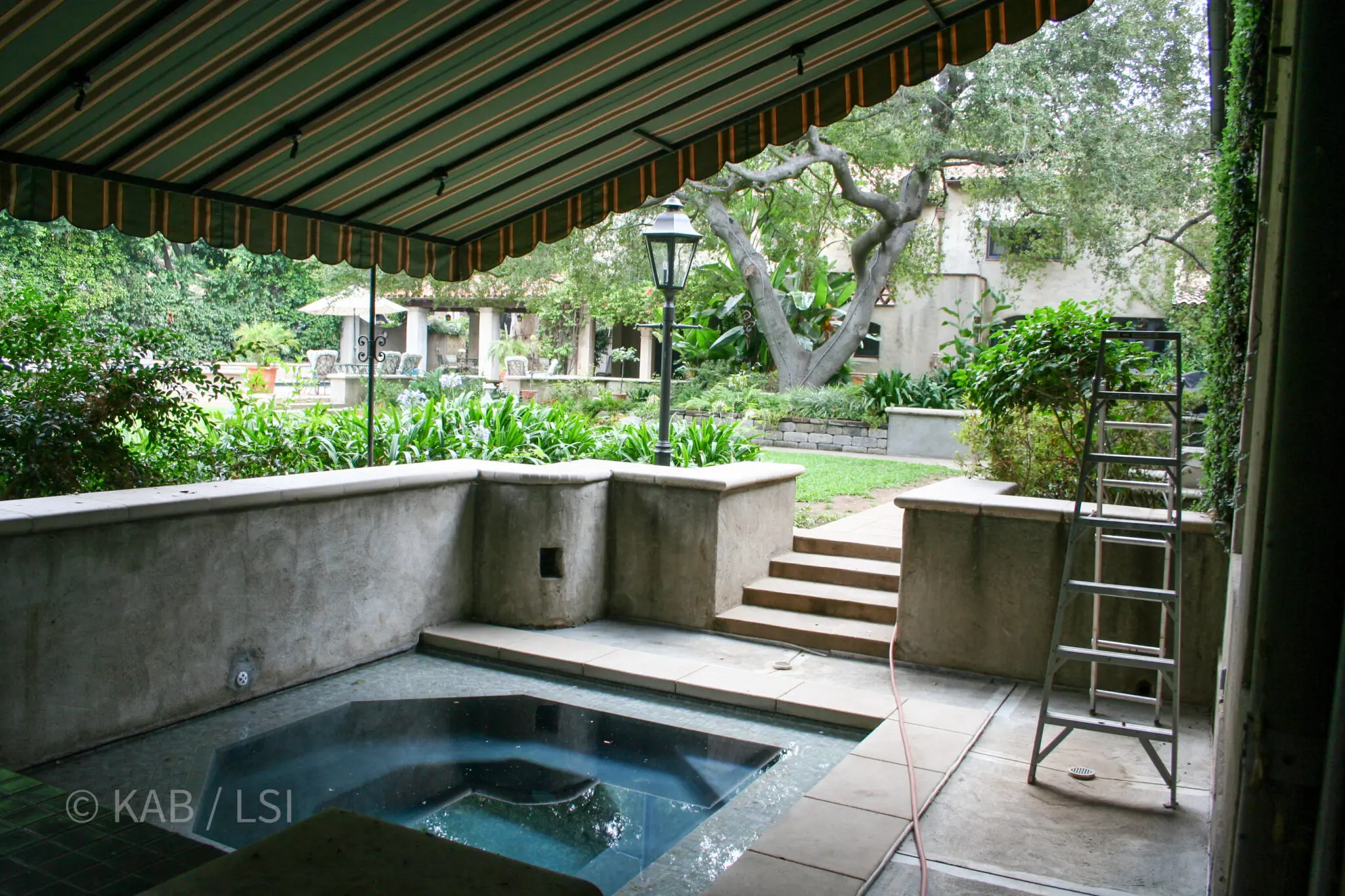
Where it started — wine cellars and restaurant build-outs
Hollywood found out I could build a wine cellar that looked like it had always been there. Then it called Beverly Hills.
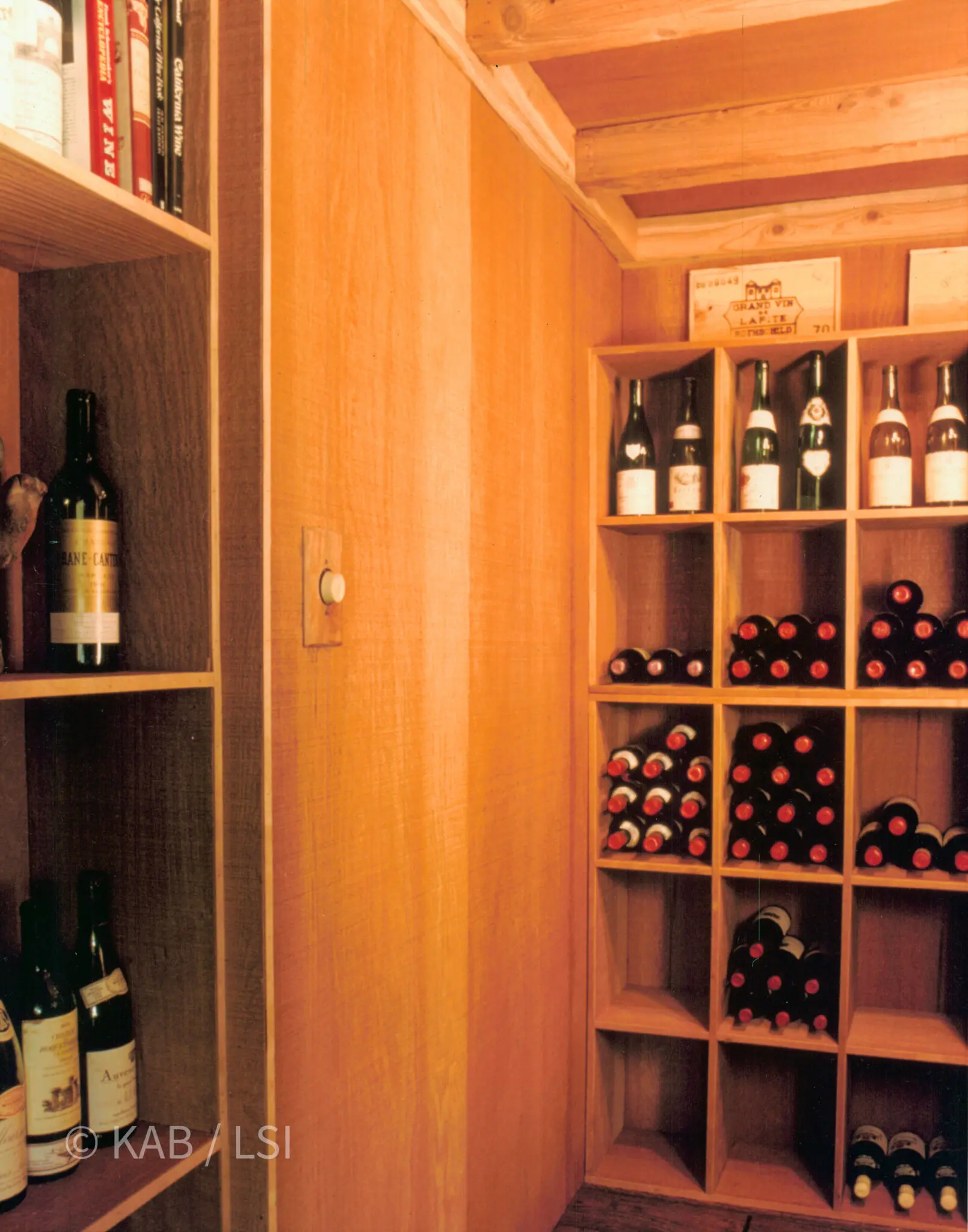
I had a manufacturing company in South El Monte called Vintage Guardian, producing a branded wine cellar unit — 220 bottles, polyurethane construction, finished to look like fine furniture. Alongside the indoor cellars, we built prefab, free-standing insulated outbuildings that shipped to the site and assembled on a concrete slab — backyard temperature- and humidity-controlled wine cellars, saunas, storage, and detached home offices, years before Tuff Shed and “She Sheds” became a vibrant industry. We sold both product lines through wine and lifestyle magazines across the western US.
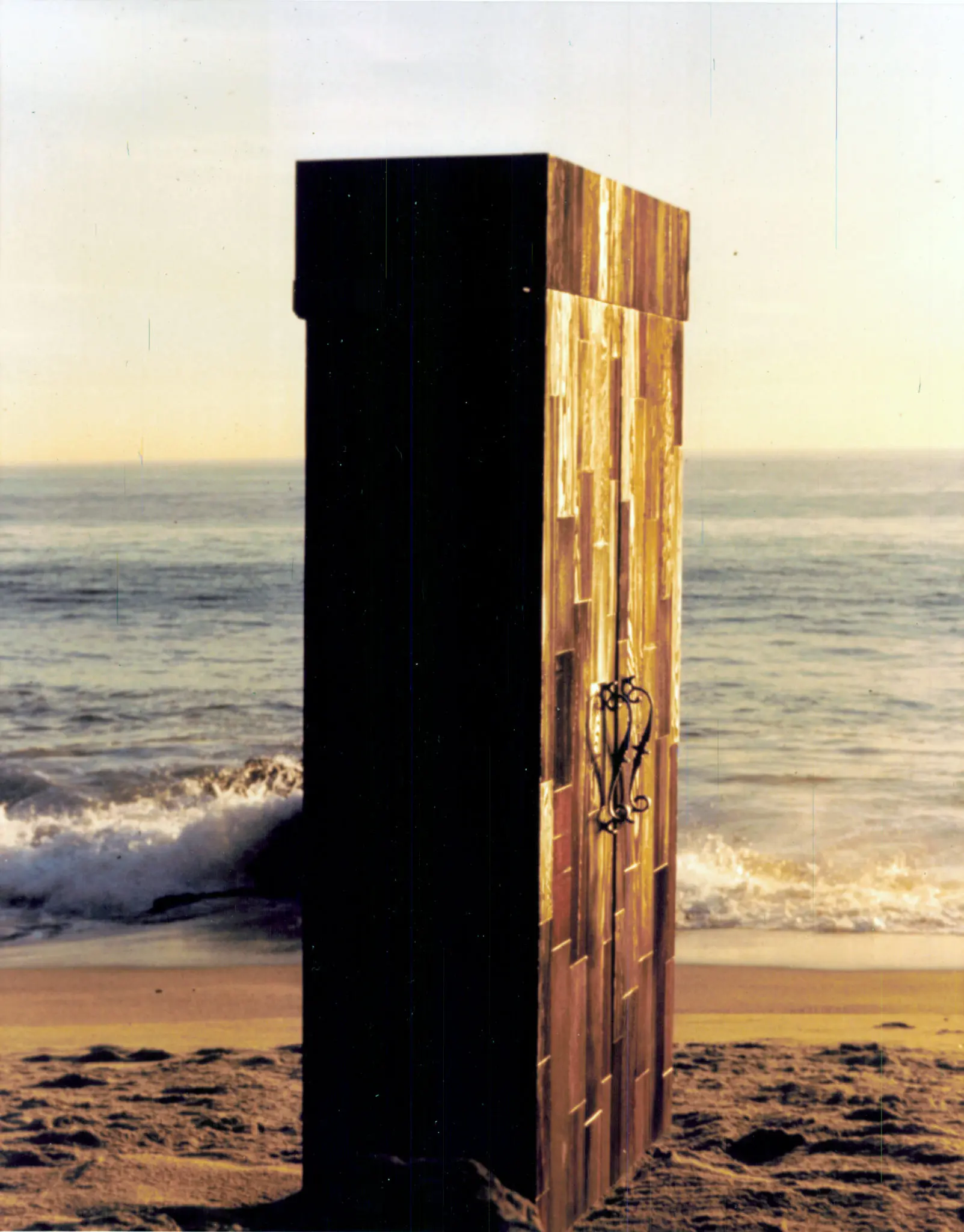
The original wood prototype — built by hand before the polyurethane molds were ever cast. © KAB/LSI

The original Vintage Guardian brochure — sold through Los Angeles Magazine, Orange County Magazine, and wine publications statewide.
Demand from restaurant owners pulled us in a new direction. They wanted custom wine rooms built into their private spaces, where a well-designed cellar could anchor the entire dining experience and move serious inventory for the house. That’s what drove my first contractor’s license in 1975 — out of necessity. Almost overnight we had a contracting division that was busy, fun, and exciting.
That work led naturally into full commercial build-outs — meeting rooms, private dining spaces, specialty interiors. It’s where I learned that a client who trusts your judgment will give you more work than a contract that spells out every nail.
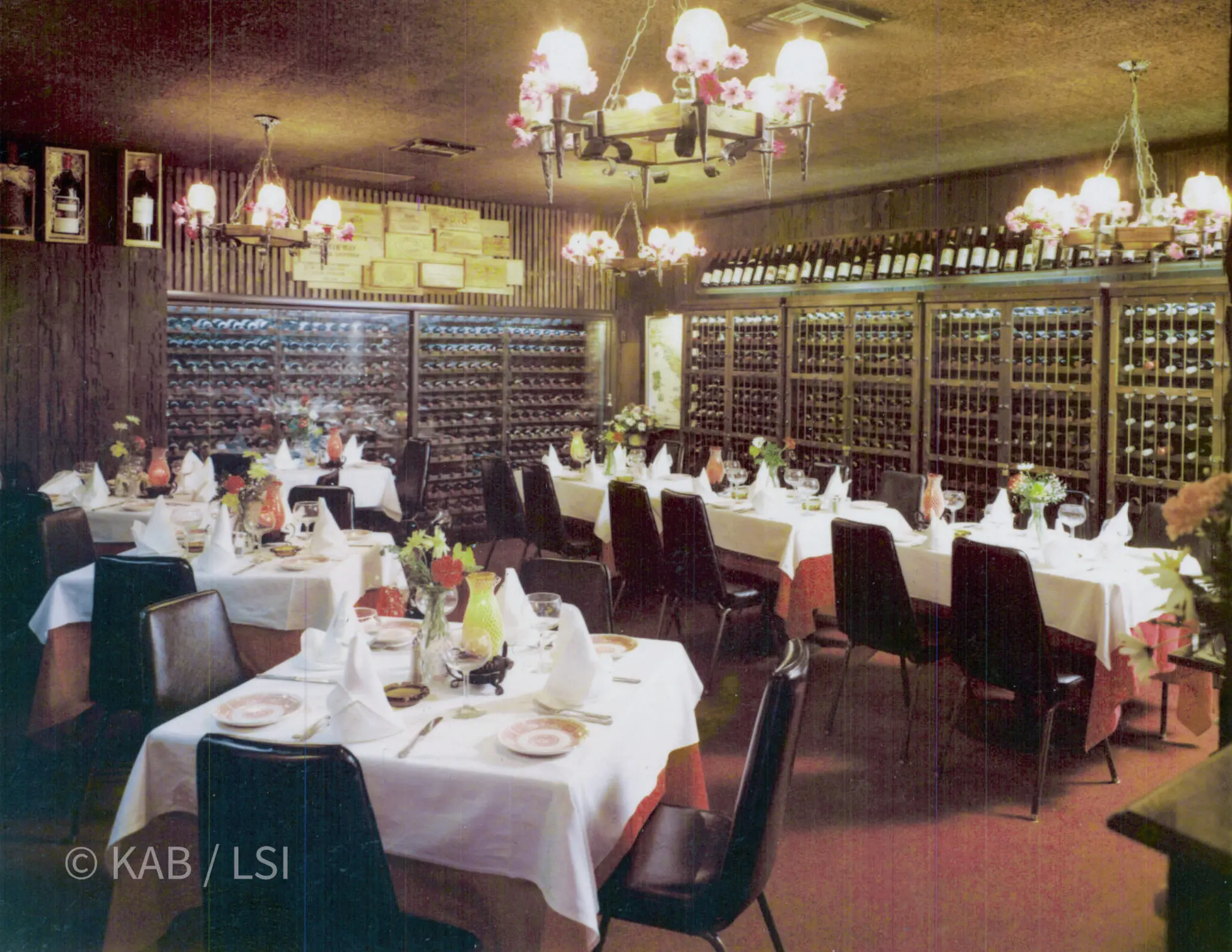
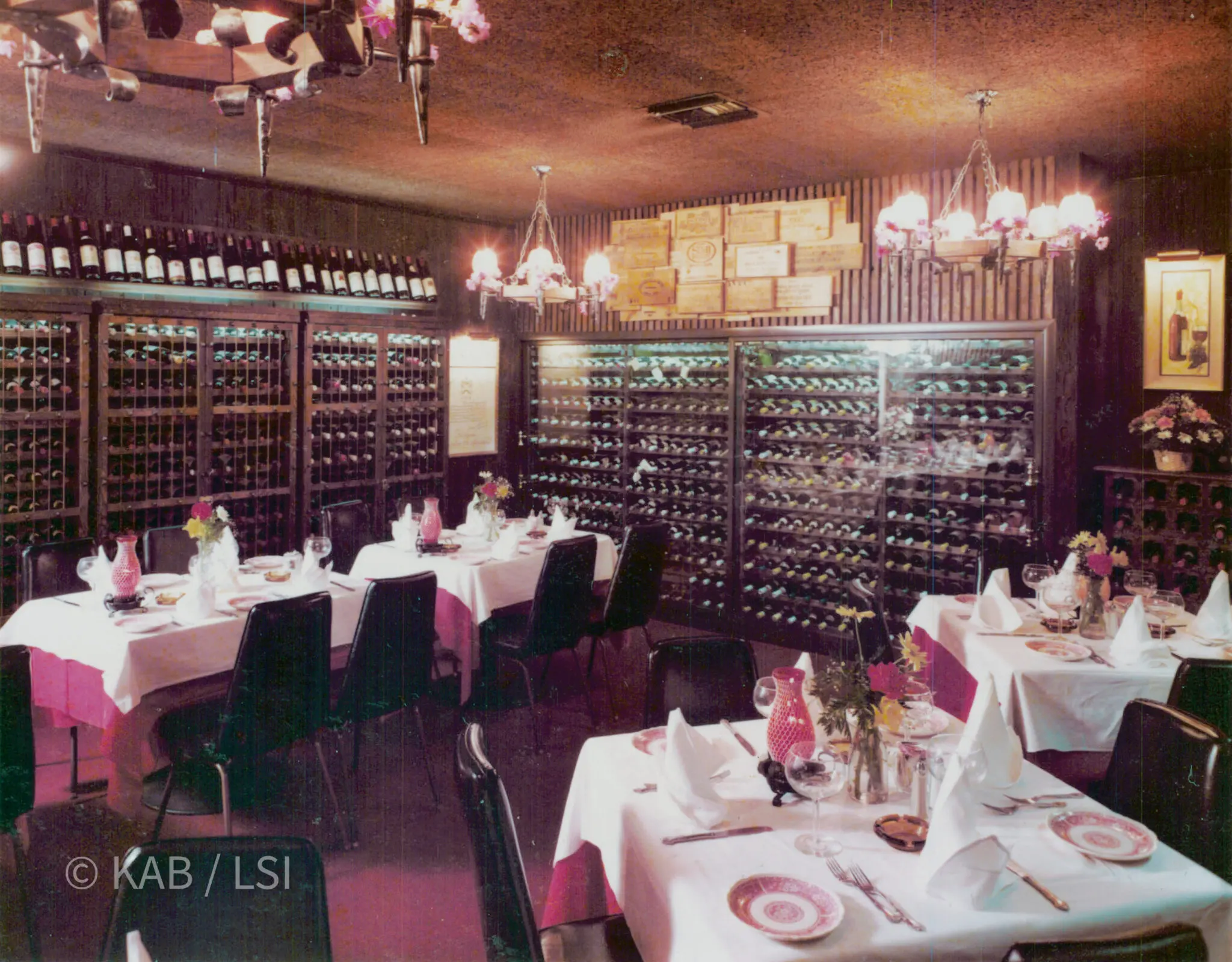
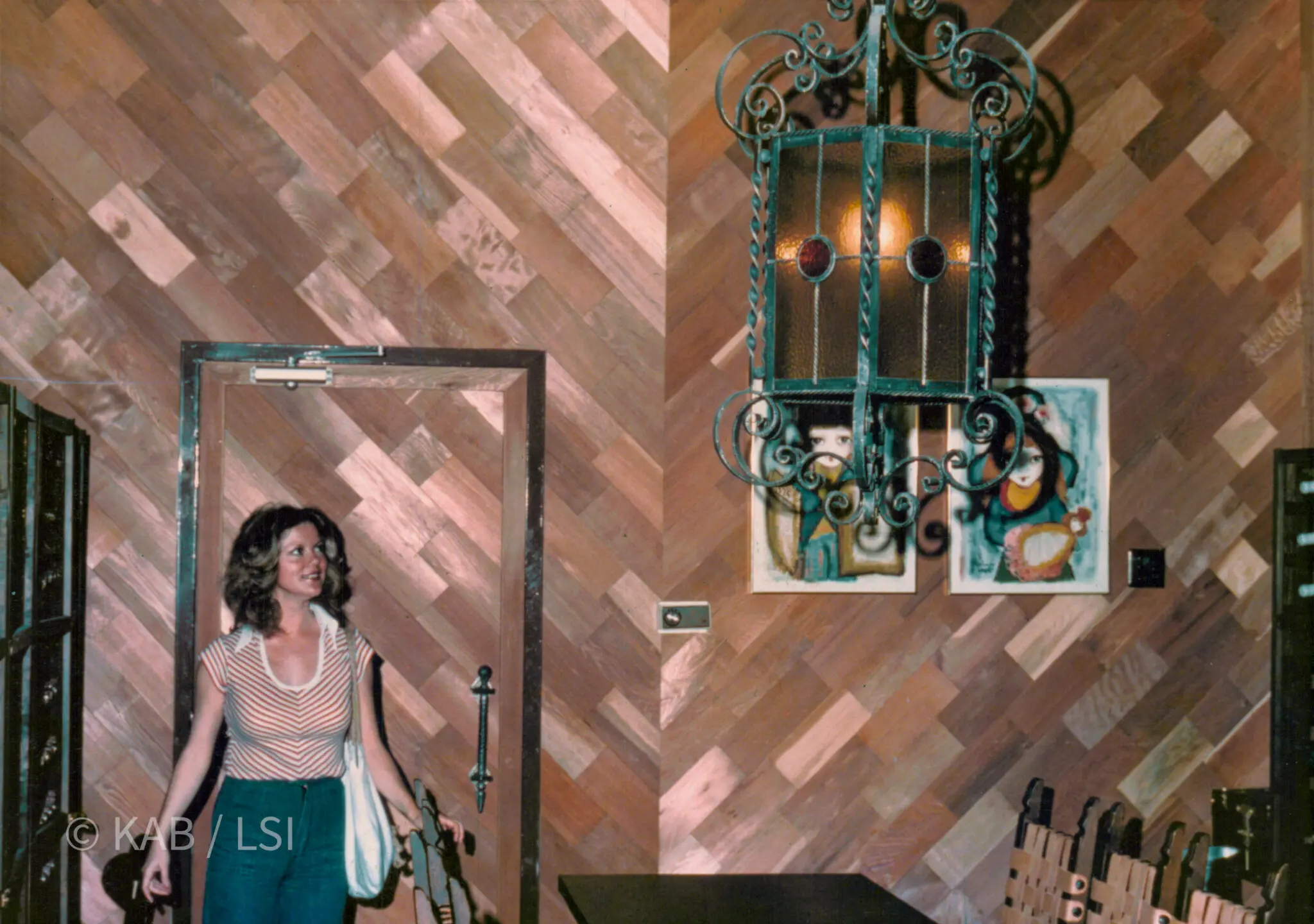
Antonio’s Mexican Cuisine — Melrose
A private wine-dining room for 40 to 50 guests, built when Antonio Gutiérrez leased the adjoining Melrose storefront and doubled the size of his restaurant. New bathrooms, new booths fabricated by a vendor we sourced, a new bar faced in hand-painted Mexican tile, and a new dining space in front of the wine room. Racks running floor-to-ceiling on every wall, wrought-iron chandeliers draped with silk flowers, every seat facing the bottles — our modular redwood-faced racking at full commercial scale.
Antonio’s — The Refrigerated Bay
The wine-dining room you saw on the last slide is one-third of the expansion. The other two-thirds: two separate dining rectangles with glass windows onto Melrose — studio lunch crowds by day, serious diners and destination dinners at night and on weekends. We built all-new booths on the expansion side (the original side kept its tables), added an L-shaped Margarita bar, and put in new Hombres and Mujeres bathrooms. Behind the brass-wire grille doors here: a commercial-refrigerated bay for whites, Champagnes, and fortified wines — the door had to seal like a walk-in refrigerator’s.
Antonio’s — The Hidden Threshold
The entrance to the private wine-dining room. Clear-heart redwood cladding laid on the diagonal, a heavy cast-iron door pull with spear-tip finials, and a commercial hydraulic closer pulling the door shut quietly behind every party. The room behind it was a full climate-controlled cellar — the door had to work like a walk-in refrigerator’s.
Dr. Garry Whitlow’s Cellar — Hollywood Hills
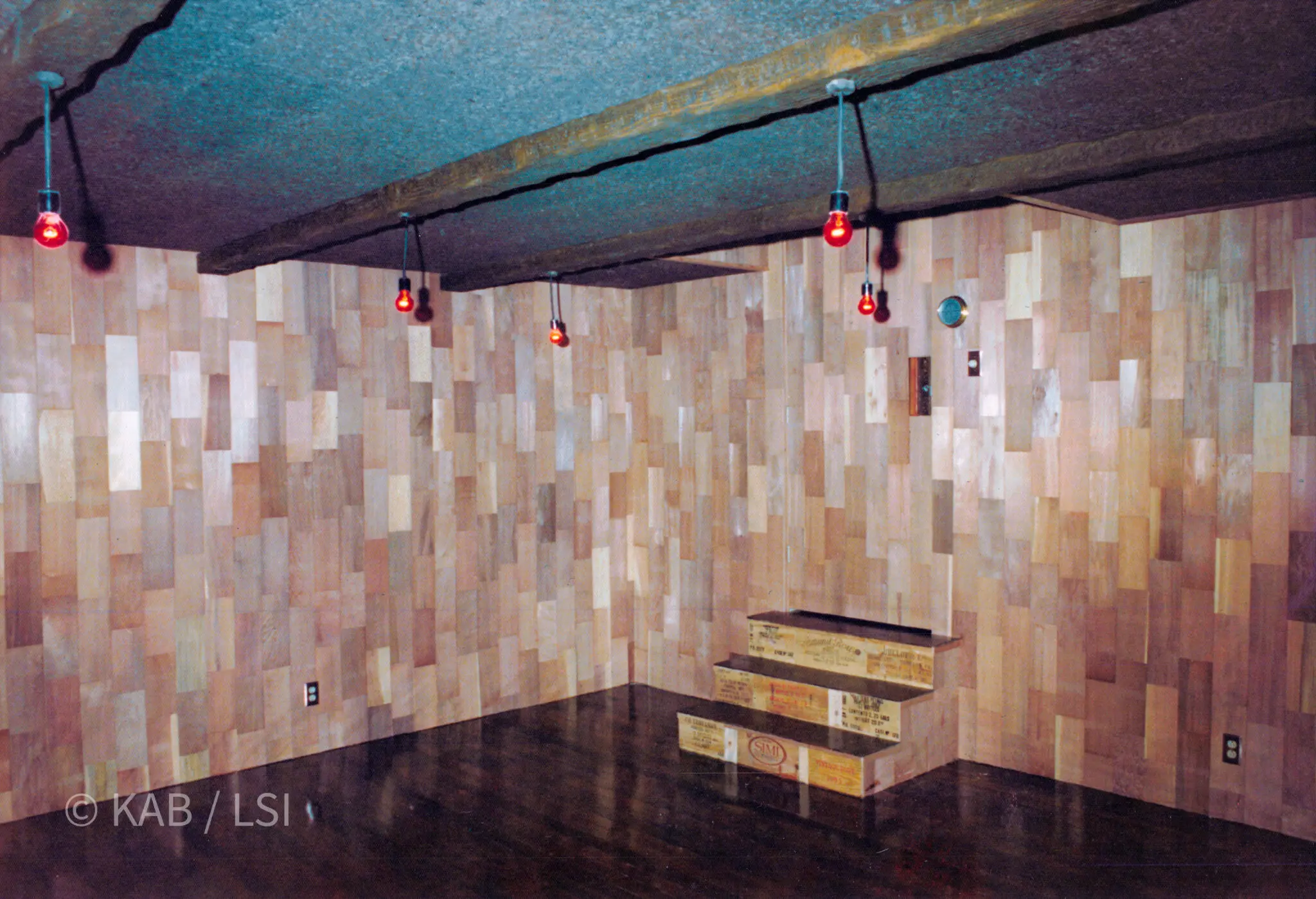
A 6,000-bottle cellar beneath a Mulholland hillside home overlooking Studio City. Shown here before a single bottle went in: redwood-offcut walls, hardwood floor, teal-dyed Spanish cork ceiling, hollow polyurethane beams carrying red sign-industry bulbs. The hidden door at the far end is closed — waiting for the first case delivery.
Garry Whitlow’s Cellar — The Riddling Rack Corner
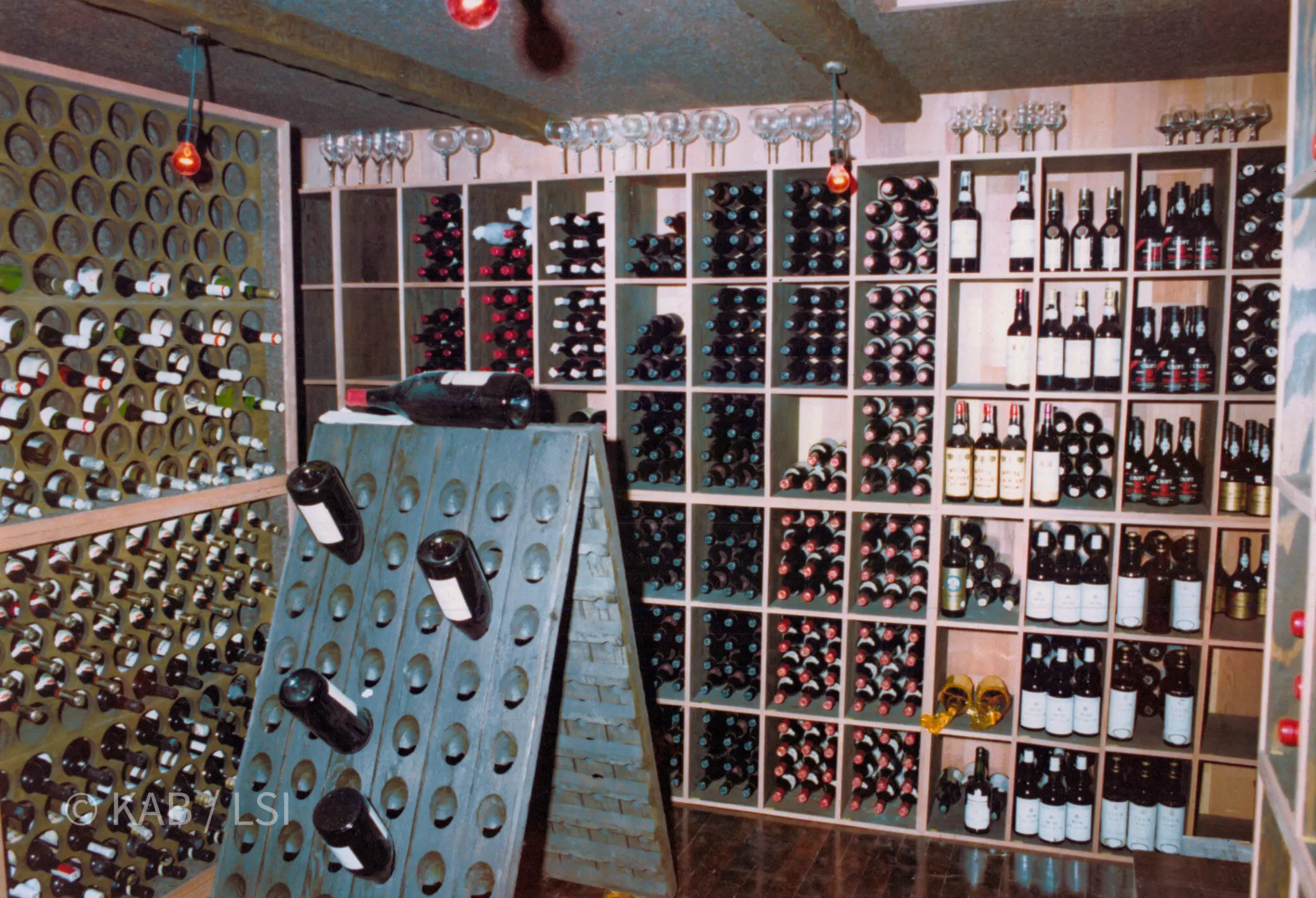
One small corner of Garry’s cellar. The A-frame in the foreground is a pupitre — a riddling rack invented in 1816 by Madame Clicquot for traditional Champagne production. We drove to Napa to source this one from a vineyard rotating out its old stock. Beside it, our cast-polyurethane circular-bore racking, safer in a California earthquake than rectangular bins.
Garry Whitlow’s Cellar — The Modular Racking
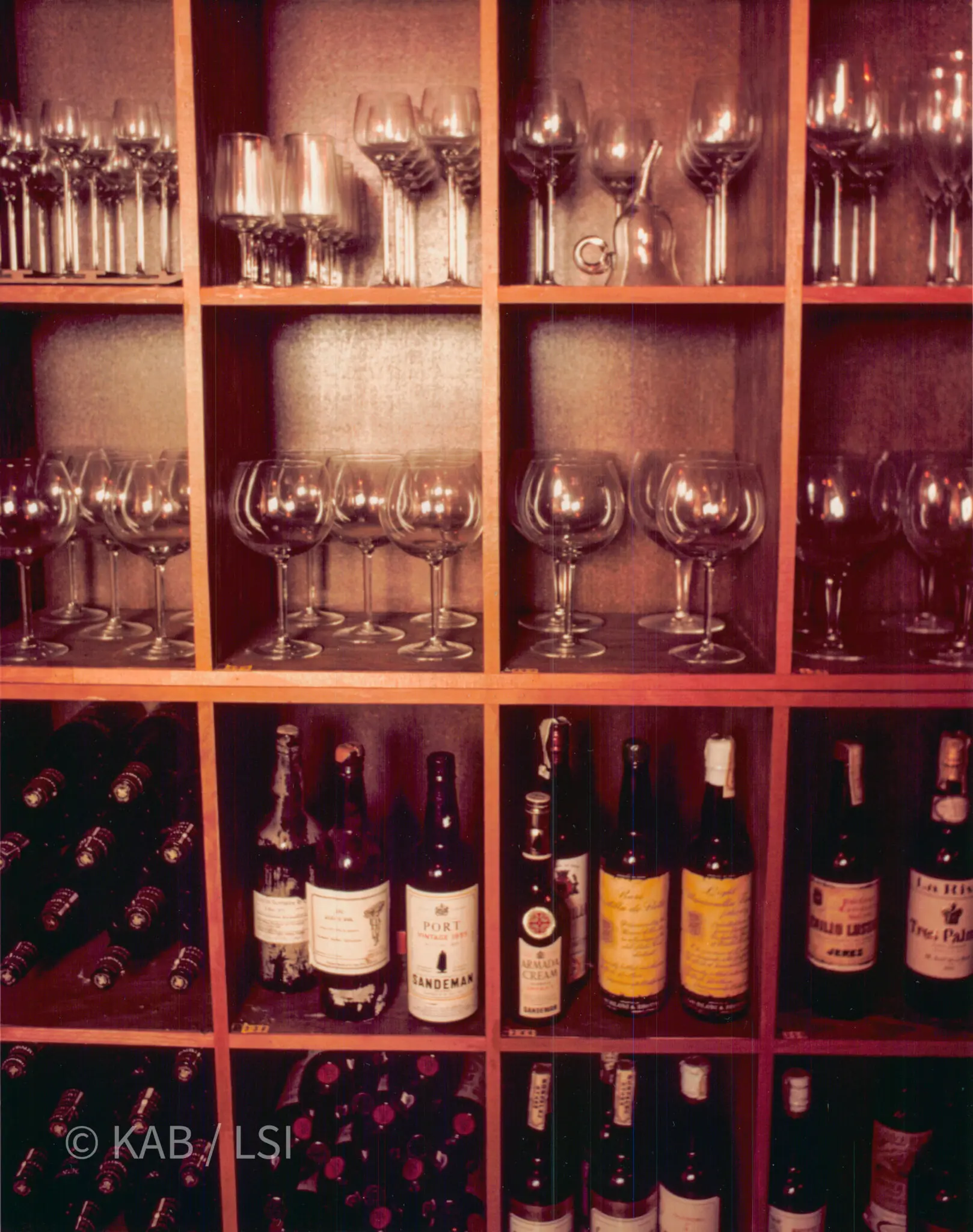
Close-up of the interlocking plywood racking we manufactured at our South El Monte plant — flat-pack construction in the spirit of IKEA, faced with three-quarter-inch redwood strips so the edges read continuous with the walls. Top shelves hold Garry’s glassware; lower shelves hold his fortified collection: Sandeman, Lustau, La Riva Tres Palmas, a shelf of Jerez most Americans have never tasted.
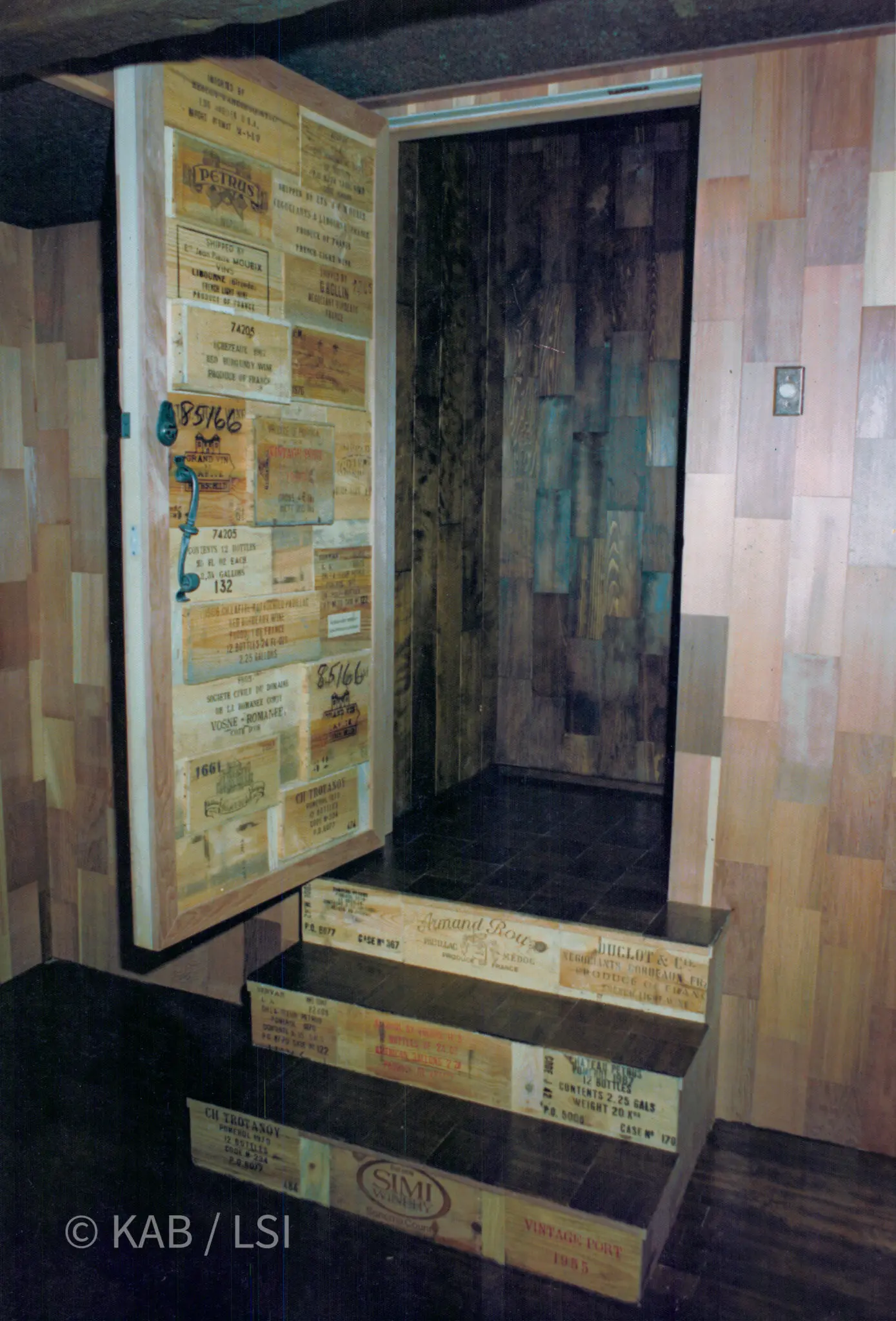
Garry Whitlow’s Cellar — The Hidden Door Opens
Looking out from inside Garry’s cellar, back up the stairwell. The door hides twice: from the stairwell side it reads as stacked wine cases (Pétrus, Vosne-Romanée, Château Trotanoy); from inside, as continuous redwood. We added the cast-iron handle and combination lock after guests kept getting lost trying to find the way in.
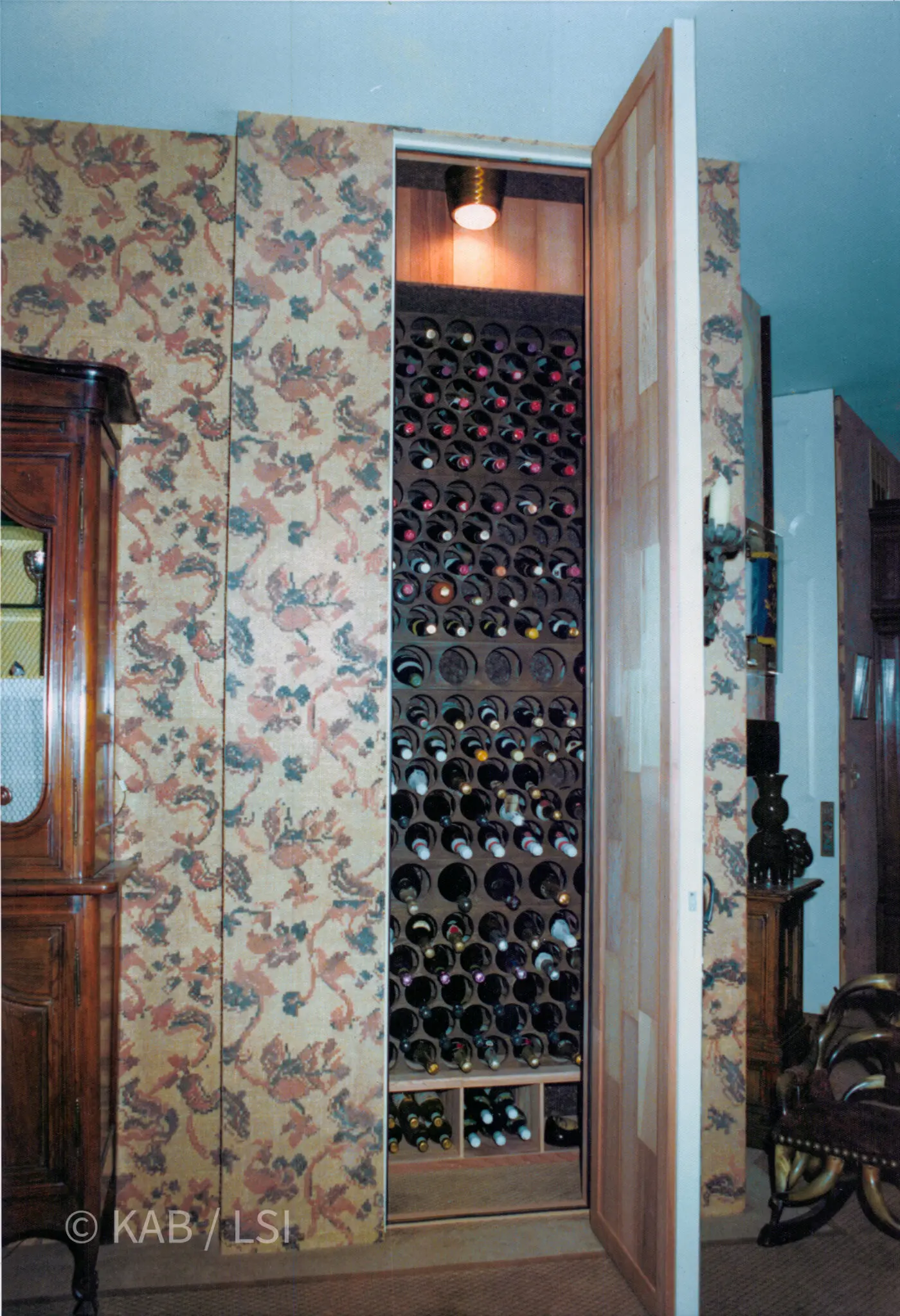
Don & Barbara Rickles — Beverly Hills
Don didn’t want television sets cluttering up his house, and he didn’t want a wine cellar announcing itself either. So we hid the cellar inside a wall — closed, the door reads as a continuous panel of floral wallcovering. Behind it, our cast-polyurethane racking tower with a custom-built temperature and humidity refrigeration unit tucked into the top housing.
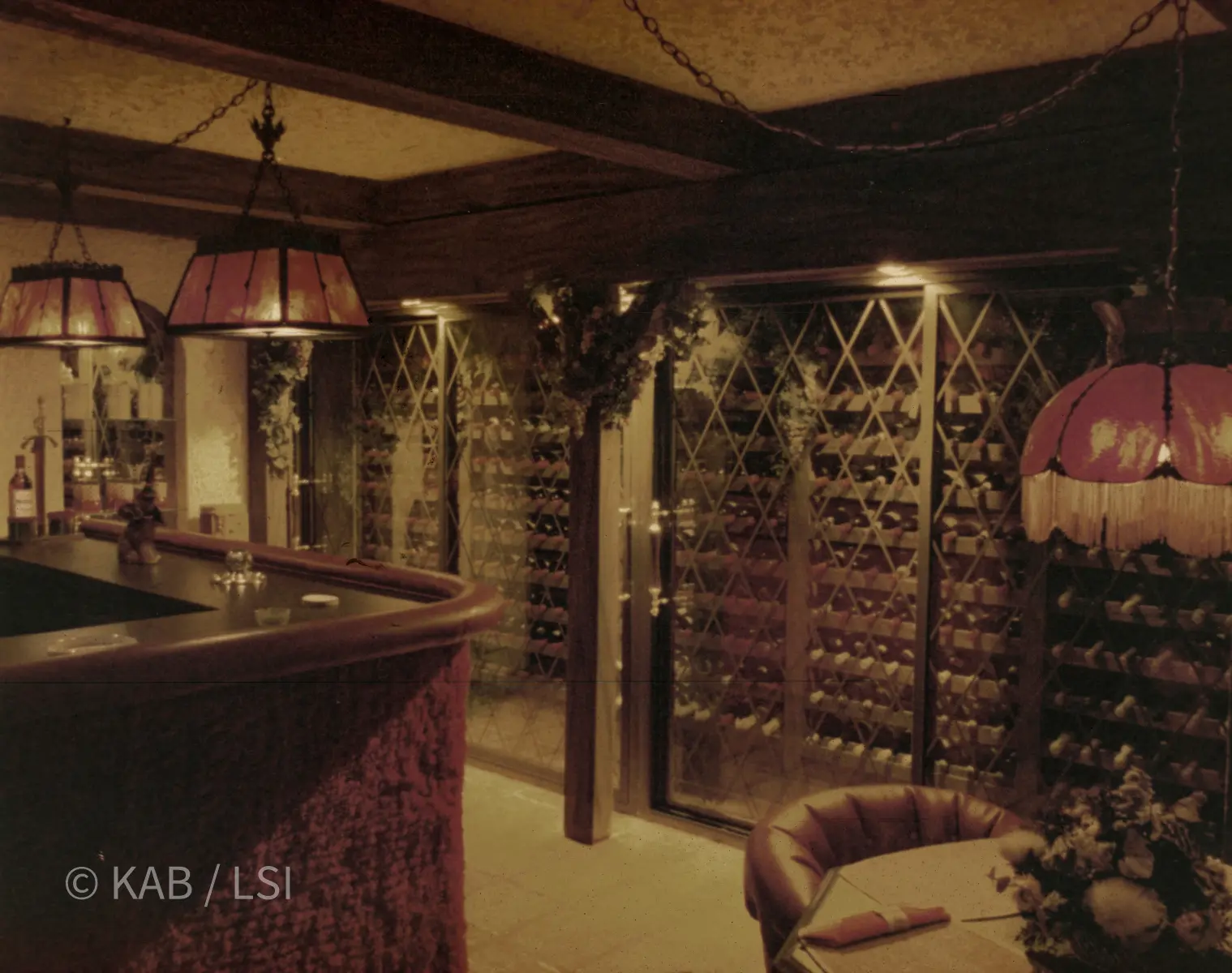
The Carpenter Family — The Bar Side
The bar side of the Carpenters’ wine room in Downey, California — the entertaining half of the project. Padded oxblood leatherette bar-front, black-granite-look laminate top, Tiffany-style slag-glass pendants on wrought-iron chains, diamond-bin display racking built into the interior wall. Through the glass doors at right you can see the long refrigerated storage run — two sets of double doors, four commercial-retail glass doors in total, holding the gifted bottles Richard and Karen rarely opened themselves.
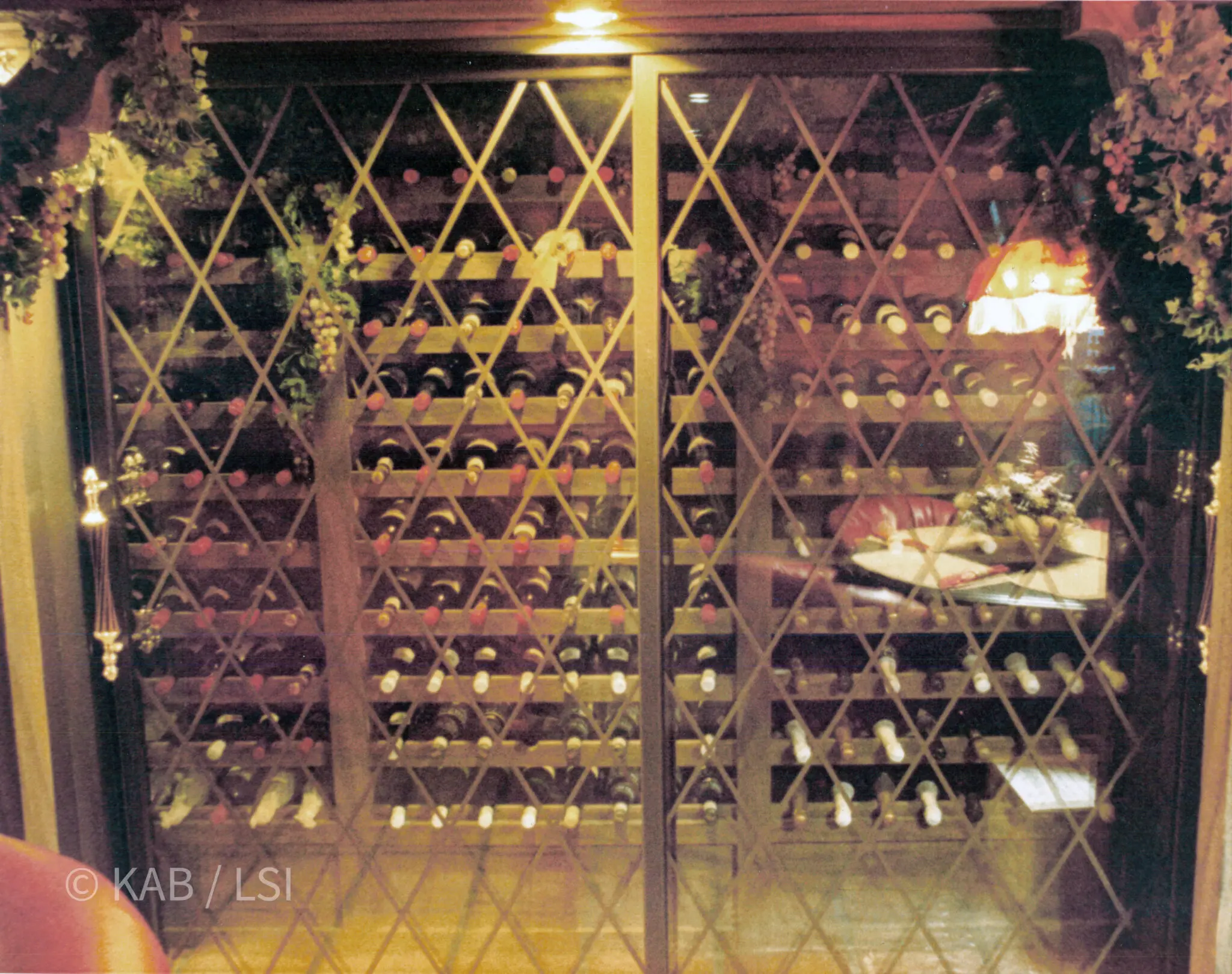
The Carpenter Family — The Refrigerated Storage
A closer look at one pair of the four commercial-retail doors from the previous slide — triple-pane nitrogen-filled sliding doors, the same units used at high-end LA wine retailers. Karen, Richard, and their parents didn’t drink wine. But when you’re one of the most successful acts in American music, every industry visitor arrives carrying a bottle. This long refrigerated run held the gifts. The bar side out front held the conversations.
West LA — Bedroom Conversion
A client found us through Valentino Restaurant and asked us to convert a spare bedroom into a climate-controlled cellar. Mixed storage systems — our modular redwood racking plus decorative wine-case end-treatment. A bedroom conversion remains one of the fastest paths to a serious cellar: no trenching, no permits, one to two weeks start to finish.
Hollywood Producer — Beverly Hills Garage
A client on the same Beverly Hills street as Don Rickles had no room in his house and no useful backyard. But he had a six-car garage for his live-in staff. In one corner of that garage, we installed an exterior outbuilding with no exterior weatherproof skin — just the fully climate-controlled inner shell, at a fraction of the cost.
The Outbuilding Begins — Concrete Pad
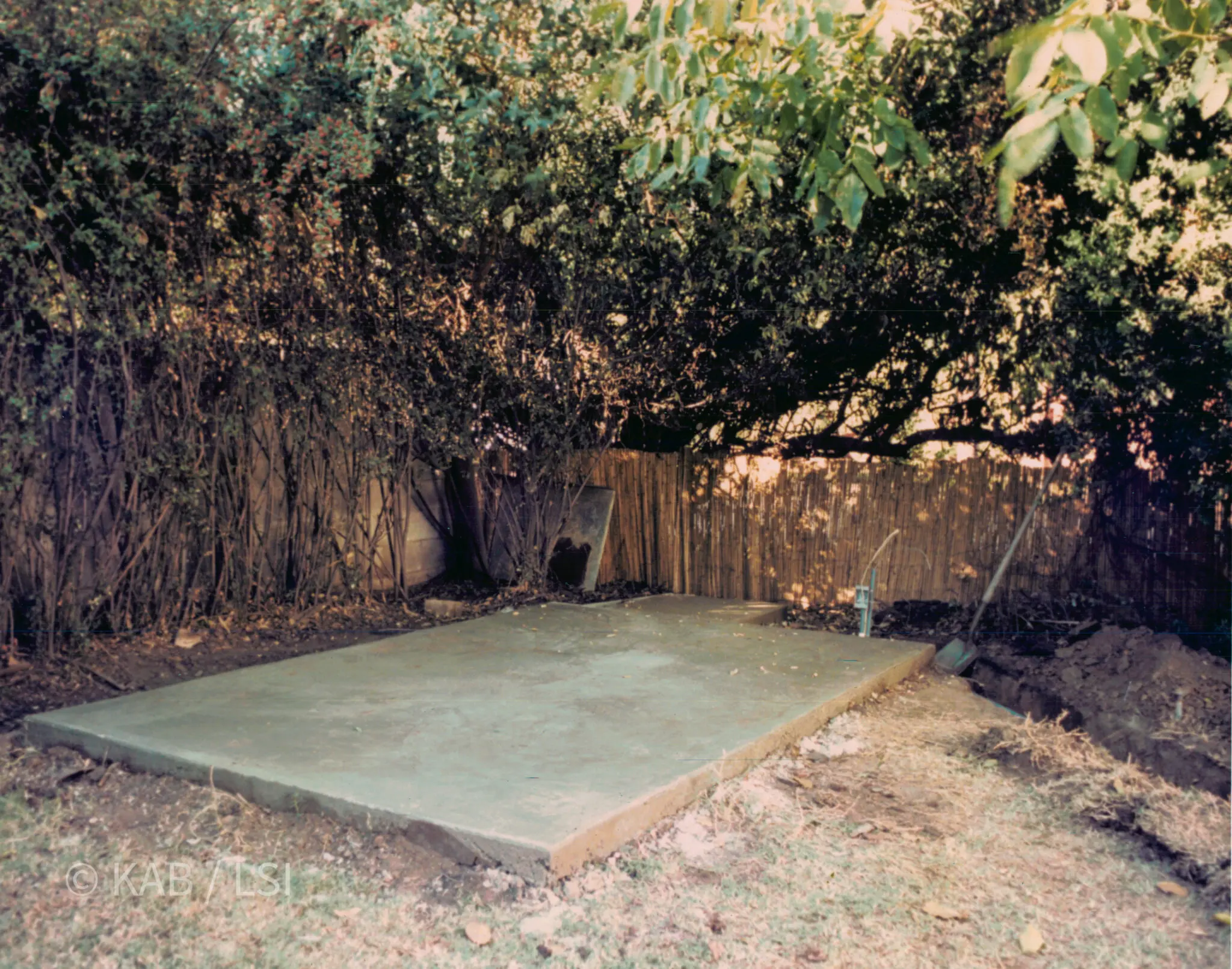
Every Vintage Guardian outbuilding started here. A modest rectangle of troweled concrete, a trench running back to the main house carrying power and phone, a shovel standing in fresh earth. Forty-five years later, the slab is still the starting point — but now for La Habra Heights home offices, tele-health rooms, studios, and she-sheds.
The Outbuilding Finished — Ringo’s Producer
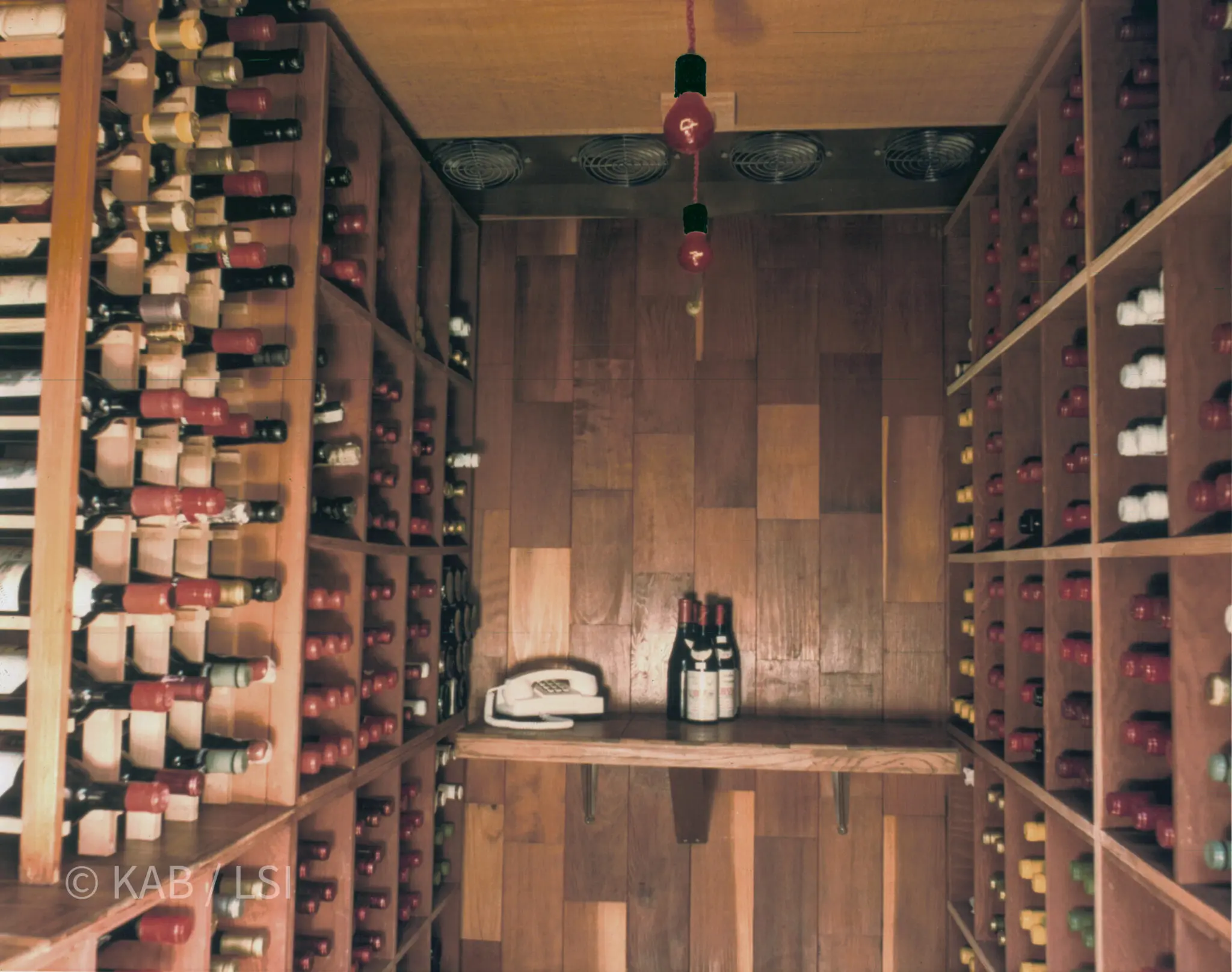
Inside the completed outbuilding we built for a recording engineer who worked with Ringo Starr and other ex-Beatles on the West Coast. Floor-to-ceiling racks in a variety of configurations on both side walls. Four-fan refrigeration array flush to the ceiling. Redwood uncorking counter with a corded telephone for merchant calls. Between 1,000 and 1,500 bottles depending on rack type.
The Plastic Surgeon’s Cellar — The Private Entrance
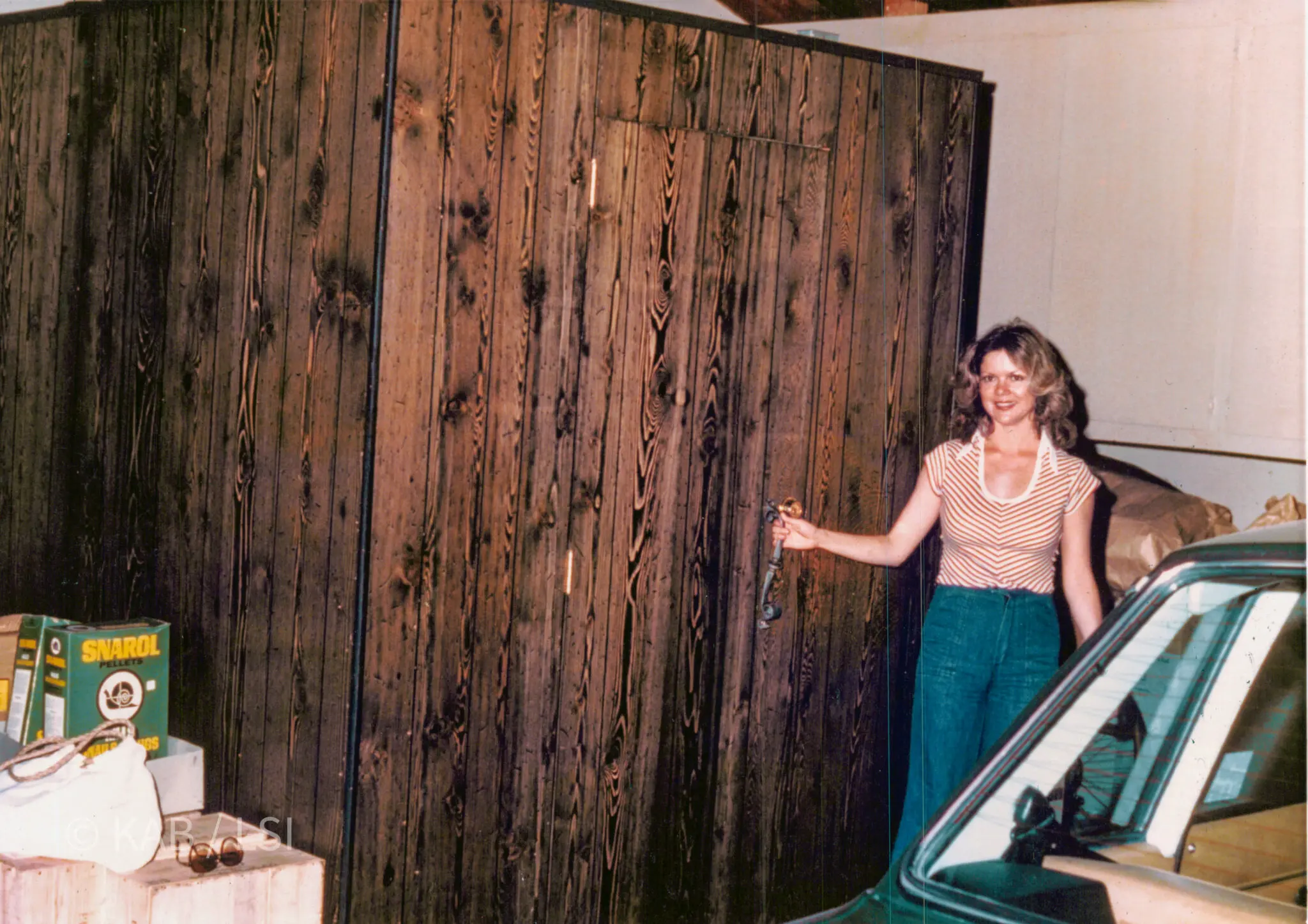
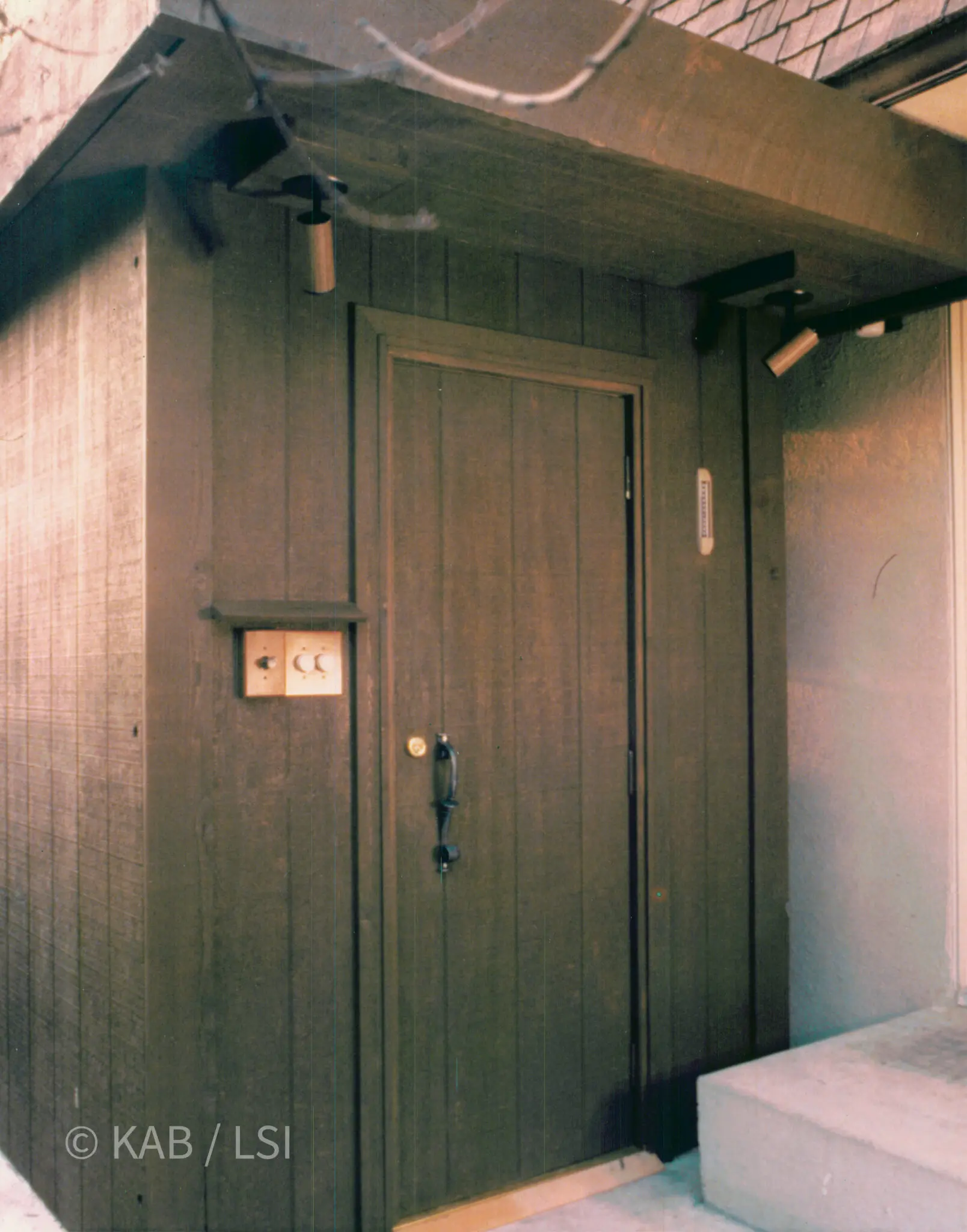
The entrance door of a Vintage Guardian cellar we installed for a well-regarded plastic surgeon whose practice served the entertainment industry. Stepping out of his private home office between surgeries, the doctor walked a few paces and opened this door — stained-redwood plank panels, cast-iron pull, a combination keypad on the left wall for the climate control and lights. The building sits under the overhang of the house’s mansard roof, tucked in like it had always been there.
The Plastic Surgeon’s Cellar — From the Street
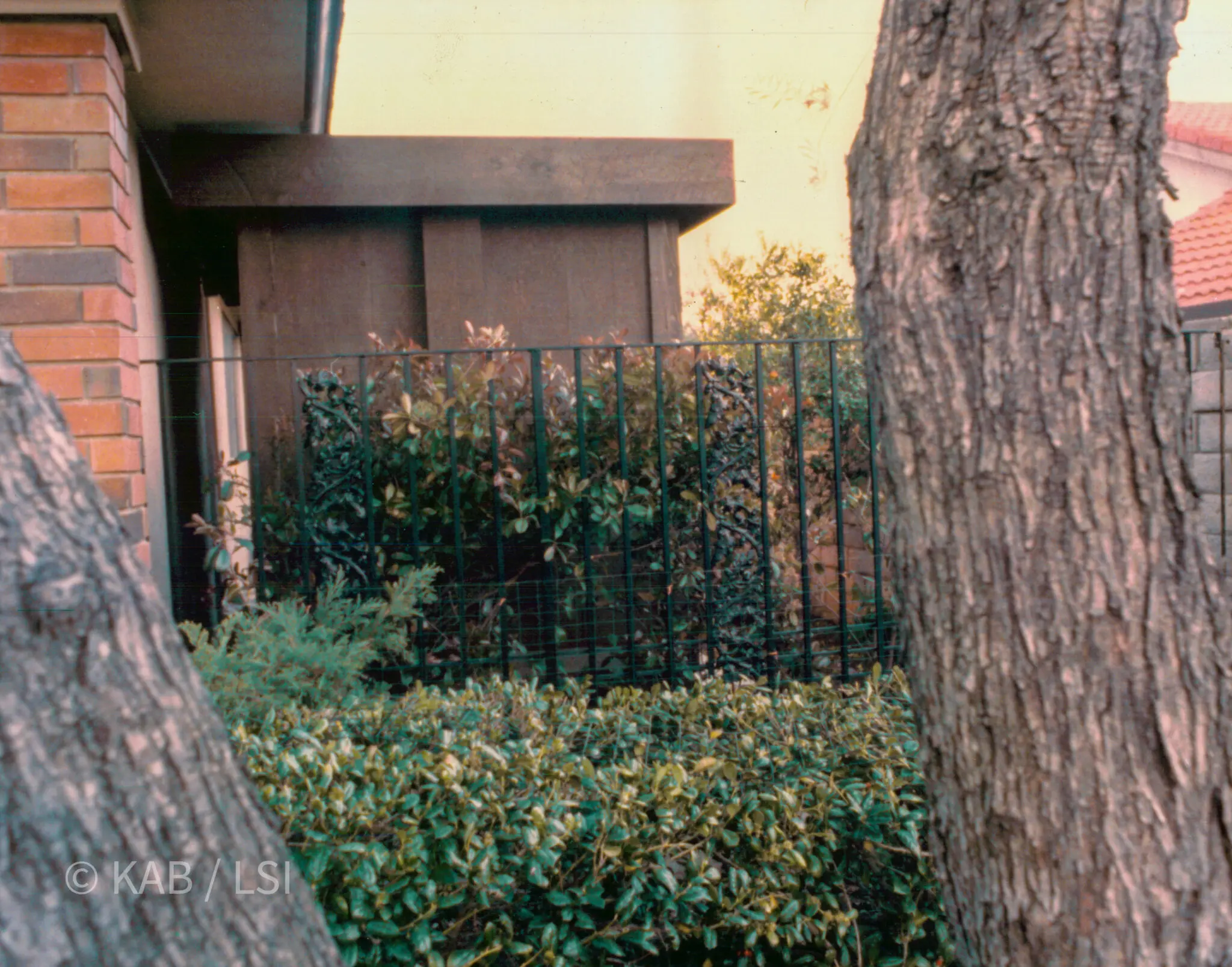
The same building viewed from the street, past the property’s wrought-iron security fence. Stained to recede into the mansard’s shadow. First-time visitors walked right past and never saw it. That’s the goal of every Vintage Guardian exterior installation: the building does its work, the client uses it every day, and the neighbors never quite see it.
Historical Fun Facts
Hollywood, Melrose, and the Wine Cellars They Hid
Three short stories from the ’70s through the ’90s — when the studios were running full tilt, Melrose was Hollywood’s best-kept secret, and a well-built wine cellar was the quiet heart of a restaurant or a home. Tap any story to open it.
Santa Monica · 1972–2018
Valentino — The Crown Jewel on Pico
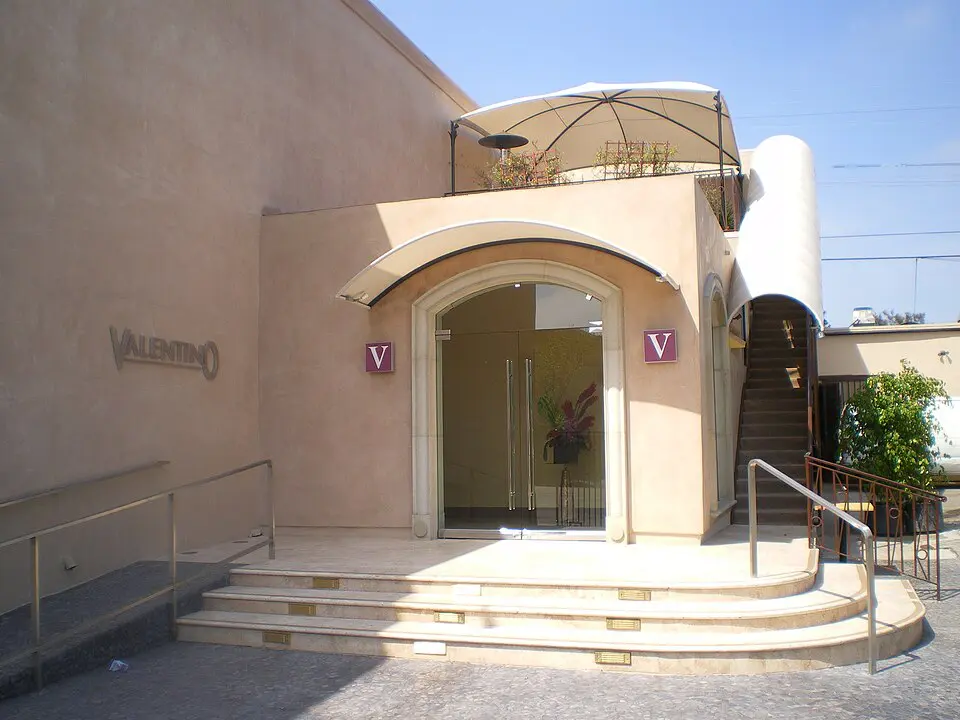
In December 1972, a 25-year-old Sicilian immigrant named Piero Selvaggio and his partner took over a former beer bar on an unglamorous stretch of Pico Boulevard in Santa Monica and named it after a silent-film star. The place was, in his own words, “so ugly and depressing that I almost didn’t do it.” He did it anyway. Valentino would go on to become what Bon Appétit called one of the places that changed American dining forever.
Selvaggio rewrote the American idea of Italian food. Before Valentino, Italian in Los Angeles meant checkered tablecloths, heavy red sauce, and straw-flask Chianti. After Valentino, it meant the first real burrata in America, the first white truffles from Alba, the first mozzarella di bufala, the first serious Italian olive oils. Ruth Reichl, then at The New York Times, called it “by far the best Italian restaurant in the country.”
Building the wine cellar for a restaurant like Valentino wasn’t decoration work. It was infrastructure — temperature, humidity, racking, access, the quiet craft that lets a sommelier pull a ’68 Barolo at 55 degrees on a Tuesday night without thinking about it. That was the era we walked into when the first commercial calls came through Vintage Guardian’s door. Valentino closed in 2018 after forty-six years. Piero retired. But the standard he set — that the cellar is the restaurant — became the reason we got most of the work we got.
Piero Selvaggio and chef Nicola Chessa at Valentino Restaurant on Pico Boulevard, celebrating the restaurant’s 40th anniversary (2012). Video hosted on YouTube — watch on YouTube.
Melrose & Highland · 1968–1998
Emilio’s, Antonio’s, and the Studio-Lunch Secret
Long before Melrose Avenue became the neon-and-tourist strip people think of today, it was a quiet corridor of small Italian rooms that the Hollywood studios knew about and most civilians didn’t. Paramount was ten minutes away. Warner Bros. was a short drive over the hill. The actors, the producers, the studio people — they’d slip over for a two-hour lunch with a bottle of something good and drift back to the lot.
The anchor was Emilio’s, at the corner of Melrose and Highland. And at the center of Emilio’s was Emilio Baglioni, who was not the sort of man you forgot.
He’d come out of a mountain village in Abruzzo, survived being shot by a Black Shirt as a teenager during the war (a partisan saved his life, and a local woman hid him until he could walk again). After the war he studied architecture in Rome for two years, then hotel school in San Remo, then worked his way across Europe — Lausanne, London’s Savoy Hotel — until he landed in New York in 1959 as a host and chef at the Four Seasons. That’s where Jack Warner found him. Warner didn’t just hire Emilio. He drafted him — moved him from New York to Los Angeles specifically to run the Warner Bros. executive dining room: the private room where Warner himself ate, where his top executives ate, where the directors and producers he wanted to keep in his orbit ate, and where the actors he disliked were not allowed in the building. (Warner’s own stated reason for the ban: “I don’t need to look at actors when I eat.”) For nearly a decade Emilio ran that room and the larger commissary that served the rest of the lot. He was, in effect, Jack Warner’s personal restaurateur — a Savoy-trained European host operating inside the single most power-weighted lunch room at any major American studio. When Warner retired in 1968, Emilio opened his own place on Melrose and took much of that lunch crowd with him. LA Weekly named him Best Restaurateur in 1983.
I liked the man intensely. He was raw grit — you knew he was a powerful man, that he could pull strings if he needed to, but he didn’t lord it over anyone. He was confident in his skin. He seemed happy as all get out.
But the résumé isn’t the man. The man arrived every morning at six in a Bentley, in the dark, while I was pulling up out back in my work van after coming off the 5 Freeway at Melrose, there to spend the day on-site while running the South El Monte manufacturing operation by phone. I was 23 years old, and as the general contractor, I had to be on the job. Emilio was already there: white leather shoes, white dinner jacket folded carefully over the seat beside him, dusted off before he draped it across his shoulders — never with his arms through the sleeves, the way a handsome Italian with a narrow waist can wear a coat. He would unlock the place in the cold and dark, leave the kitchen light on for the chef arriving next, then walk to the far end of his own bar — where the cash register lived — and spend the next hour and a half going line by line through two rolls of paper tape, the bar receipts and the dining-room receipts. He had an office. He preferred the bar. He was the host, the entertainment, and the owner of his own universe, and he read every number in it himself before the doors opened.
I spent the better part of six months alone in that restaurant, building out his cellar and his private dining rooms on my hands and knees in the damp quiet of a restaurant kitchen before the day began. By lunch he was a different man. He’d walk his dining room with a ukulele, sometimes a concertina, and sing to his tables — Hollywood regulars, studio people, Sinatra himself at the corner booth — in an accent that was half Abruzzo, half forty years of Los Angeles. Emilio’s had dark booths, music, a slight theatricality that never tipped into a gimmick, and regulars who stayed through two glasses and a coffee because nobody wanted to leave. He was elegant, opinionated, and completely at home in a restaurant that felt less like a business than an extension of his own personality.
A few years in, Antonio Gutiérrez — who had trained under Emilio at Warner Bros., who had waited tables on Natalie Wood and Fred Astaire and Sinatra himself — opened Antonio’s Mexican Cuisine just up the street. Antonio and his wife Yolanda lived in Hancock Park and ran the restaurant as an extension of their home. Two dreamers, one mentor, one stretch of Melrose. For more than forty years, Antonio’s was a fixture, quietly hosting the industry generation after generation.
Emilio retired in 1998. The space at 6602 Melrose is now Nancy Silverton’s Michelin-starred Osteria Mozza. Antonio’s closed in 2022. Valentino in 2018. An era of Hollywood, quietly ended.
Beverly Hills, Malibu, Downey · The Residential Years
The Homes — Wine Cellars for the People Who Owned Hollywood
Commercial work opened the residential door. A studio executive eating dinner at Emilio’s would lean on the bar, admire the cellar he was drinking out of, and a week later we’d be in his Beverly Hills driveway measuring a basement. That’s how it went, one introduction at a time, for twenty years.
Don and Barbara Rickles weren’t drinkers — but in the entertainment business, top-shelf wine and champagne arrive as gifts at birthdays and holidays and premieres, and the bottles pile up. The Rickles needed proper storage, not a bar. We built them a quiet cellar for the collection they never intended to acquire. That one call led to several more in the same circle of comedians and their friends.
Mark Goodson — the daytime-television producer behind The Price Is Right, Family Feud, Match Game, and To Tell the Truth, who built Goodson-Todman Productions into one of the most powerful names in American television — commissioned a cellar for his Beverly Hills home. Mark had taste, wealth, and friends, and a handful of those friends became our clients too. That’s how Beverly Hills referrals work.
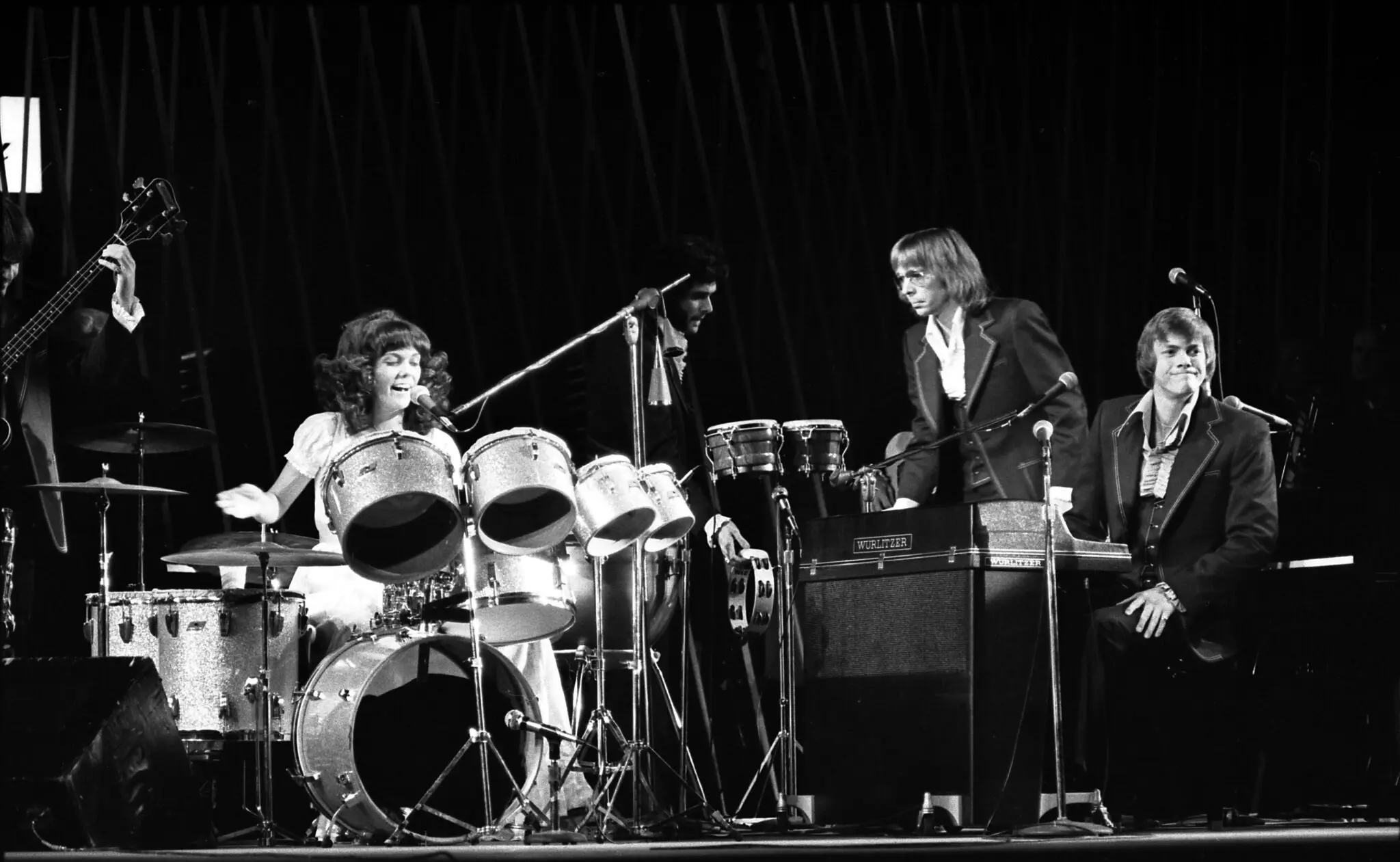
Karen and Richard Carpenter — the singing duo who defined the sound of American pop for a decade — ran their family operation out of a compound in Downey that served double duty as family home and working recording studio. They asked us for a temperature-controlled cellar on the property. The Carpenters were serious, private, extraordinarily kind people, and the project mattered more than the music trivia suggests.
That work is elsewhere in this portfolio. But the thread that ran from Pico Boulevard through Melrose into the canyons of Beverly Hills — it was all one story. One era. One handshake that led to the next. This is how a Vintage Guardian outbuilding company in South El Monte turned into a hillside stewardship practice in La Habra Heights. It took forty-five years. Most of it started with somebody admiring a cellar over dinner.
Commercial construction — the years that sharpened everything
Pentagon-spec defense electronics. A 100,000-square-foot frozen juice plant. The years a residential contractor learned what real tolerances look like.
The defense electronics shell — Orange, 1987
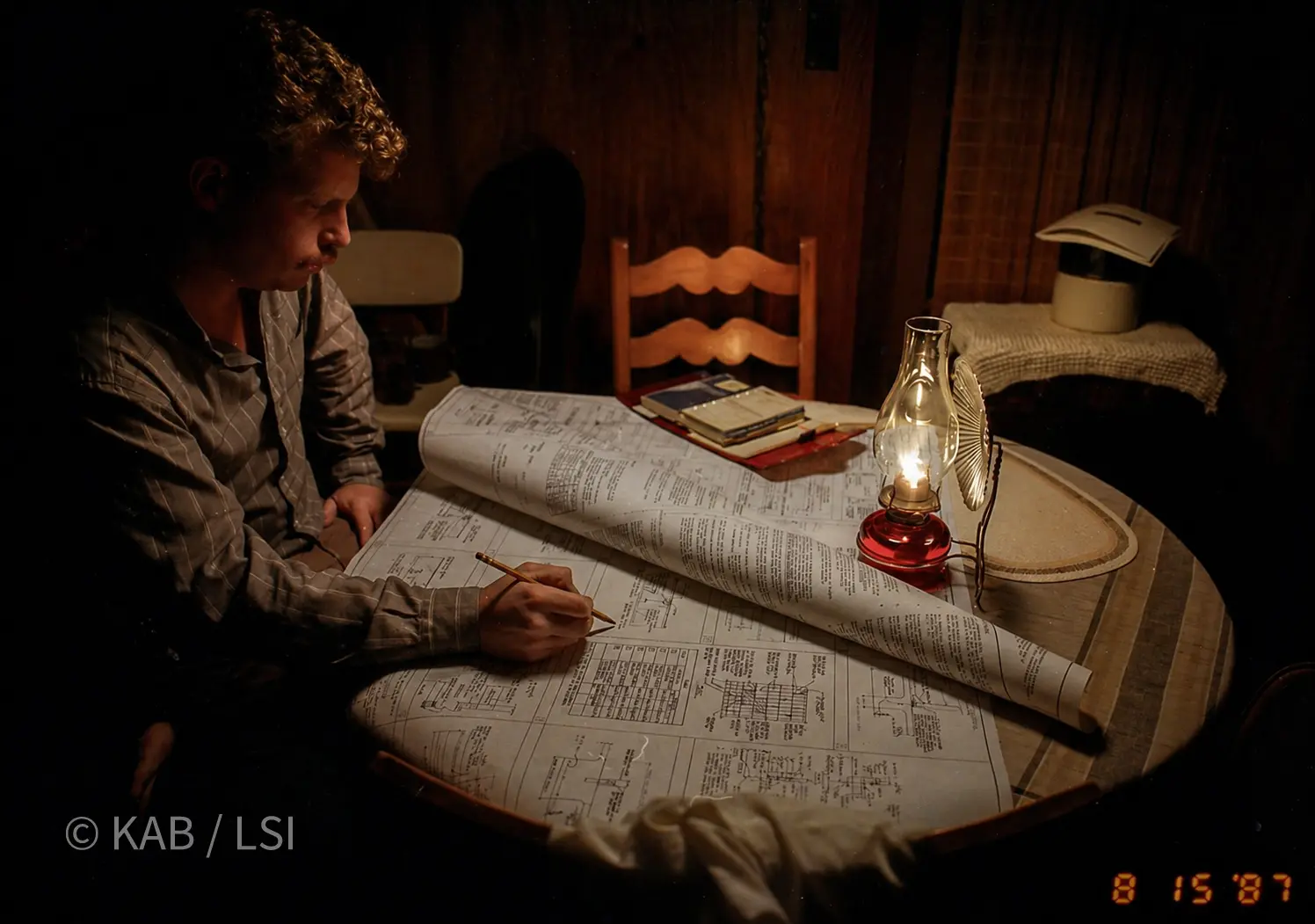
Amos Deacon Jr. had built MDB into one of the early ruggedized hard-drive manufacturers — DataShuttle removable 5.25″ drives, Pathfinder ruggedized optical drives, the kind of storage that had to survive vibration on a Navy destroyer or a Pentagon shock test. He needed a clean, organized factory. I built it out for him.
About 30% of the front of the building was offices — two stories deep, wrapping in an L into the parking side, with a 45-degree reception entry and skylights running along the spine. The back was manufacturing. Above the back wall, a 12,000 sq ft mezzanine for parts inventory and the conveyor automation Amos was already planning, set up so it never encroached on the production floor below. Two large atrium openings — about 30 feet by 30 feet — pulled daylight straight down through the building. A handful of rooftop skylights sat over the manufacturing area too, with two more on the second floor where the office package units had to work harder against the sun.
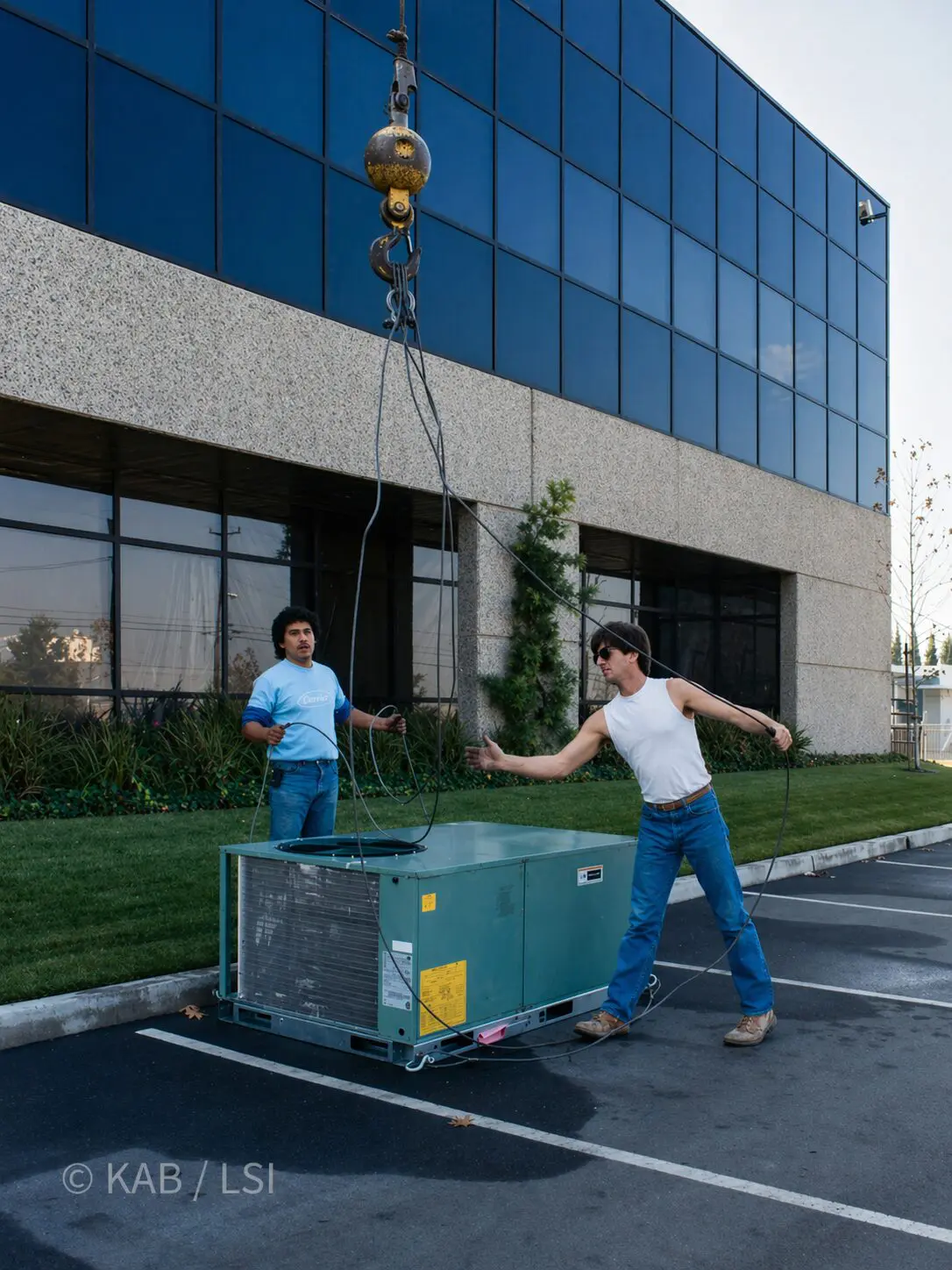
The photo above caught one of those lifts. More followed that day, and more after that, each Carrier hauled up to its roof curb on a building that was almost ready to start running.
Personal · 2026
Lessons in Wisdom
What I didn’t fully understand at thirty-four was that Amos was offering more than a contract. He was a U.S. Naval Academy man, Hughes Aircraft engineer, USC MBA, Beta Gamma Sigma — the kind of operator who invited his contractor up to his office and asked real questions. About the trades. About the people I worked with. About what I thought of the building going up around us.
I gave him a clean building and a competitive bid. I didn’t give him my time outside the work.
Amos passed away in 2015. He was eighty-two. His son Amos III runs Phoenix International today, a few miles from where we stood on that rooftop in 1987 — still in Orange County, still building rugged storage for people who need it to work in places where ordinary equipment fails.
That’s the lesson at seventy-three I couldn’t have learned at thirty-four. Some clients are also colleagues if you let them be. I’d like to find Amos III. I’d like to bring him the 1987 photo. I’d like to do the second thing I missed with his father.
The same shell still works. Today it’s three tenants — DMG HVAC and ToroAire (under Ambient Enterprises) running fan fabrication and HVAC distribution out of the manufacturing volume, and Brand New Life Christian Center holding Suite B for more than two decades, Pastor Chuck and Amy Battaglia leading services five nights a week and twice on Sunday under their own cross.
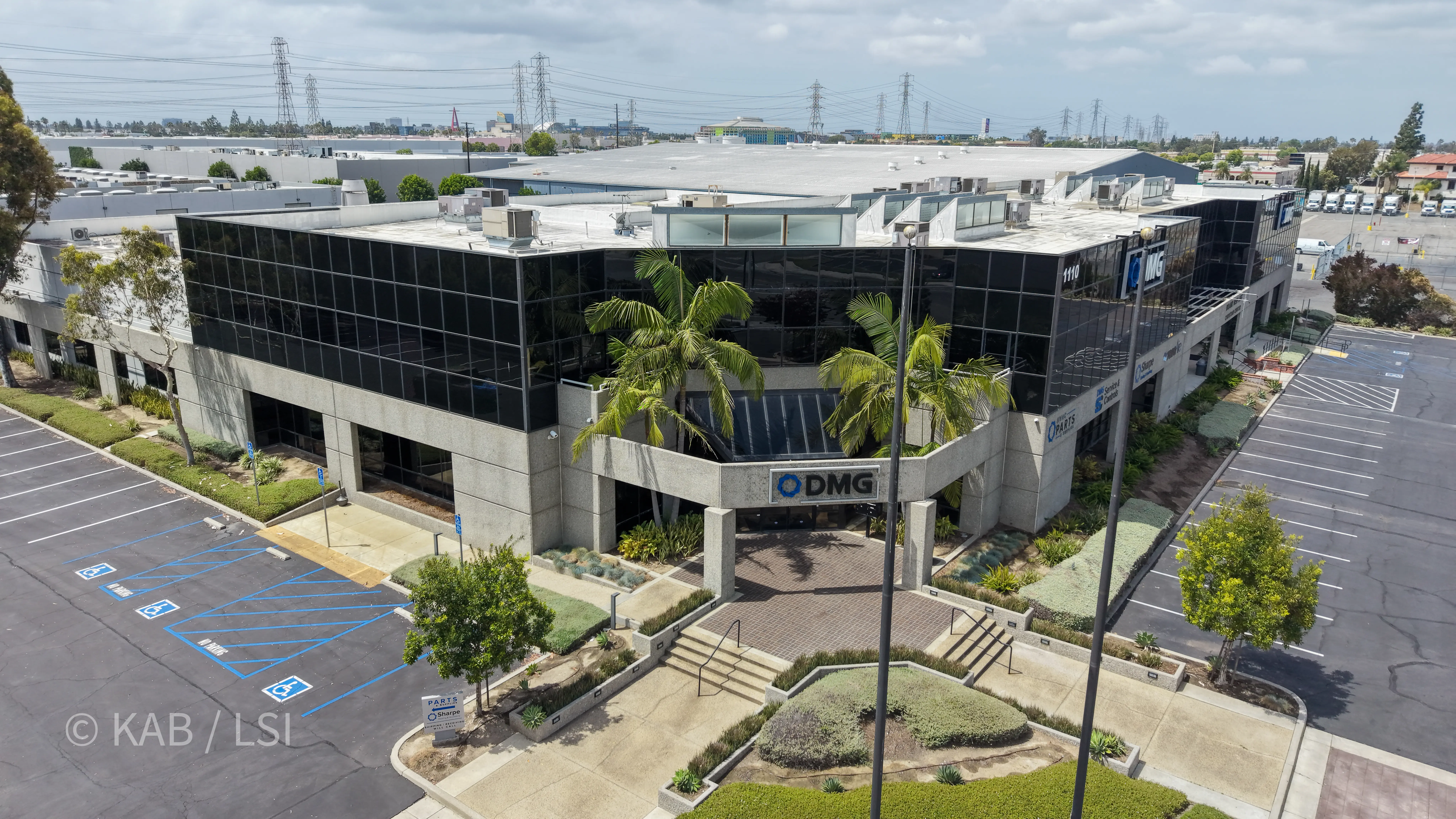
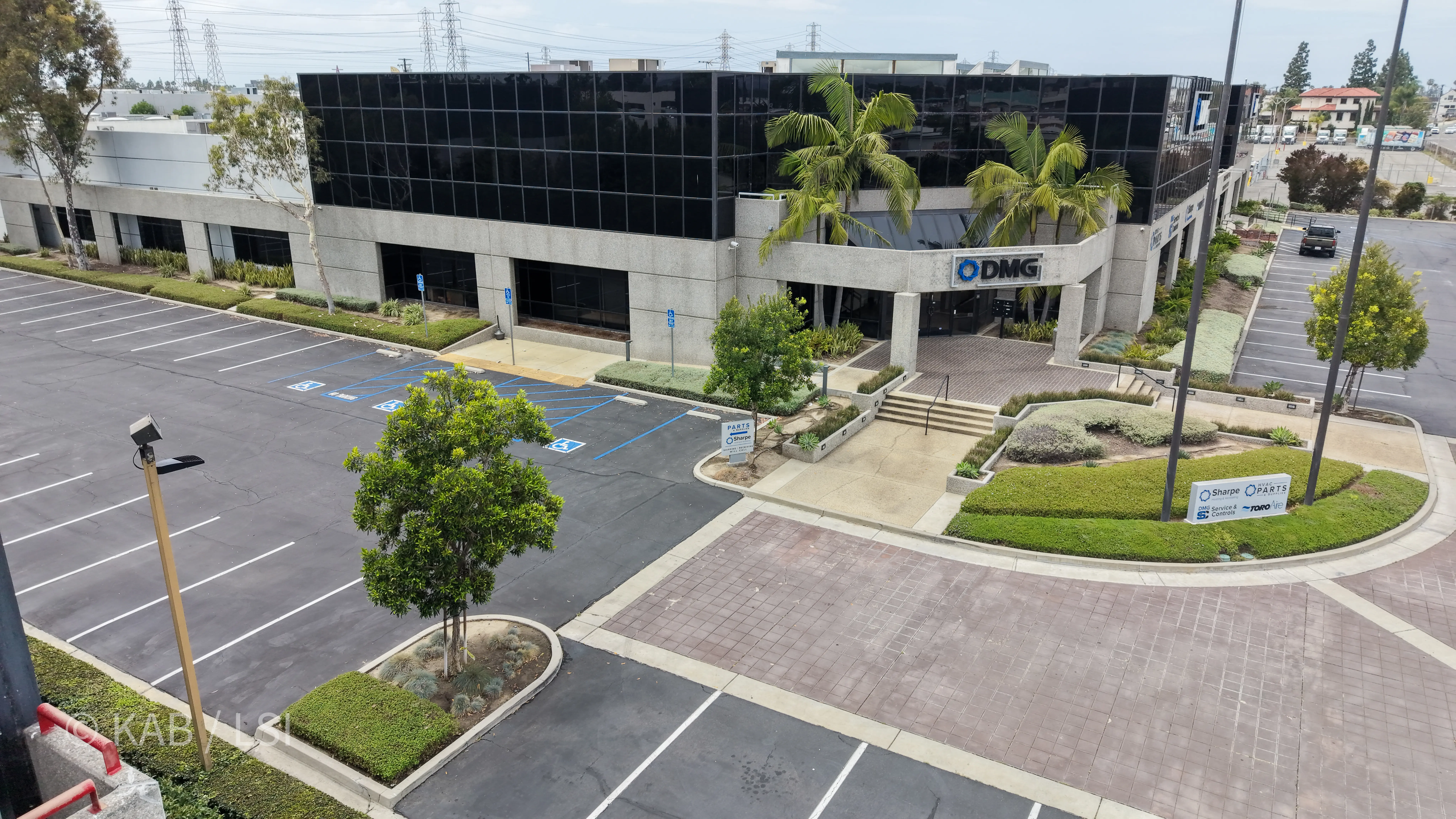
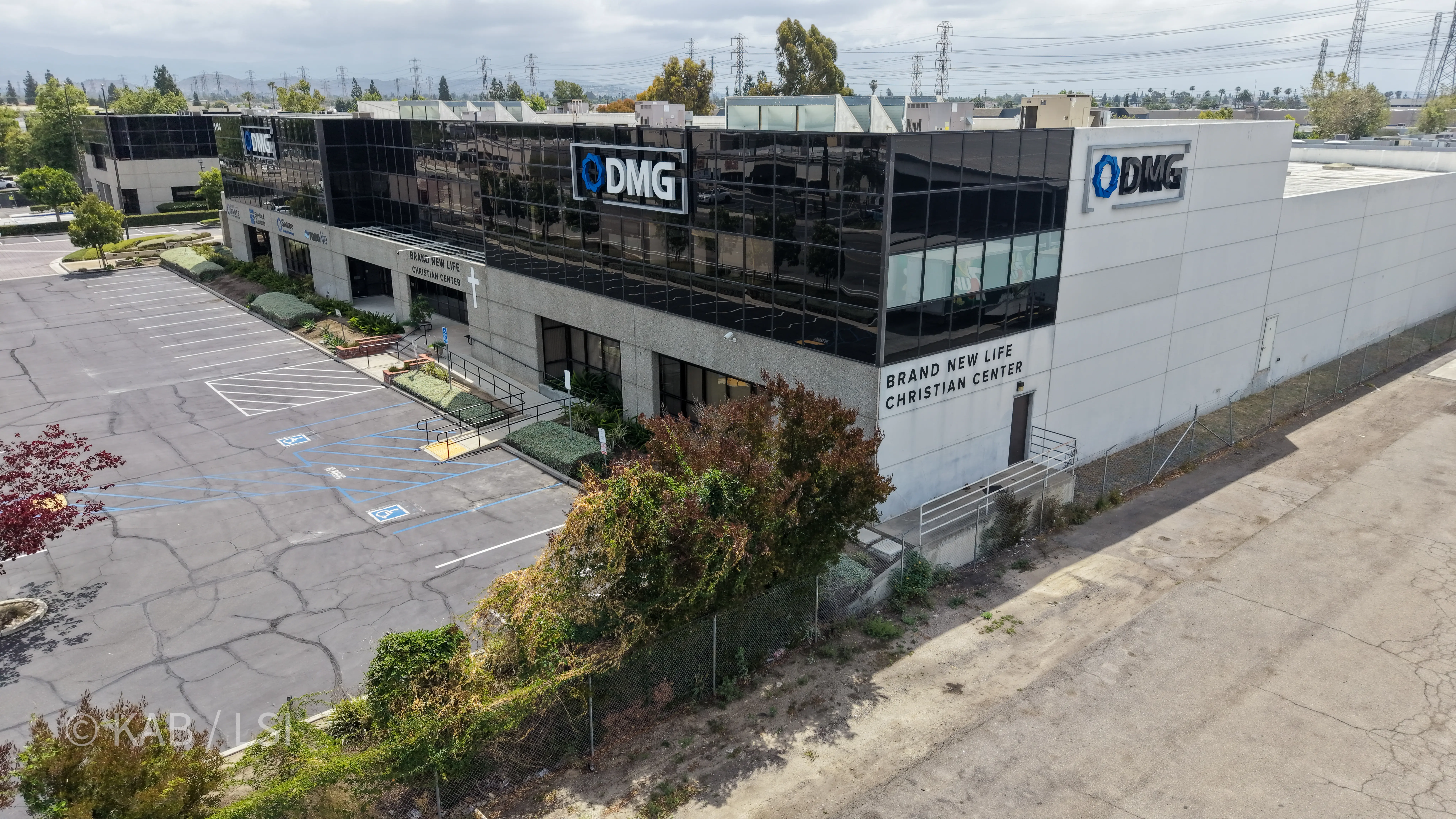
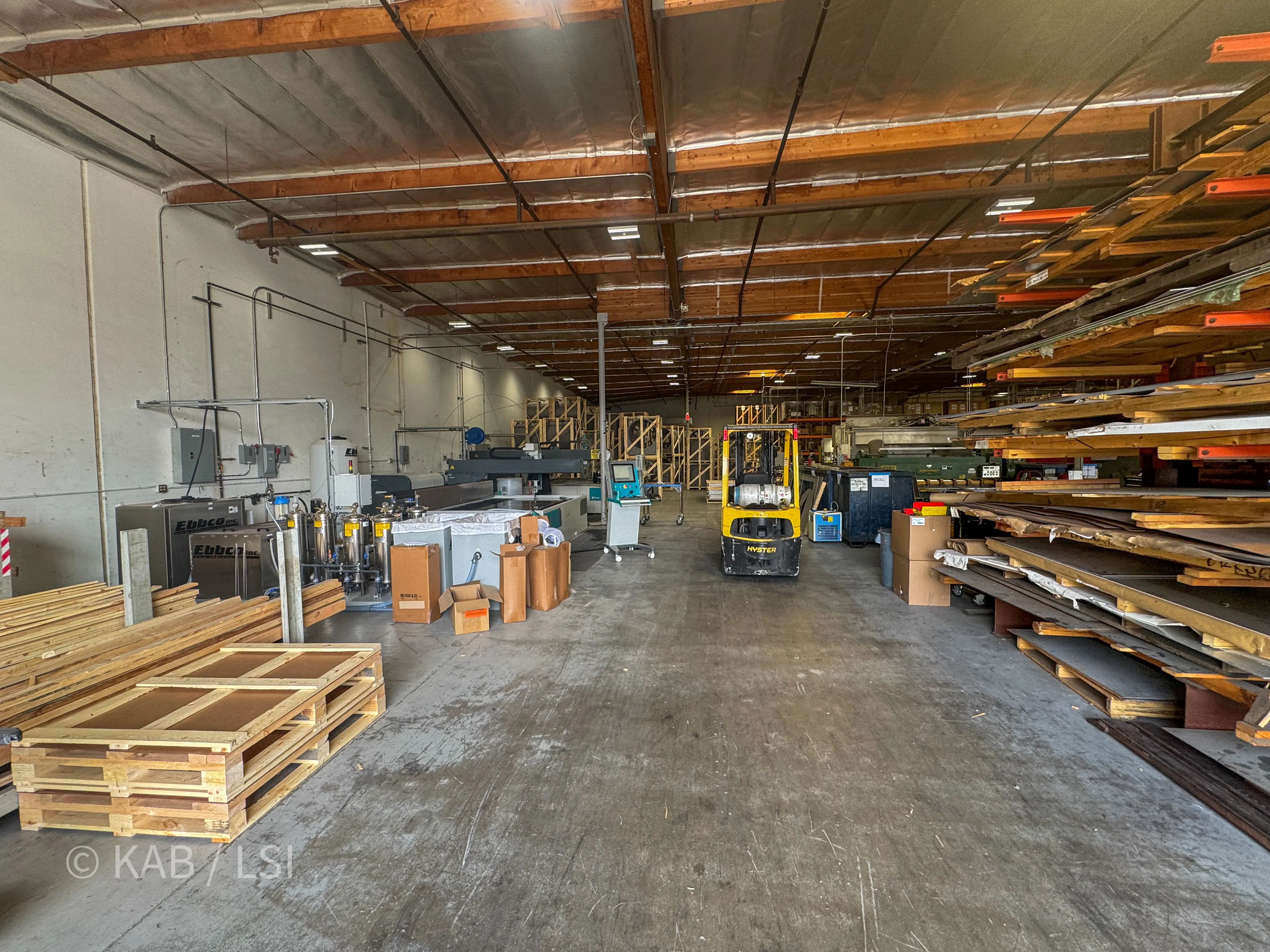
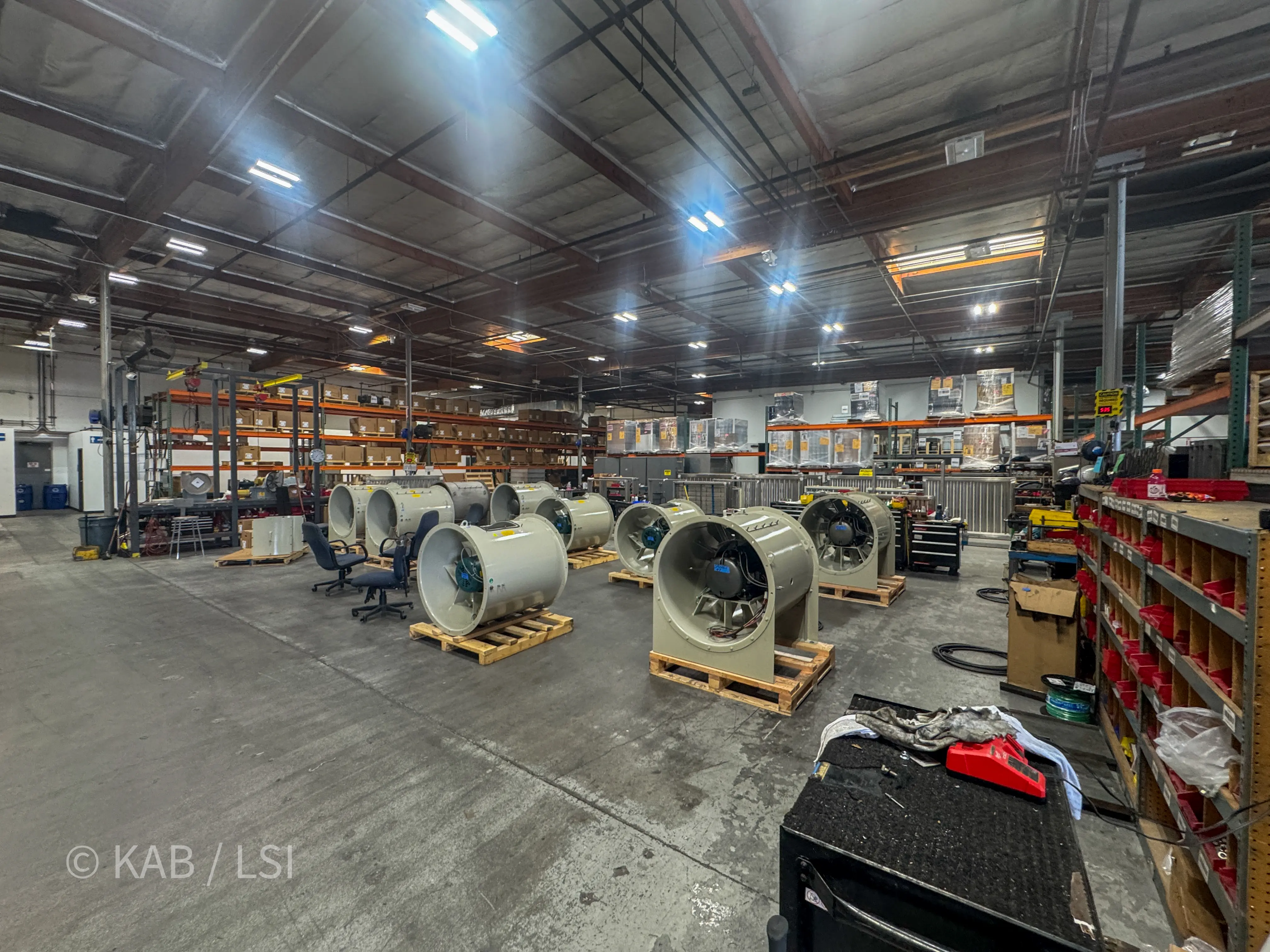
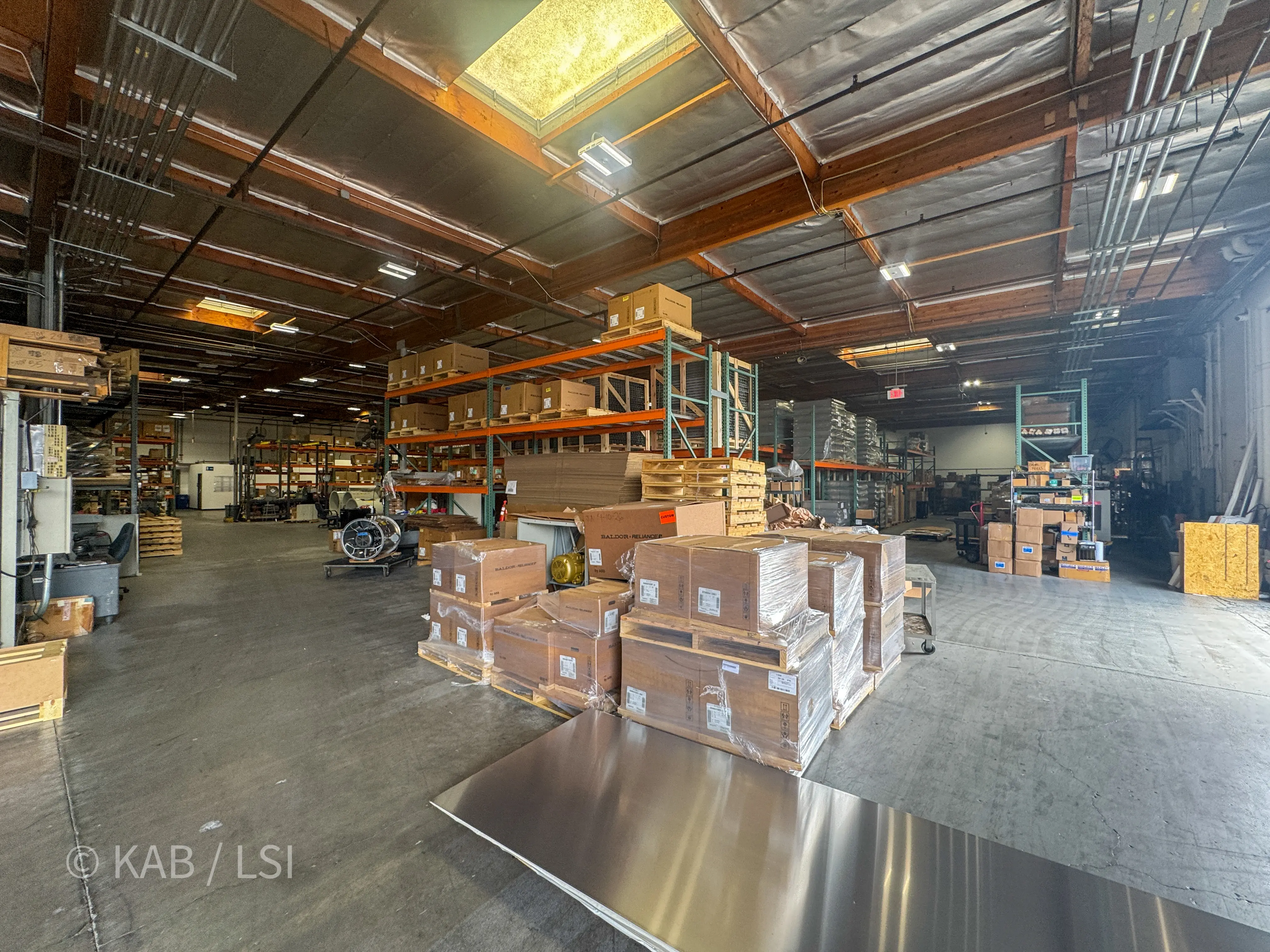
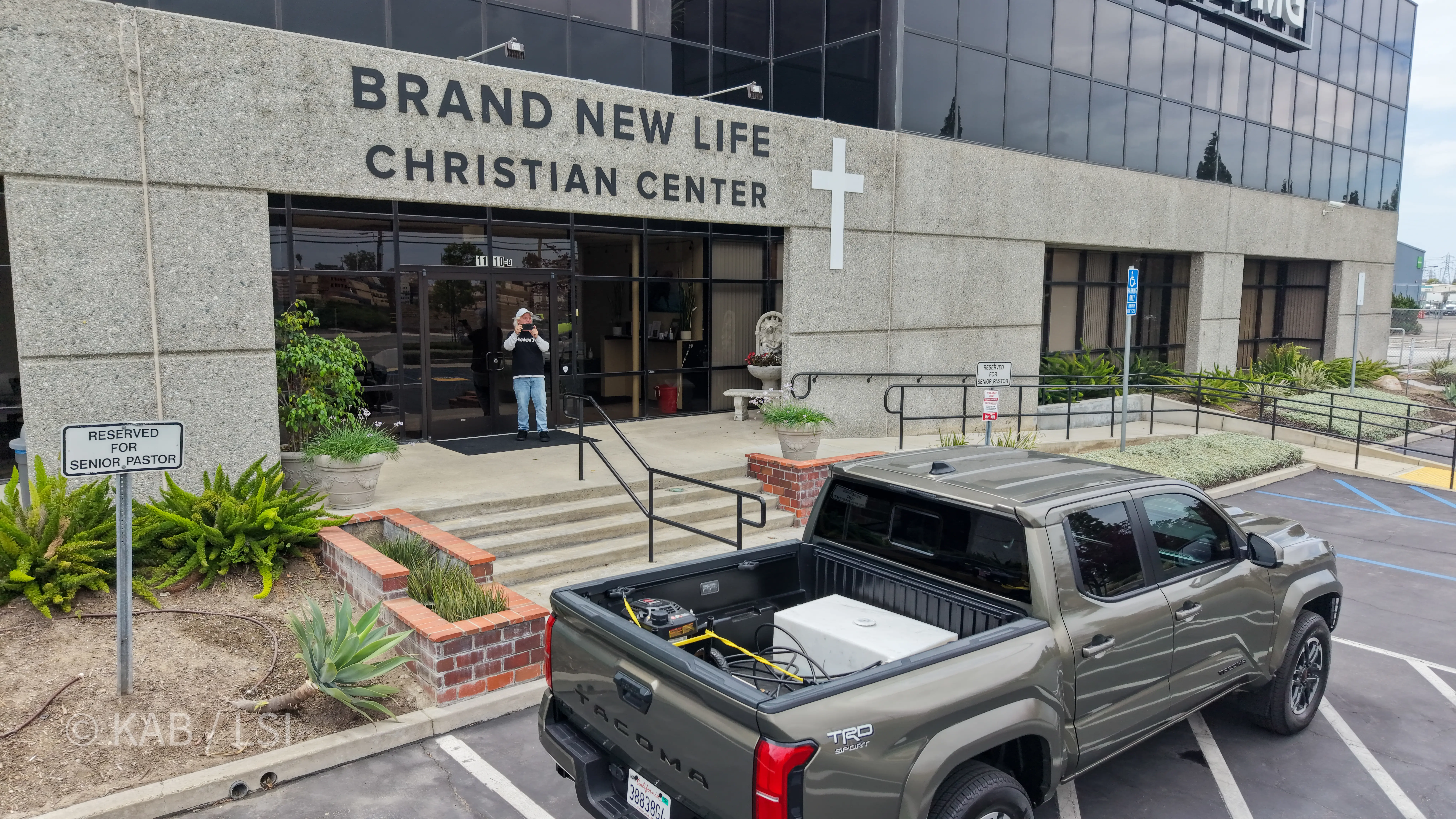
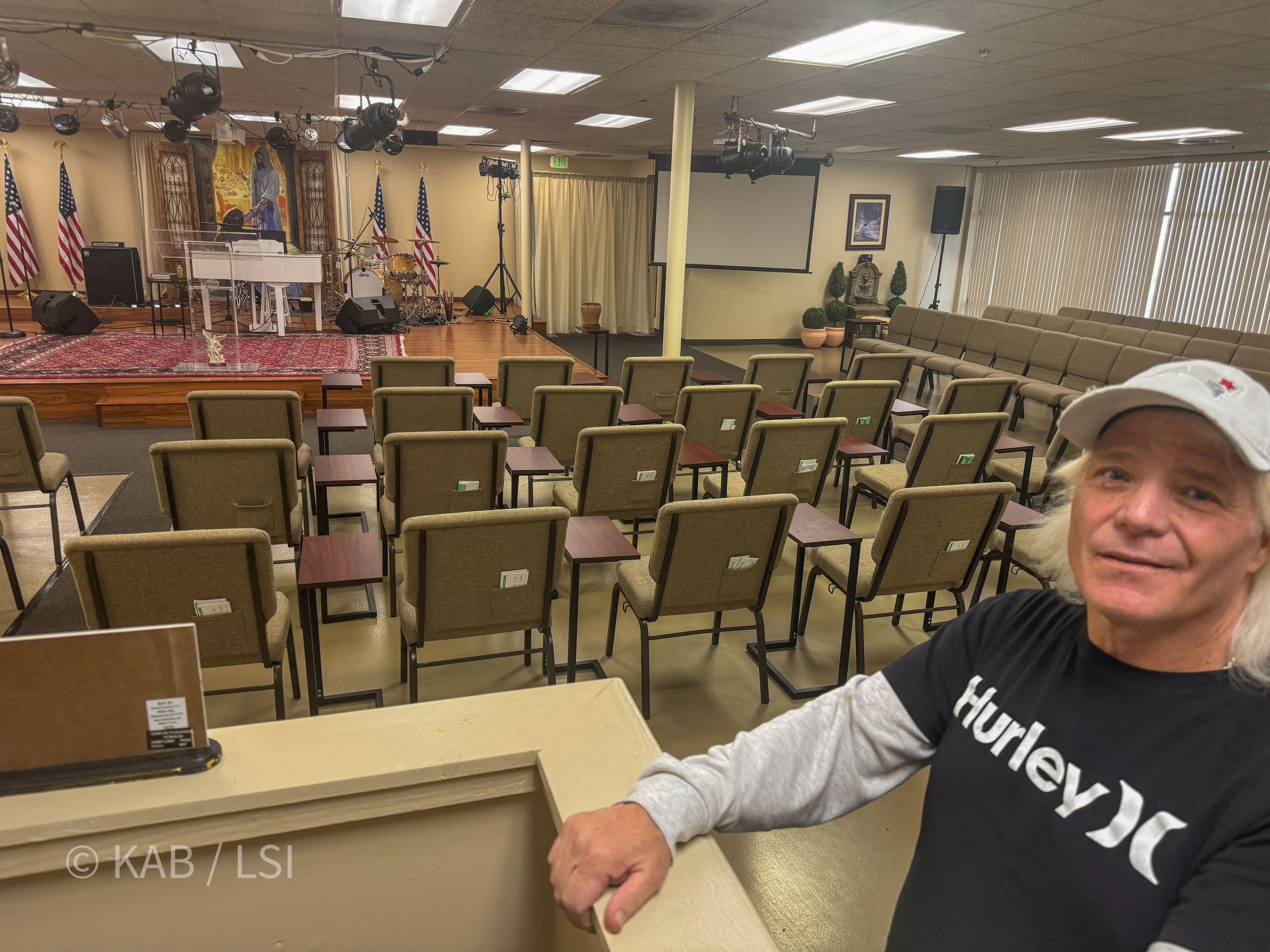
Saturday, April 25, 2026 — the same building 39 years later. 1110 W. Taft Ave., Orange. The defense electronics shell I built out for MDB Systems in 1987 is still working, now as the corporate headquarters of DMG HVAC and ToroAire under Ambient Enterprises. © KAB/LSI
The front entry, ground level. Queen palms, brick paver walk, the same 45-degree reception entrance I framed in 1987 — now the public face of a multi-tenant industrial campus. © KAB/LSI
Side elevation. Three tenants share the footprint today: DMG HVAC in the front office wing, ToroAire’s fabrication floor in the back, and Brand New Life Christian Center in Suite B. Same shell, three different uses, all of them productive. © KAB/LSI
Inside ToroAire’s fabrication floor — water-jet CNC cutting heavy-gauge stainless steel for fan housings, Ebbco closed-loop water filtration on the wall, sheet stock cantilever racking on the right. The original 1987 wood-truss roof is overhead. © KAB/LSI
Eight bolt-together tube-axial industrial fans staged on pallets, ready for shipment — ToroAire’s product line, built in the same volume that once produced ruggedized military hard drives for MDB Systems. © KAB/LSI
Mid-building view. Pallets of Baldor-Reliance motors staged for fan assembly. Smaller commercial-grade HVAC components in the deeper racking. Overhead, one of the original 1987 rooftop skylights still pulling daylight onto the manufacturing floor. © KAB/LSI
Around the corner from the manufacturing floor — Brand New Life Christian Center has held this side of 1110 W. Taft for more than two decades. Pastor Chuck and Amy Battaglia lead services here five nights a week and twice on Sunday, under their own cross, on a building first built for defense electronics in 1987. Jeff Billig, longtime church volunteer, met me in the parking lot and opened the door. © KAB/LSI
Inside the sanctuary. Jeff walks me through the room where Pastor Battaglia teaches. Forty years ago a building was poured for shock-isolated drives and Pentagon contracts; today the same room holds chairs, a stage, a cross, and Sunday morning. The work the building does is different. The work it does still matters. © KAB/LSI
Setting the first 5-ton HVAC package on the bare commercial shell — Orange, California, 1987. The building was 88,000 square feet of empty concrete and steel that we built out from the inside: finished offices, an industrial mezzanine, factory floor, full HVAC and electrical, drywall, and a DoD-approved security vault. The lift was the first day of a year-plus build for a defense contractor.
The frozen juice plant — Fullerton, three years
The Jaffes had a successful operation in upstate New York packaging single-serve milk and orange juice for school cafeterias — basement-level Health Department clean room, all-tile floors and walls, two huge stainless steel batching tanks, walk-in frozen storage accessible by forklift. They’d already won the school lunch channel. The product extension that made sense was frozen juice — ICEE-style push-up squeezes, paper-wrapped, 100% juice with apple concentrate as the natural sweetener, packaged in 6-, 12-, and 24-count school-lunch cases.
They needed West Coast capacity. They financed the buildout themselves and bought a former Coca-Cola Foods plant in Fullerton — a building that already had FDA-approved infrastructure for orange juice packaging, which saved them a year on permits. Three years of work.
The build · 1986–1989
Lessons in Stewardship
The packaging machines came in one at a time, sourced through Milliken & Company in Spartanburg, South Carolina — porcelain-coated cast-iron form-fill-seal machines, refrigerator-sized, with top-mounted spools holding 24″- and 36″-wide rolls of waxed paper. Vintage equipment, twenty or thirty years old by the time we installed them, lovingly maintained because nobody was building new ones anymore. The trade name was the Milliken M-pak, and forty years later the same term still appears on Minute Maid frozen juice bars sold into school cafeterias today.
Apple concentrate came in by rail in blue plastic barrels, mostly out of Argentina and Venezuela. Blueberry, boysenberry, banana, orange — flavors blended in the basement clean room, gravity-fed up to the M-pak machines, formed and sealed and crimped into push-up squeezes that dropped onto a conveyor.
The conveyor fed two blast-freezer carousels — fifty feet by fifty feet by twenty-four feet tall — driven by two 600-horsepower ammonia screw compressor skids, delivered on lowboy trailers from out of state, the rigs sinking their feet through the parking lot asphalt the day they arrived. Eight-inch liquid lines, twelve-inch suction lines, all welded steel, all running outside to the ammonia storage tanks.
The utility brought 12,470 volts into the building on a primary feed we treated by hand — strip the shielding, apply polymer stress-relief compound, land each conductor into the contact blocks so it wouldn’t arc. The 480-volt three-phase feeders were the ones that scared you — touch one with the back of a knuckle and it would blow you across the room. The compressor itself ran on 4,160 volts to keep the current manageable, driving an ammonia loop cold enough to freeze a paper-wrapped pop in minutes.
The Jaffes kept the New York plant running while the California build was finishing — $100,000 truckloads of frozen pops crossing the country to keep California school contracts supplied during the ramp. By the time we finished, Fullerton was making what New York was shipping. The lunch ladies in California served the same product their counterparts back east had been serving for years, and the schoolchildren never knew where it came from.
Three years on a single client family. They trusted the work. I learned what stewardship of a project at that scale really meant — not just the buildout, but the relationship that made the buildout possible. That’s the second lesson the commercial years taught me, and the one that’s stayed.
Hillside homes taught me the same lesson at one-tenth the scale. The only variable that changes is the zeros on the invoice.
Hardscape, roofing, and the hillside specialty
Two decades of working hillside ground taught me what fails first, what holds, and what the next owner will curse you for.
We ran a concrete, block, and hardscape company through the build-out years of Irvine, Turtle Rock, Laguna Hills, and Laguna Beach — the kind of high-pressure work where buyers were barely qualifying for the house and already committed to finishing the yard. Heavy equipment, ten-wheel trucks, legal filings with the DMV. It was grueling, and we were good at it.
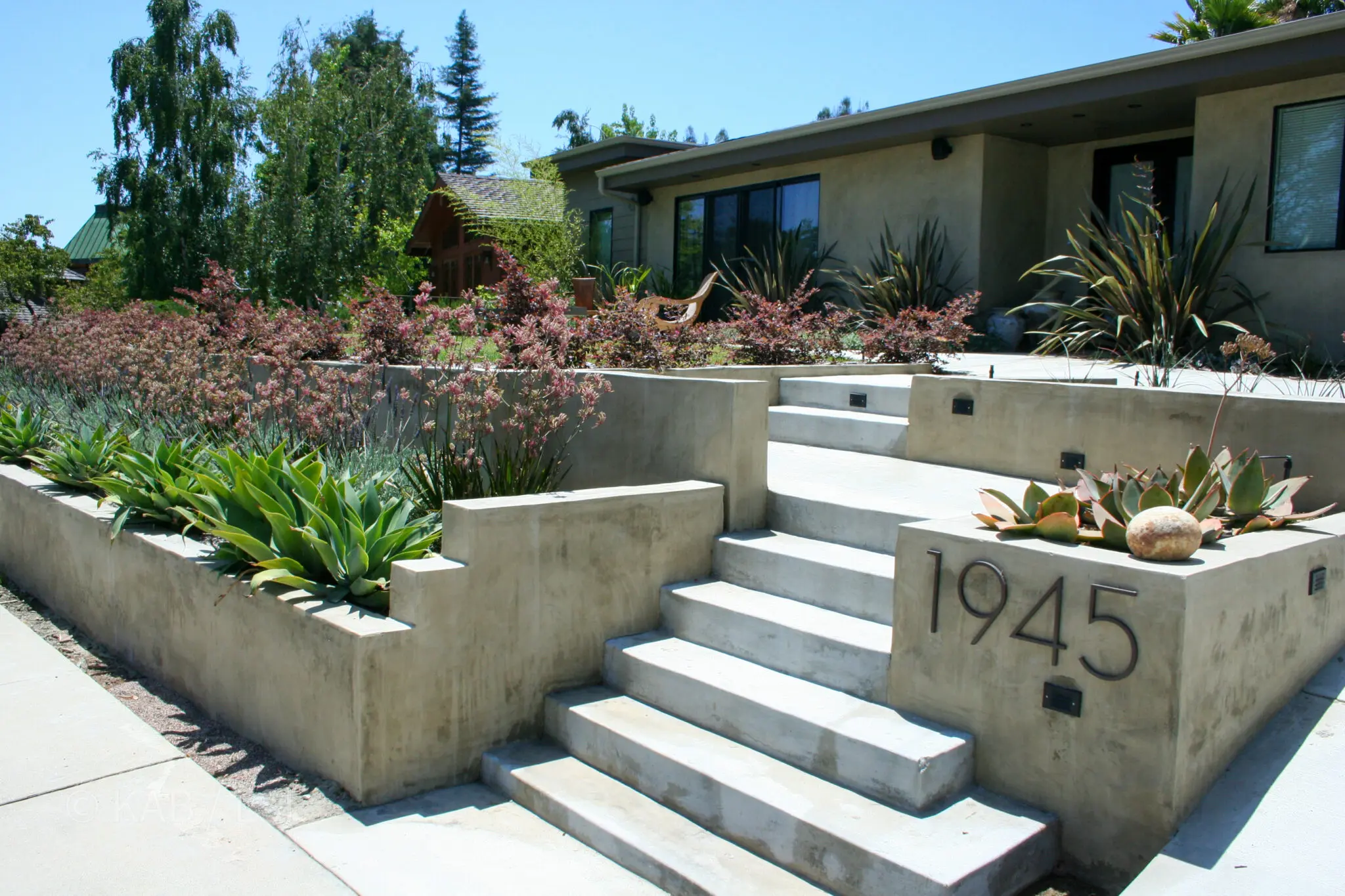
Terraced concrete planters, stepped walkways, and integrated address markers — grade control and arrival experience solved together. © KAB/LSI
The roofing company was where we found our niche. Southern California’s hillside fire risk — La Habra Heights is a Class 4 fire area, same as Malibu — meant that wood shake roofs needed to come off, and someone had to know how to replace them correctly. We did more than 1,000 fire-resistant tile and clay roofs on hillside homes throughout Los Angeles and Orange County — inspected, certified, repaired, or replaced — and over a million square feet of commercial elastomer “cool roof” in “heat island” cities across seven western states. That work put us in relationship with some of the most distinctive residential properties in the region, including estates in Beverly Hills, Hollywood Hills, Encino, Studio City, South Pasadena, Arcadia, Calabasas, Hidden Hills, Malibu, Orange Park Acres, and, of course, La Habra Heights.
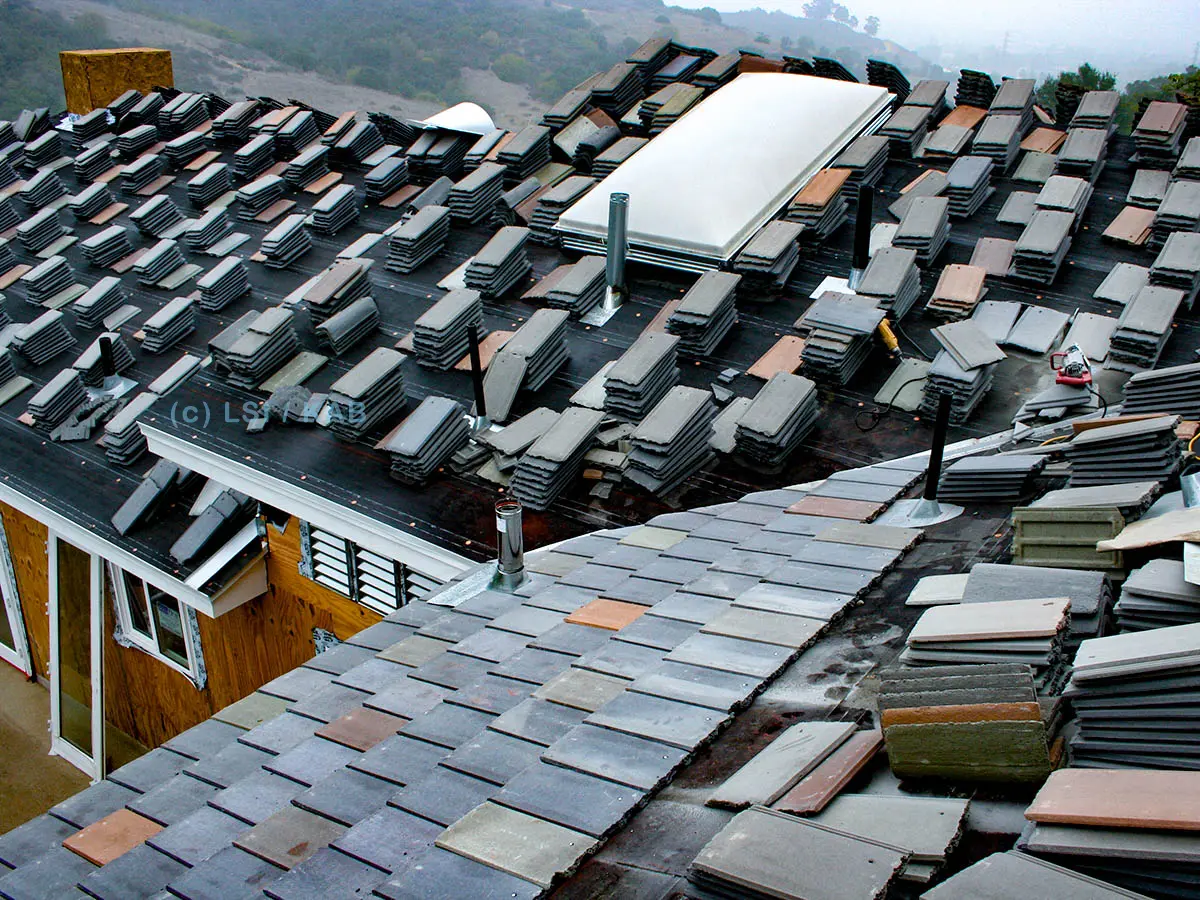
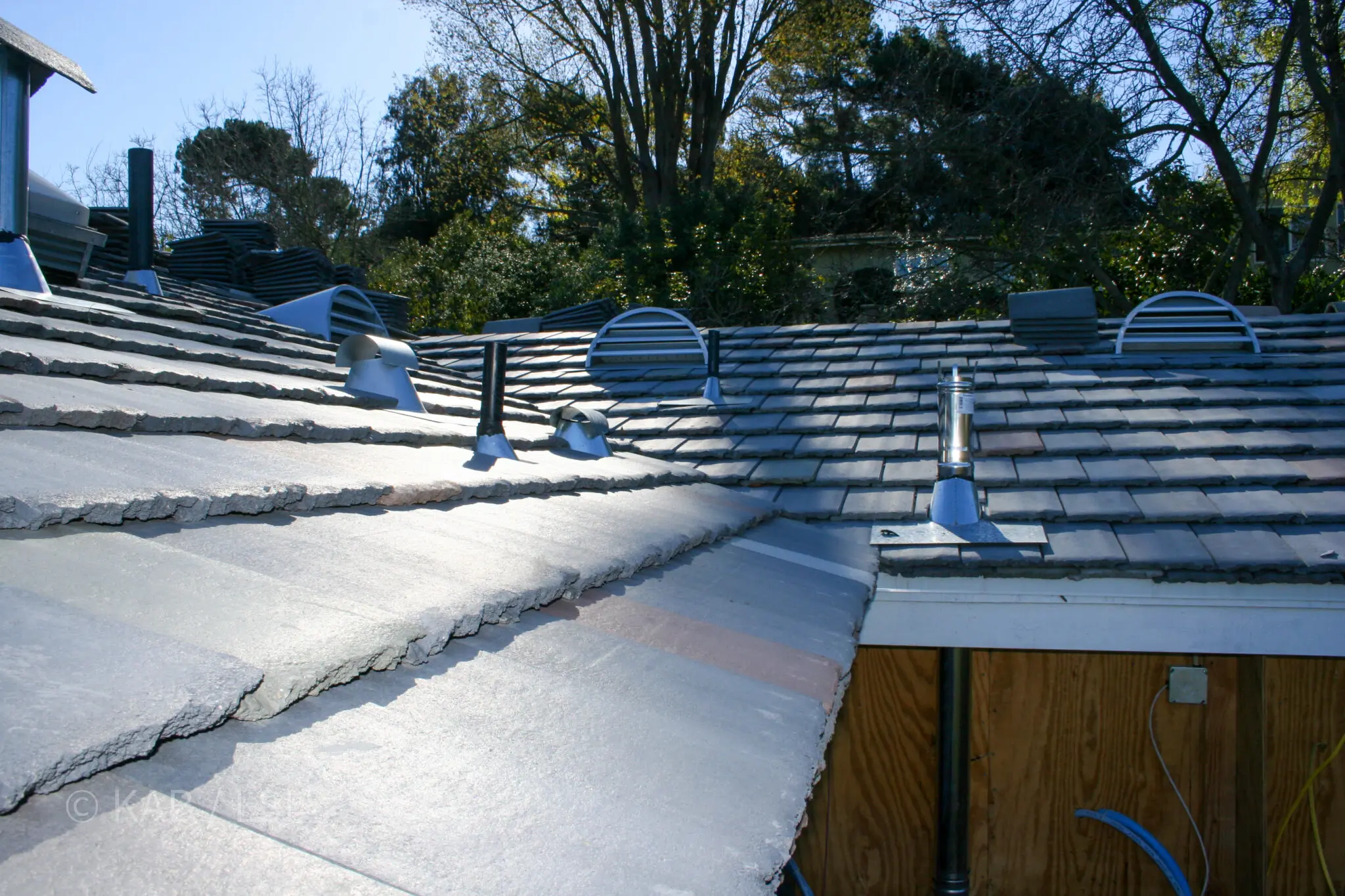
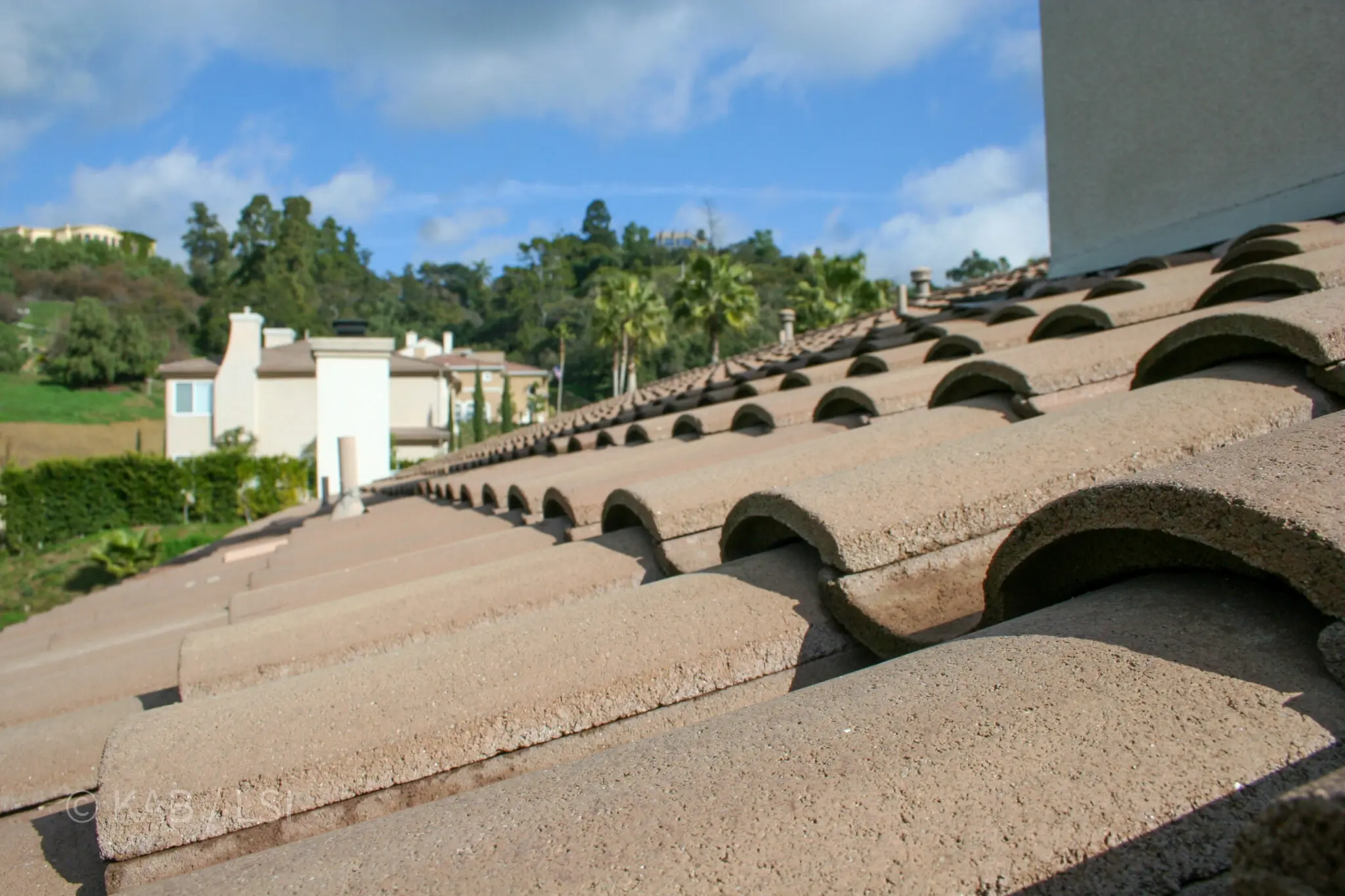
A 6-color Auburn concrete tile roof on a La Habra Heights hillside home — fire-resistant, engineered for the grade, built to last 50+ years. © KAB/LSI
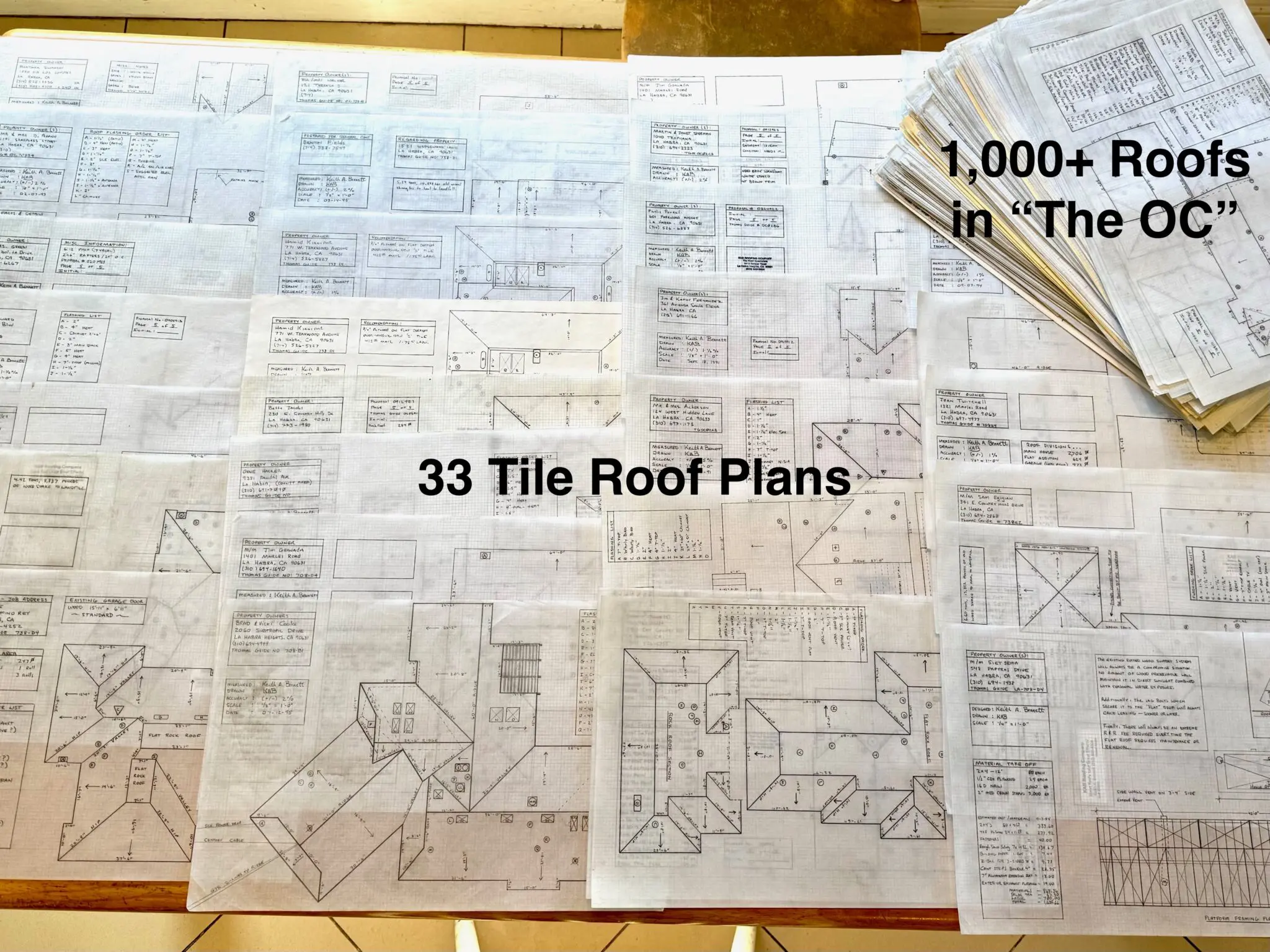
Over 1,000 hand-drawn tile roof plans — each to ¼-inch accuracy with a full bill of materials, before a single tile was ordered. © KAB/LSI
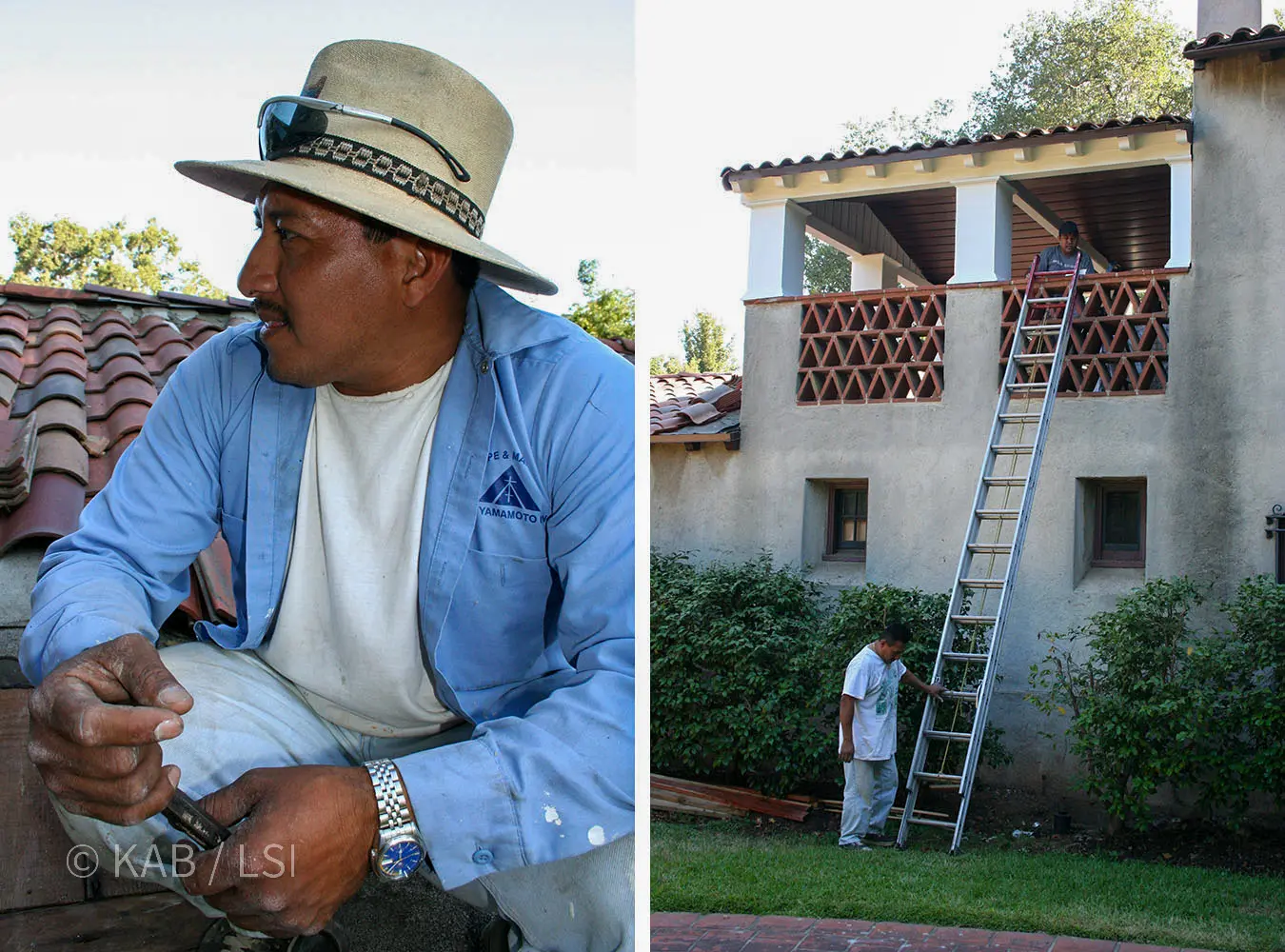
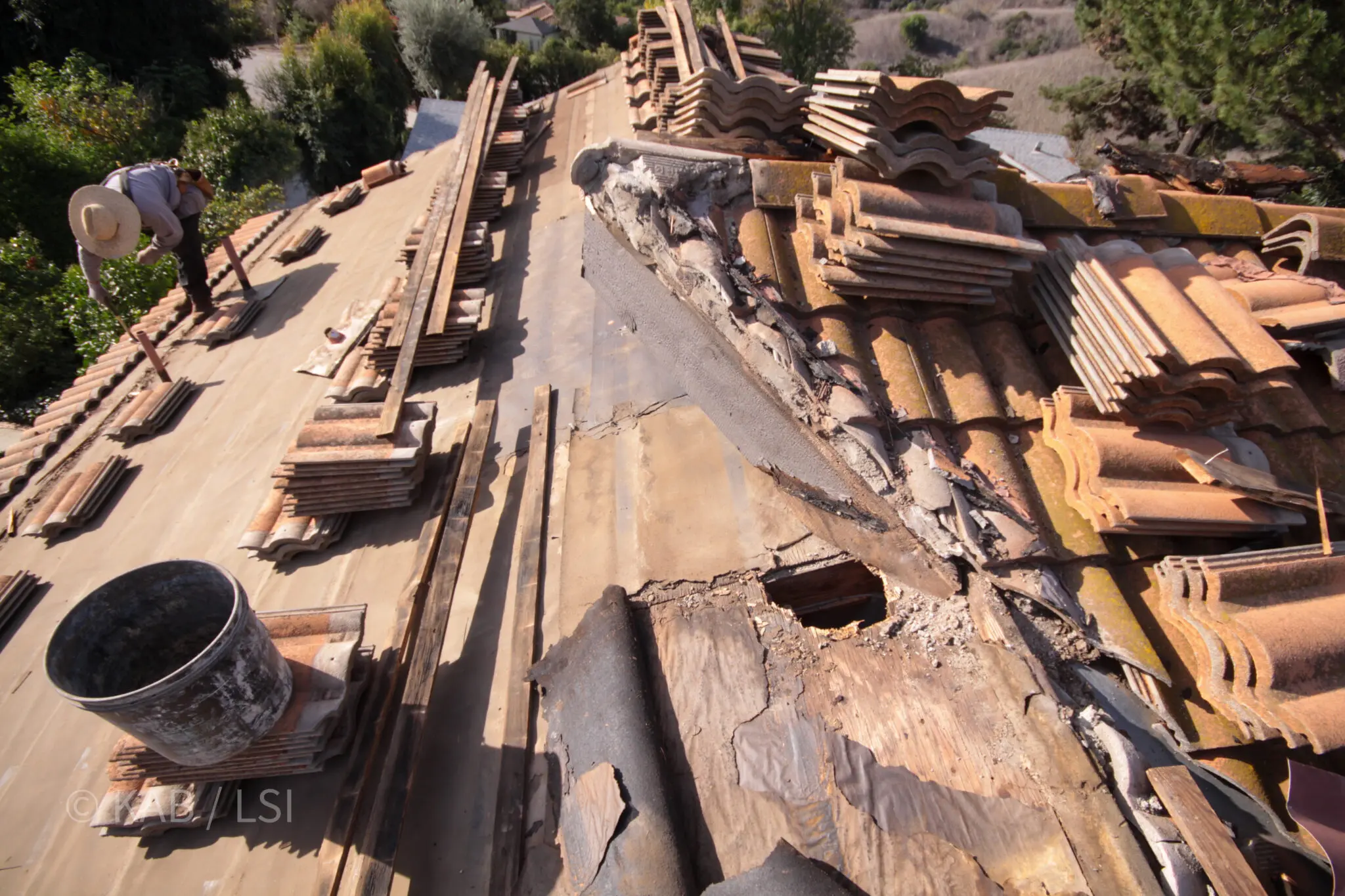
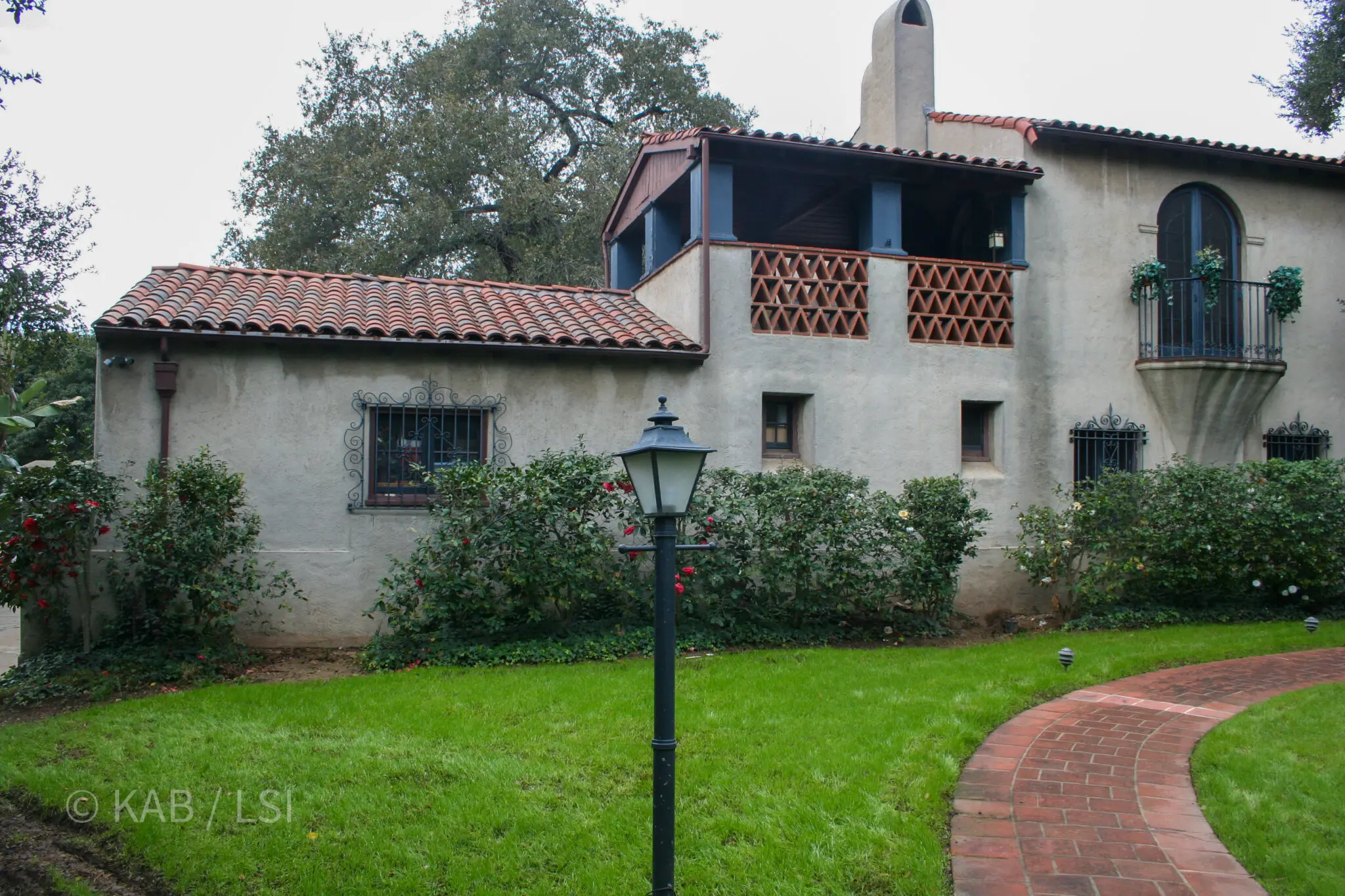
Our foreman on the 1920s estate — and the estate itself, with its original handmade clay tiles matched from historic demolition yards. Every tile pulled, every tile accounted for. © KAB/LSI
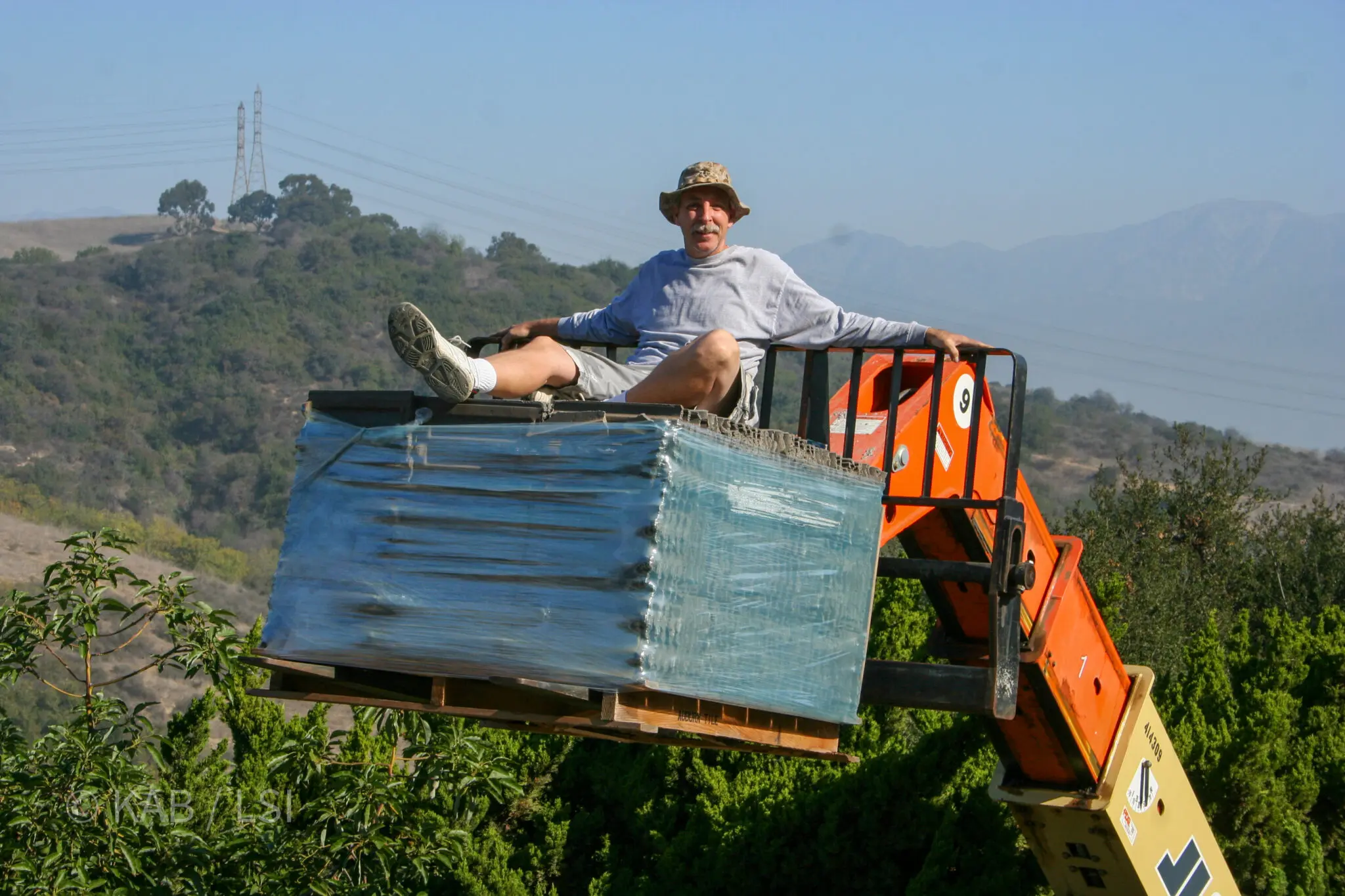
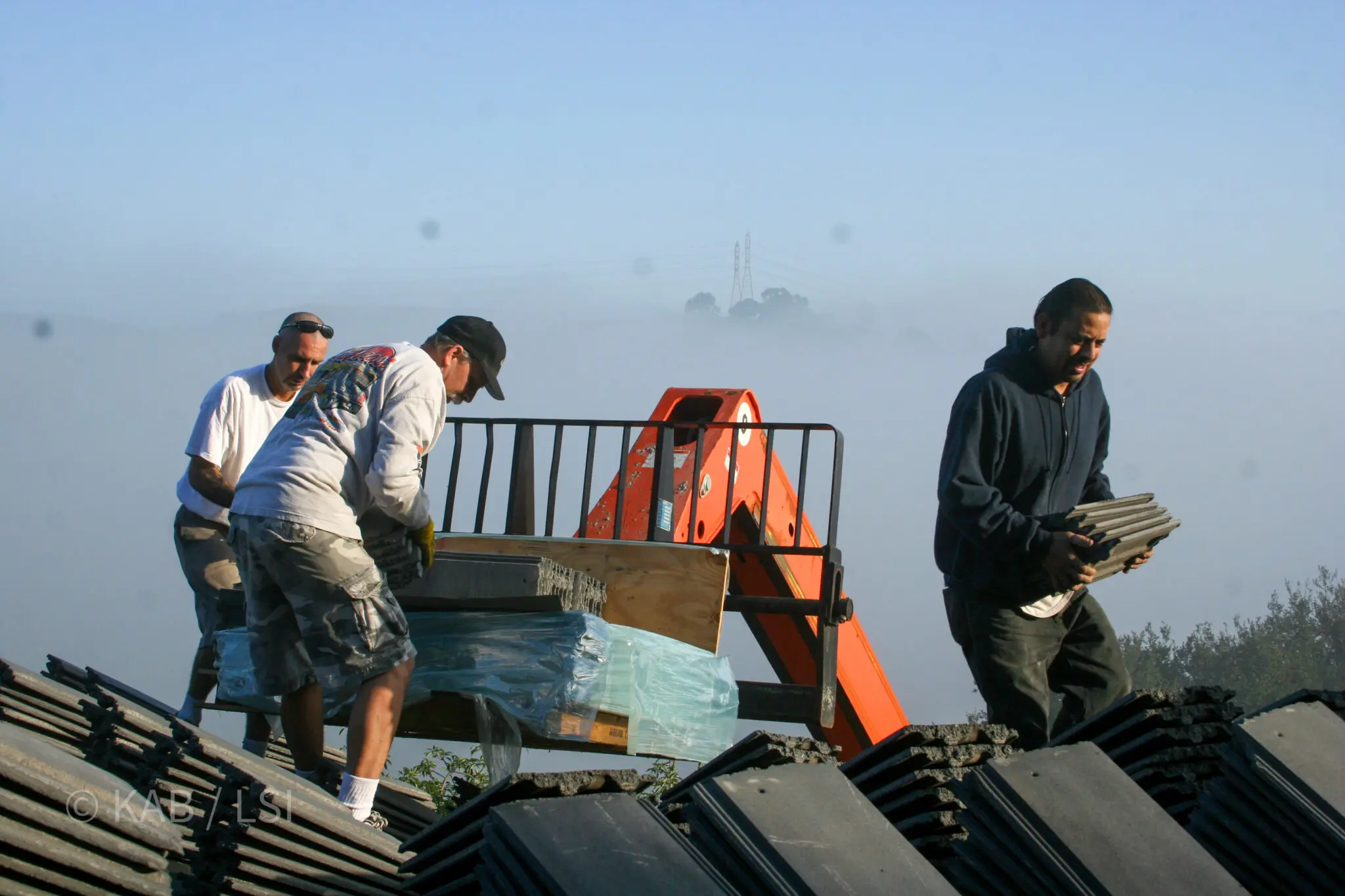
A tradition we never lost — the foreman rides the first pallet of fire-resistant concrete tiles up to a newly prepared hillside roof. When the crew sees the foreman on that first pallet, the day starts right. © KAB/LSI
Early-morning unload of full-weight, fire-resistant concrete tiles — fog still sitting on the La Habra Heights hills. The right material delivered to the right property at the right hour. © KAB/LSI
The 6-color Auburn blend, close up. “Engineered for the grade” isn’t a catalog phrase — it’s the difference between a roof that disappears into the hillside and one that looks like it was bought off a shelf. © KAB/LSI
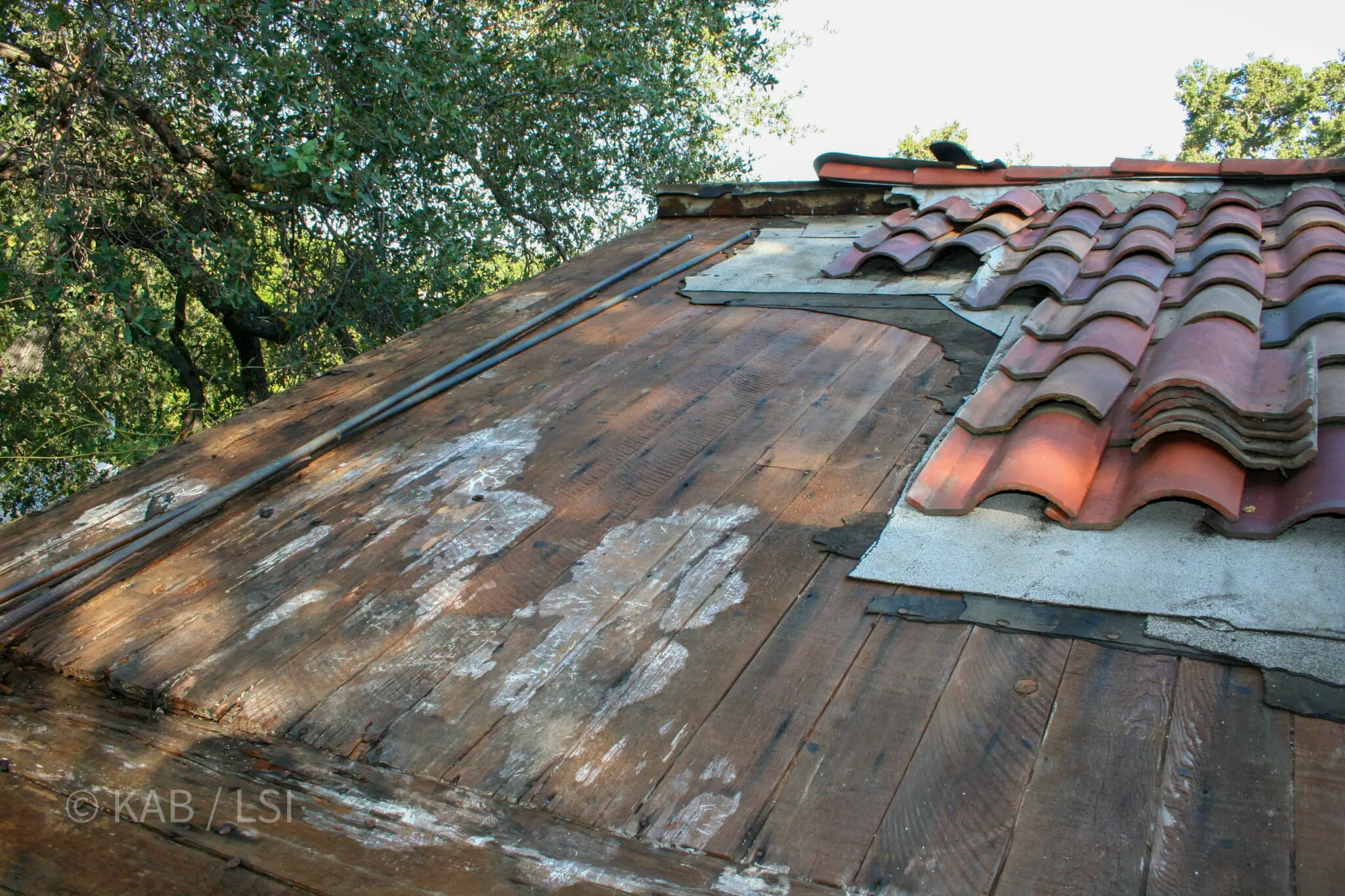
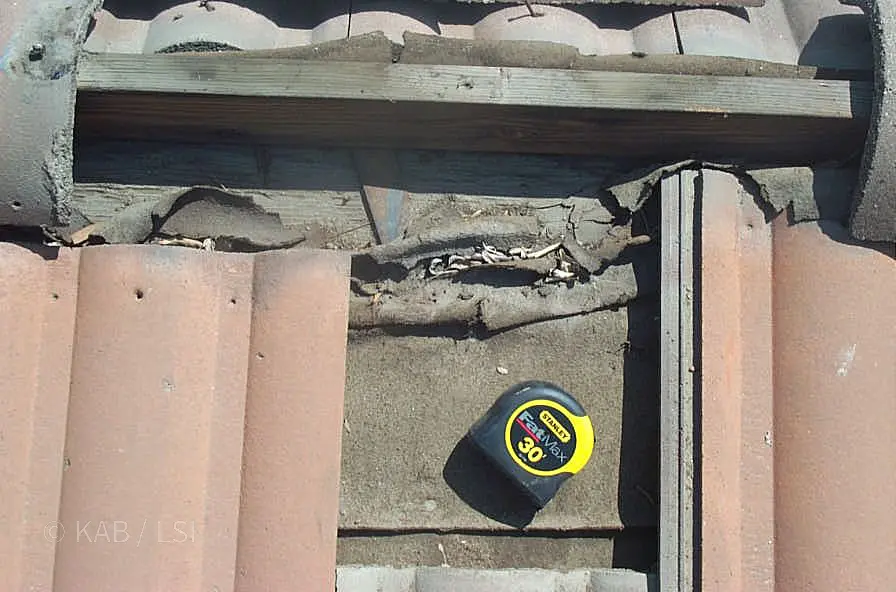
What you don’t see from the ground. Severe roof deck deterioration revealed beneath a clay S-tile roof during inspection — the kind of failure a Cert-A-Roof certification actually catches. © KAB/LSI
Hidden water damage uncovered under concrete tile on a hillside home. The tile held. The deck underneath did not. Finding this before escrow closes is the difference between a clean sale and a lawsuit. © KAB/LSI
The 1920s estate — full clay tile roof restoration. Original tiles preserved where we could; historic demolition-yard matches where we had to. Every tile pulled, every tile accounted for. © KAB/LSI
Fire-resistant concrete tile on a La Habra Heights hillside — the roofing specialty that turned a Class-4 fire-area problem into a twenty-year practice. © KAB/LSI
Property inspections and the Cert-A-Roof franchise
An inspection report during escrow lands on the underwriter’s desk while someone’s life savings sit in a holding account. A padded report kills a deal that should close — and the buyer loses the down payment. I wrote the honest ones.
We operated a full property inspection company for years — the kind hired by buyers or their realtors to examine a property from foundation to attic before escrow closes. Electrical, plumbing, sewage, structural integrity. We saw the inside of hundreds of Southern California homes at their most honest moment, when nothing is staged and everything is visible.
We also held a Cert-A-Roof franchise covering Northern Orange County — a roof-certification operation that expanded significantly during the reverse-mortgage boom. The founders of Cert-A-Roof, Les Watrous and his lovely wife Elaine, taught me a great deal about customer service and operational discipline — legacy lessons I still carry with me today. Lenders required documentation that a roof would remain sound for two years. That meant going up on thousands of roofs, making an honest assessment, and standing behind it. When you certify a roof, you’re accountable for your call. That accountability sharpened our eye for what matters and what doesn’t.


Cert-A-Roof vans in the parking lot at Orange Hill Restaurant in Orange, CA for a company dinner meeting. The reverse mortgage boom required documentation that a roof would remain sound for two years, and we certified 100’s of them. © KAB/LSI
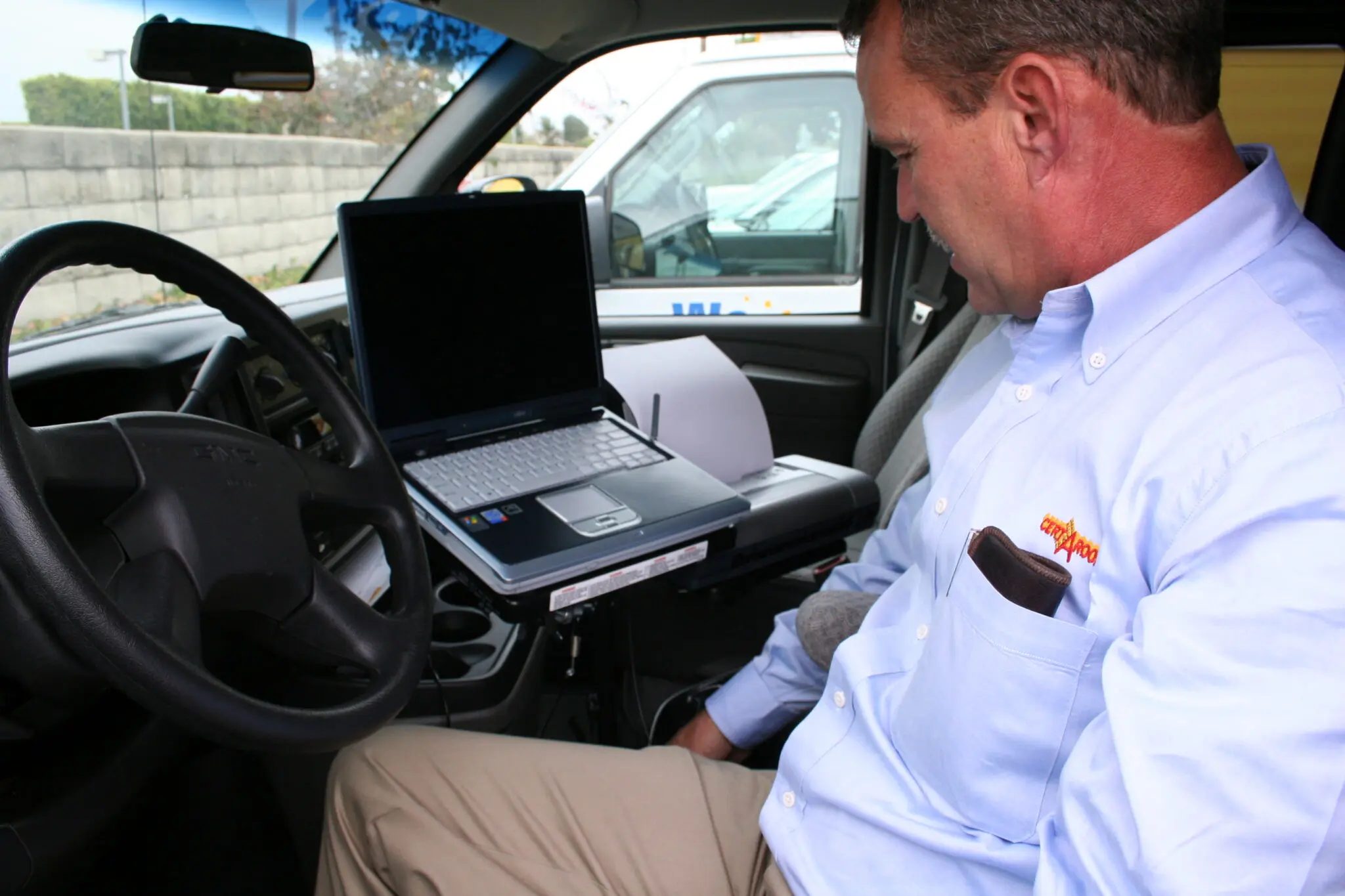
Cert-A-Roof founder Les Watrous showing my dear friend Grady Bryant why Cert-A-Roof is a worthy franchise in a Cert-A-Roof mobile office — laptop mounted at the wheel, reports written on-site and filed immediately. Technology that made same-day certification possible, long before tablets or mobile apps were standard. © KAB/LSI
Our Cert-A-Roof franchise van picking up a Whiteman commercial concrete mixer in Seattle, WA for hip & ridge solid mortaring repairs. © KAB/LSI
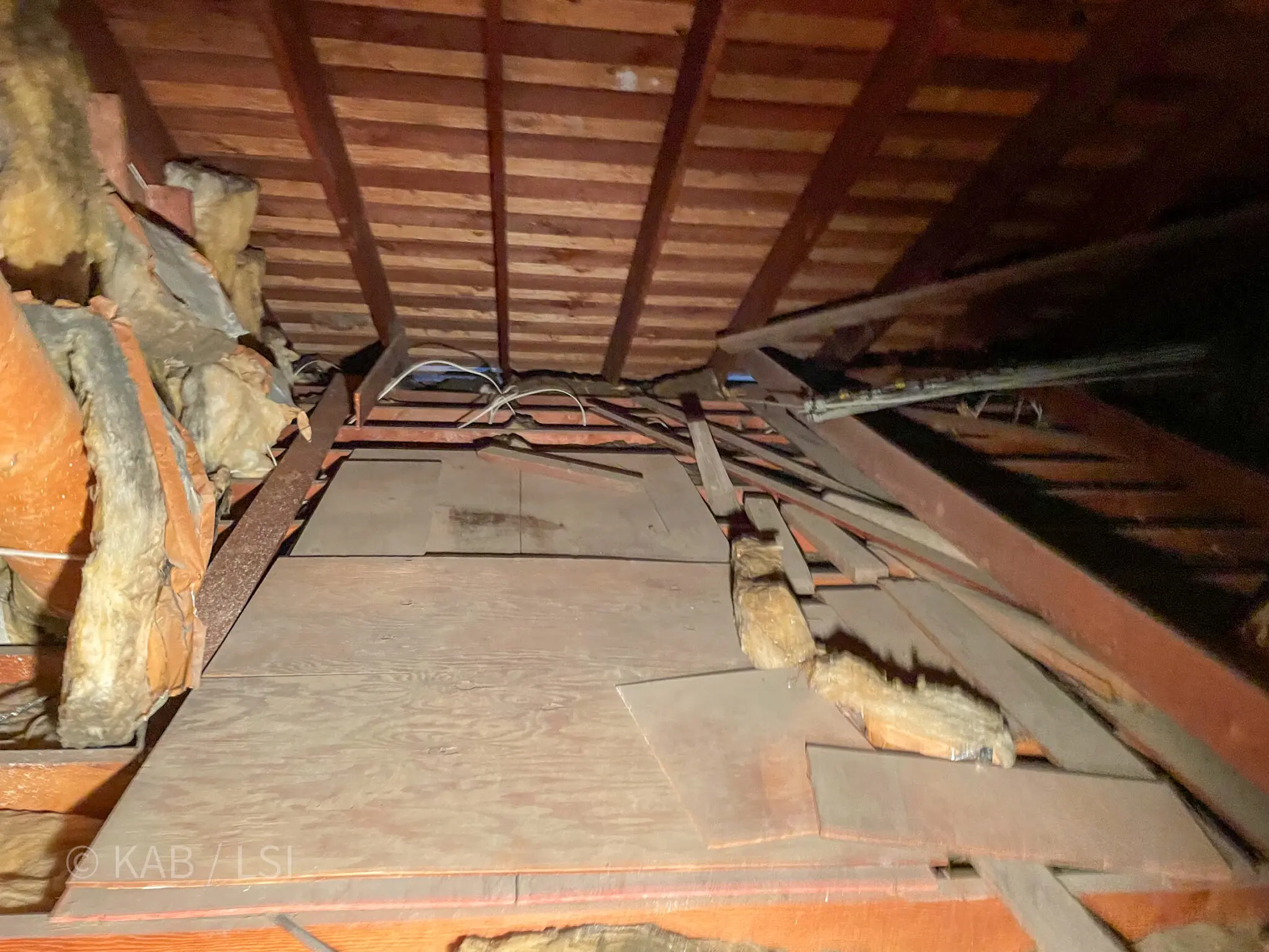
What the attic actually hides. Sagging roof rafters revealed during inspection — the kind of structural finding that doesn’t show up on a walk-through but quietly shortens the life of every component above it. © KAB/LSI
Where tile roofs actually leak. UV-damaged underlayment beneath clay tile — the tile is fine, the membrane underneath has failed. The homeowner sees a wet ceiling; the cause is 30 years of sun on asphalt felt. © KAB/LSI
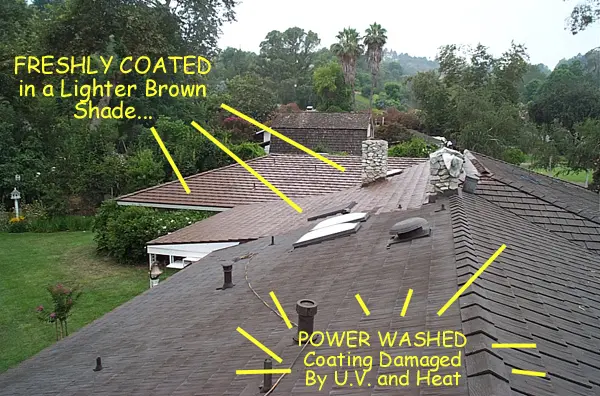
How to read a roof the way a report should. Annotated close-up showing UV-degraded coating on the left versus restored coating on the right — the kind of side-by-side a Cert-A-Roof report was supposed to deliver. © KAB/LSI
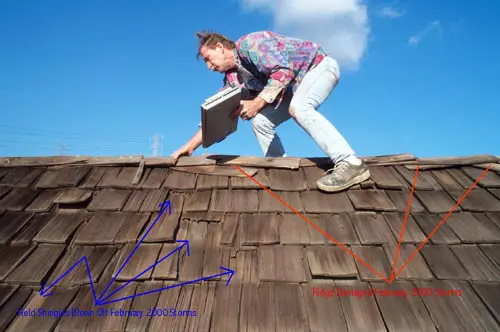
Early detection at the ridge. Dora and Dan inspecting main ridge damage — the ridge is where wind and water first find their way under the roofing plane. Catching it here is the difference between a simple repair and a tear-off. © KAB/LSI
The RV garage decades — anticipating what homeowners would want next
The acre-lot owners didn’t want a bigger house. They wanted a separate room with a roll-up door — and somewhere quiet to put the truck, the boat, the project car. I built them that awesome space — and the buildings, the lessons, and what comes next.
By the mid-2000s, buildable land in core Southern California was essentially gone. New construction had pushed out to Riverside and San Bernardino — too far for most working families. I became convinced that the answer wasn’t moving farther out, but making better use of what people already owned.
Our first test case was personal. In 2000, my wife and I bought a property in La Mirada on a cul-de-sac — the kind of pie-shaped backyard you only get when a street ends against a hillside. We dug into the hill, poured a twelve-inch concrete retaining wall on two sides, and shoehorned in a 20′ × 60′ RV garage where the lot opened up at the back. Plumbed for sewer, with a bathroom, a cleanout, and a full hookup. While we were at it we added a bedroom, a bathroom, and a laundry off the back of the house. That was the prototype. We built it for ourselves because we wanted to see whether the math worked when we were the ones paying for it.
It did. Seven years later we built the second one for a client — a La Habra Heights homeowner taking a second bite of the apple. She bought a half-acre corner property in West Covina with a 1950s house on it, and we did the full whole-house makeover plus an ADU, a two-car garage, and the 20′ × 60′ RV garage off the back. The RV garage had full electrical hookup, gray water and black water plumbed into the local sewer (West Covina has municipal sewer; in La Habra Heights the equivalent connection runs to a septic system). What we found confirmed the theory: people will specifically seek out a property because it has an RV garage. A million-dollar coach doesn’t have to sit in a storage yard. It can serve as a guesthouse, a private retreat, or a place for a grown child to land softly when they need to start over. Those are real solutions for real La Habra Heights lots. The West Covina property has been continuously leased ever since — eighteen years and counting, paying her own income and underwriting the lifestyle she lives up here on the hillside today.

The Foretravel luxury coach this garage was designed for — protected, plugged in, and available as a guesthouse or private retreat year-round. A million-dollar coach doesn’t belong in a storage yard. © KAB/LSI
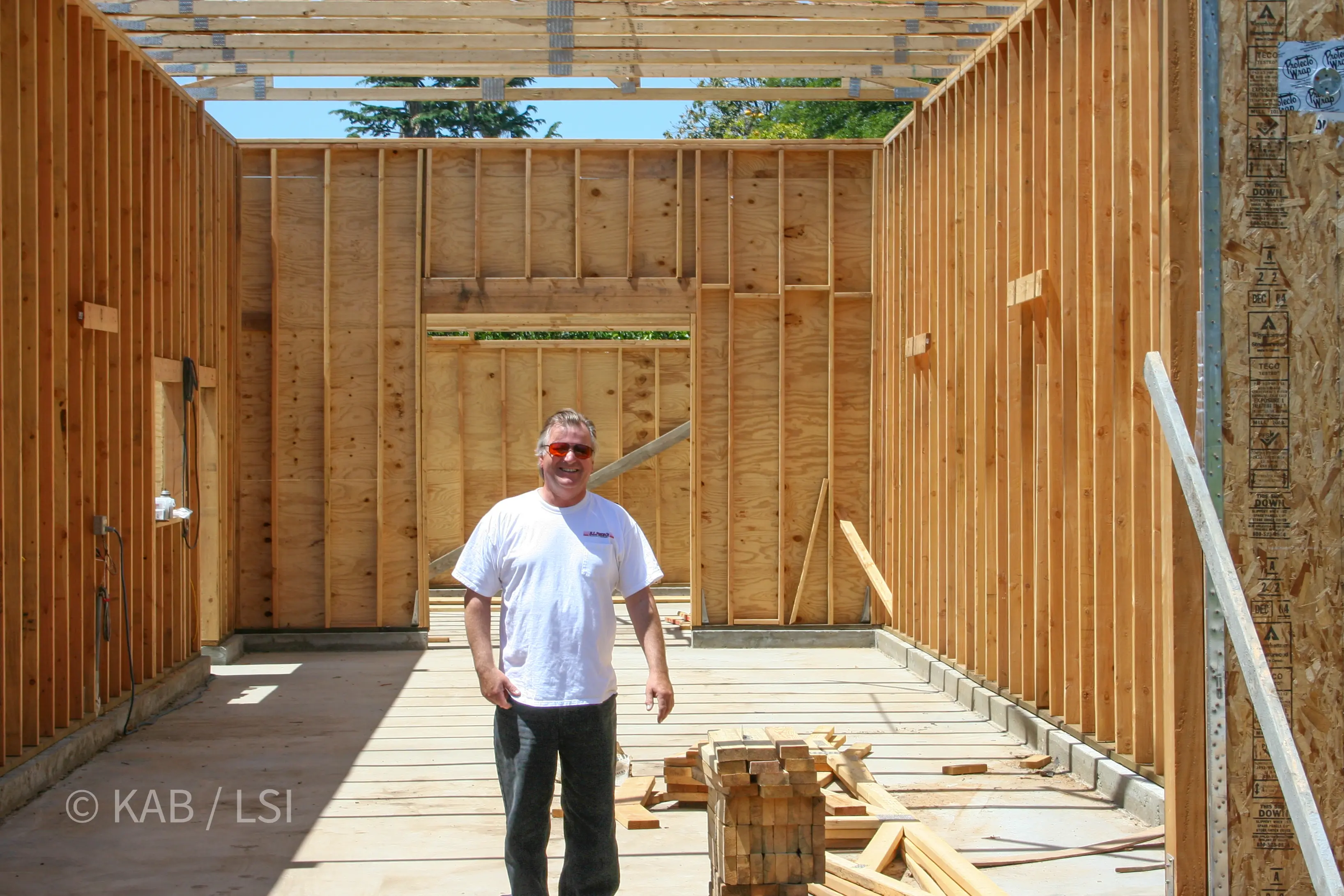
Kenny in the 60-foot-deep framing — 20 feet wide, engineered shearwalls, roof trusses spanning the full depth. Built to house a coach and serve as a guesthouse. This is what this chapter is about. © KAB/LSI
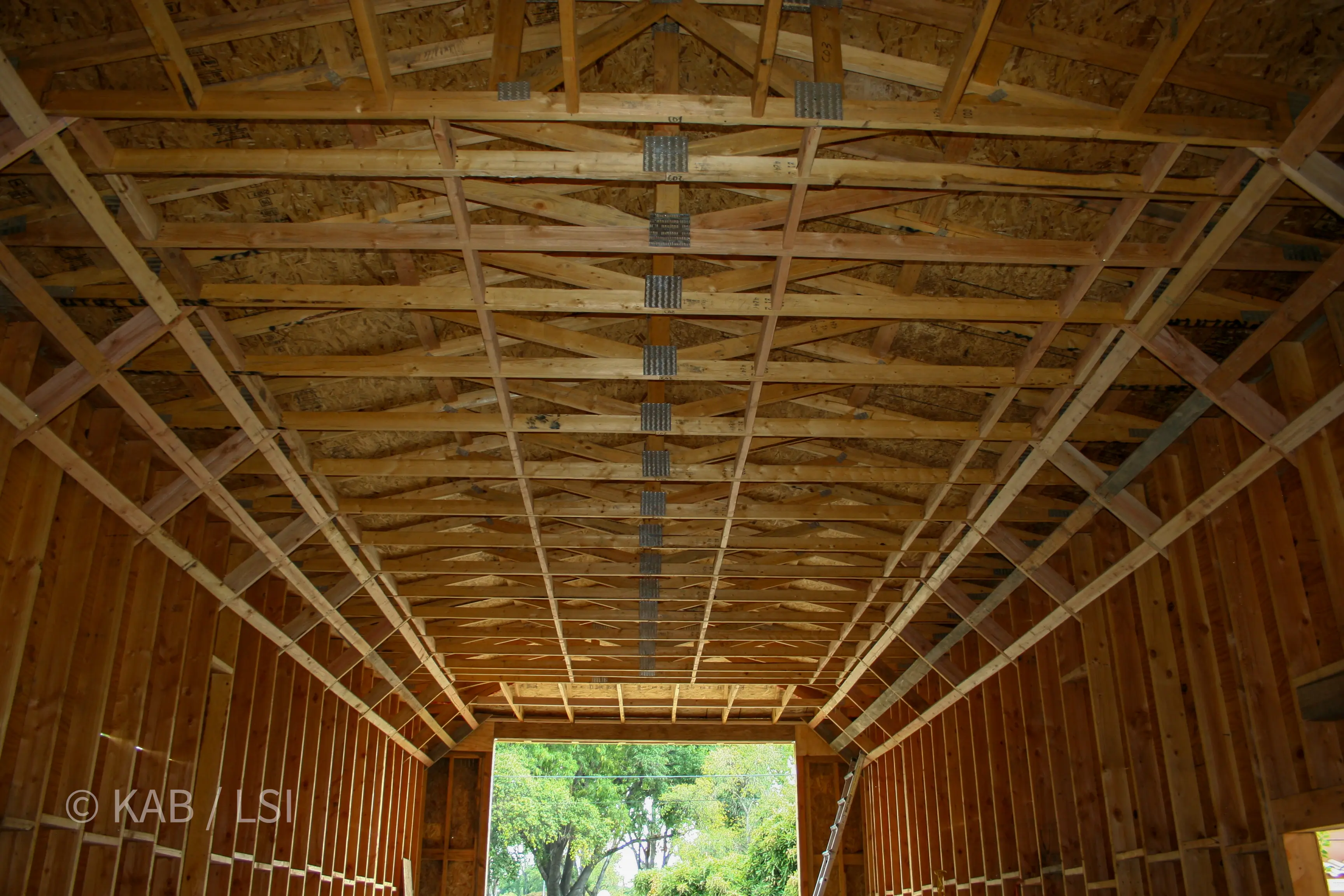
Looking up. Engineered roof trusses with seismic diagonal bracing, spanning the full 60-foot depth unsupported. A car garage is 20 feet deep. This is three of those, end to end, with nothing in the middle. © KAB/LSI
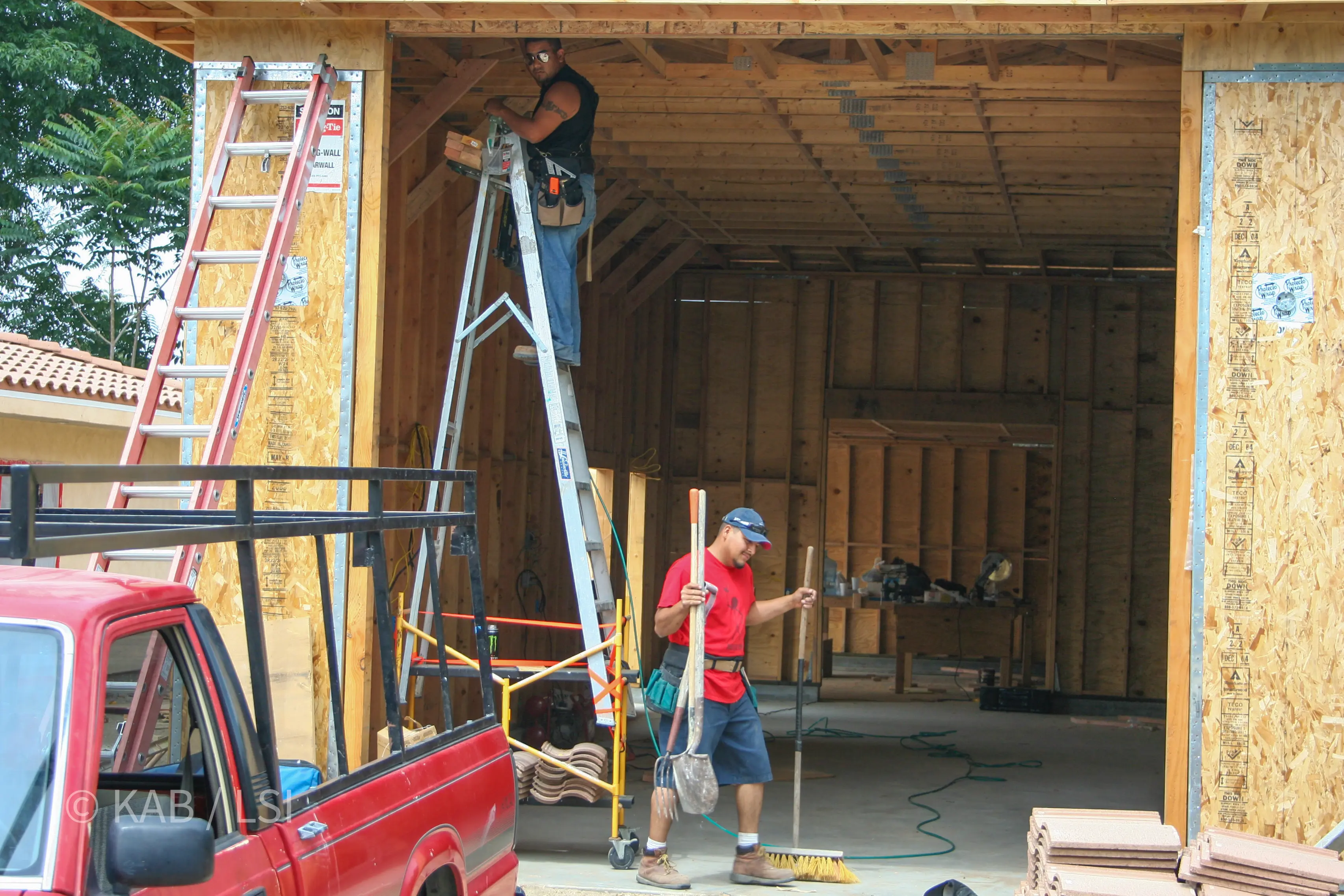
Finish stage at the entry. One crew member on the tall ladder working the header, another sweeping the slab clean. The garage door opening alone is taller than most single-story rooms. © KAB/LSI
Kenny showing the space to his diesel-mechanic friend — a man who spends his days under big rigs nodding at what he’s seeing. When your mechanic friend is impressed, you built the right garage. © KAB/LSI
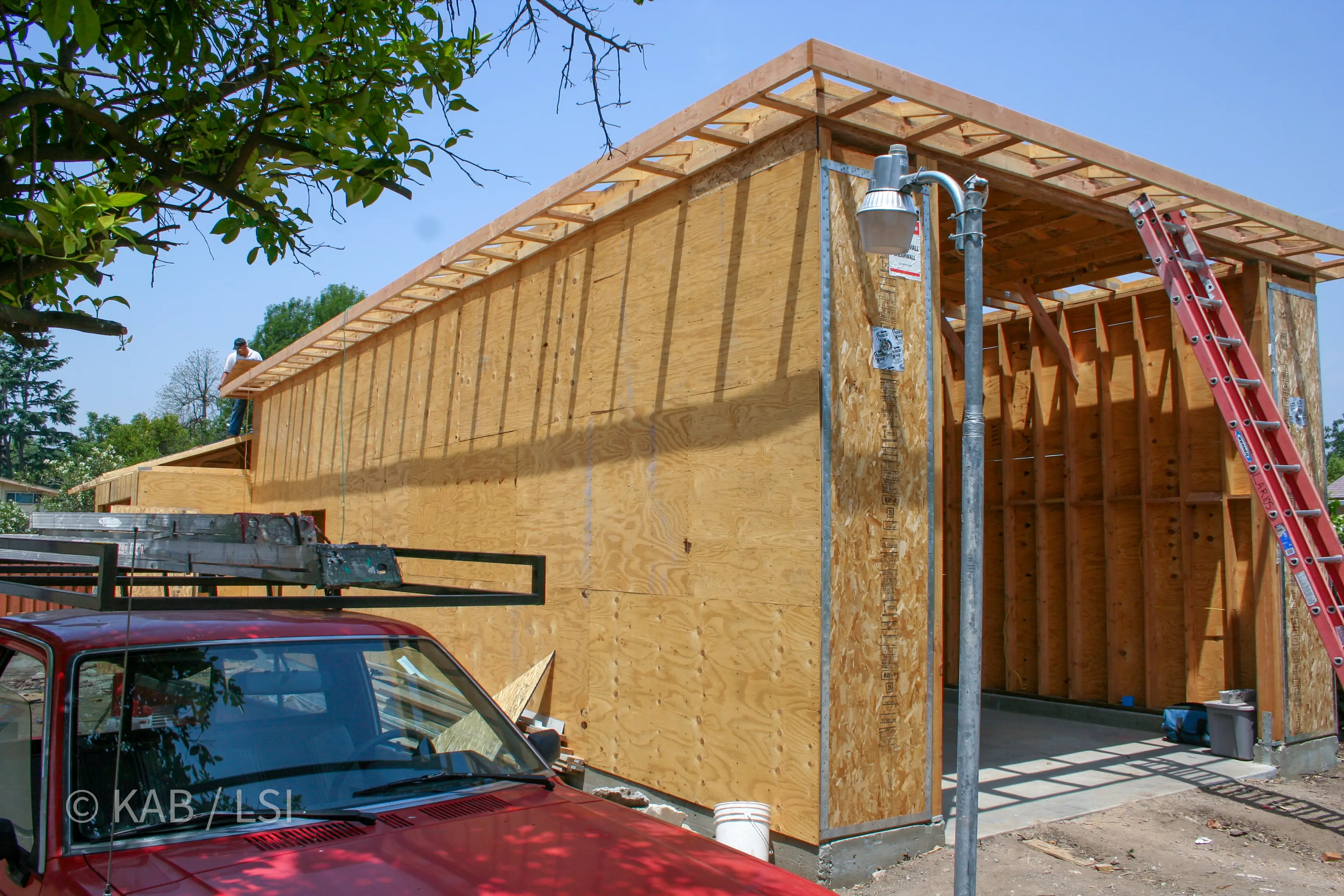
Exterior sheathed and ready for framing inspection. Strategic sheathing omissions at the overhangs so the inspector can verify hardware without having to open anything up. © KAB/LSI
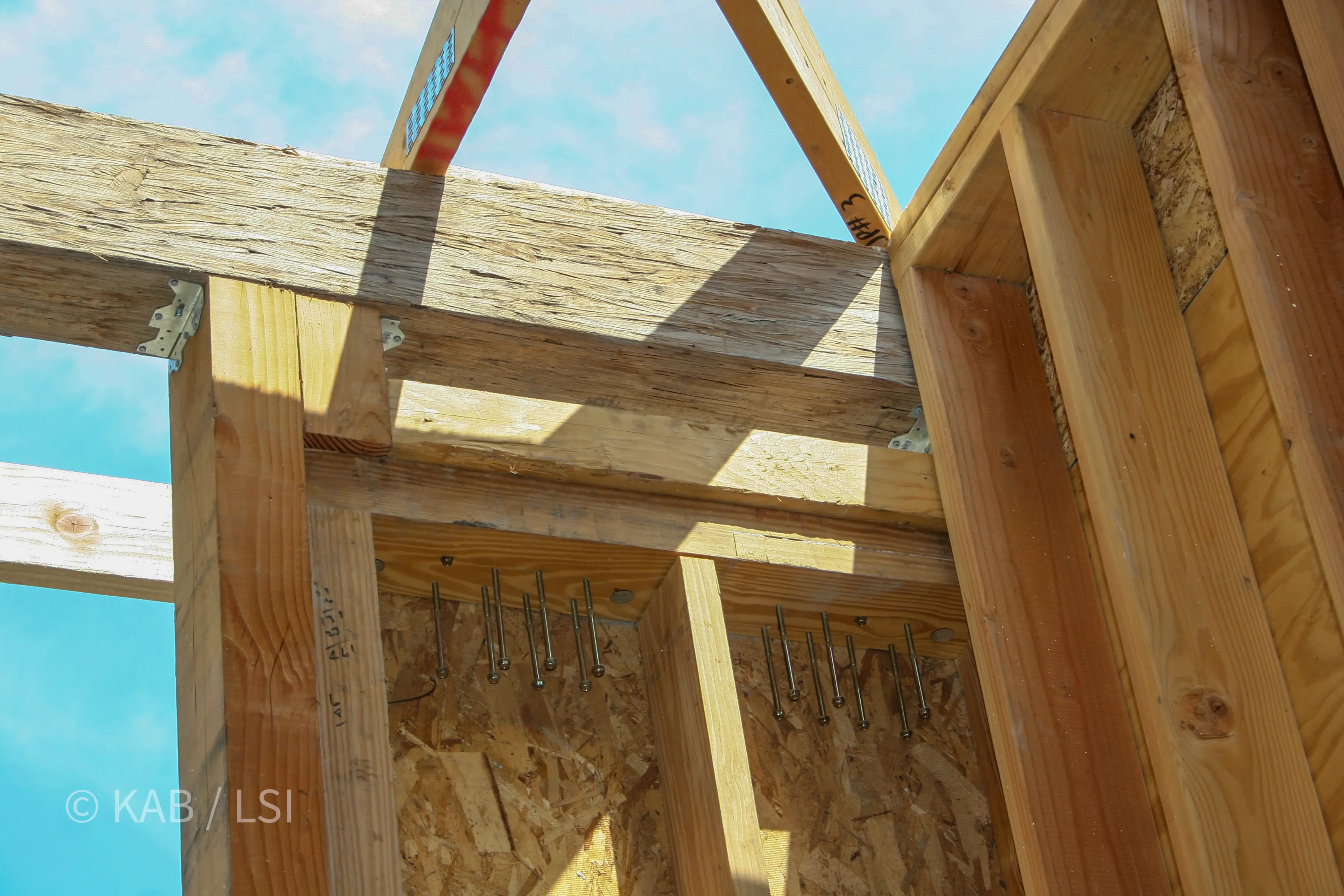
Seismic tie-down bolts protruding from the sheathing at the ridge. This is how a 20×60 garage with a 14-foot door opening stays standing when the hillside moves. Engineering first, finish later. © KAB/LSI
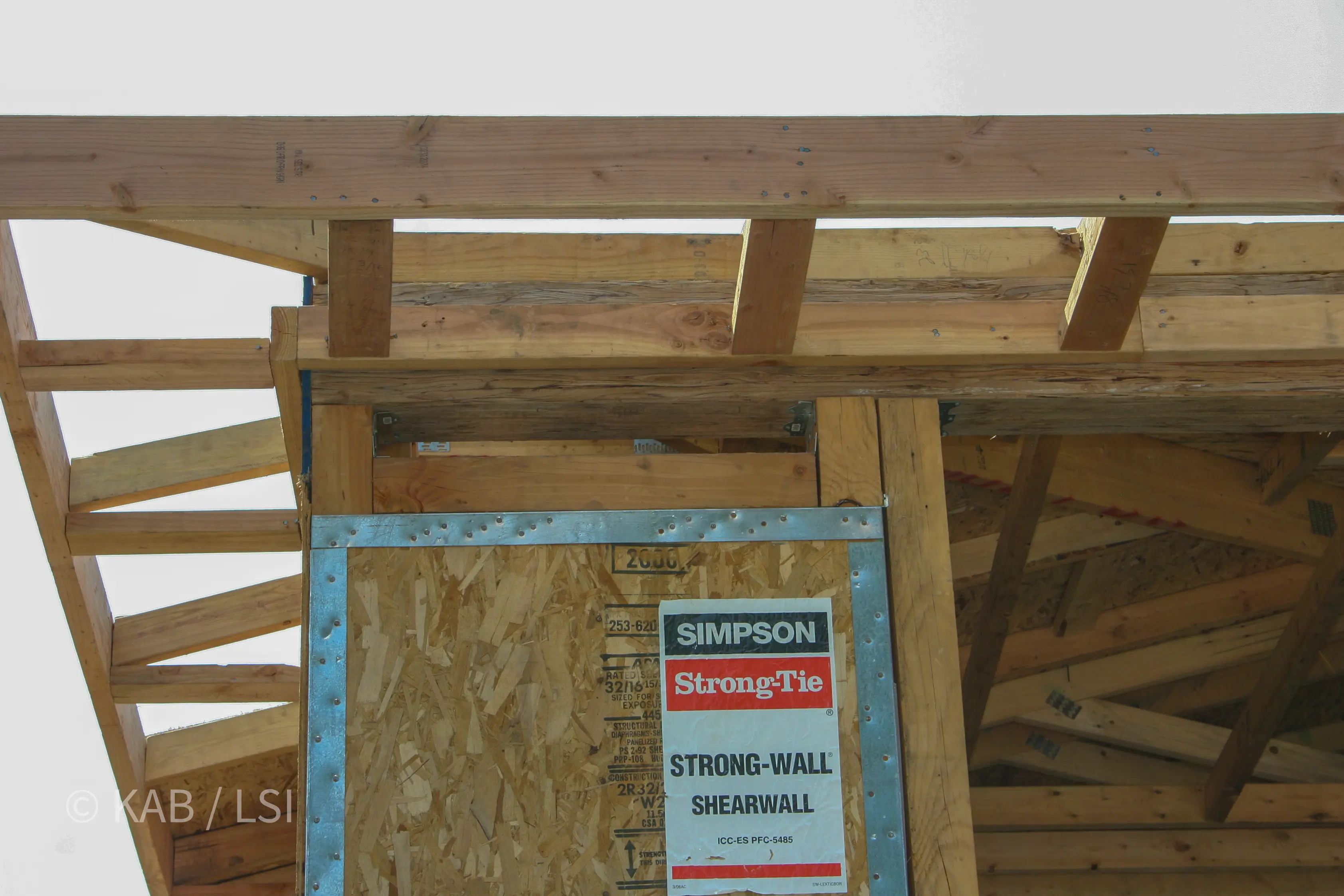
The engineered hardware behind the span. Simpson Strong-Wall shearwall with ICC approval number — the product that makes a wide-opening RV garage possible on a hillside property without adding massive posts in the way. © KAB/LSI
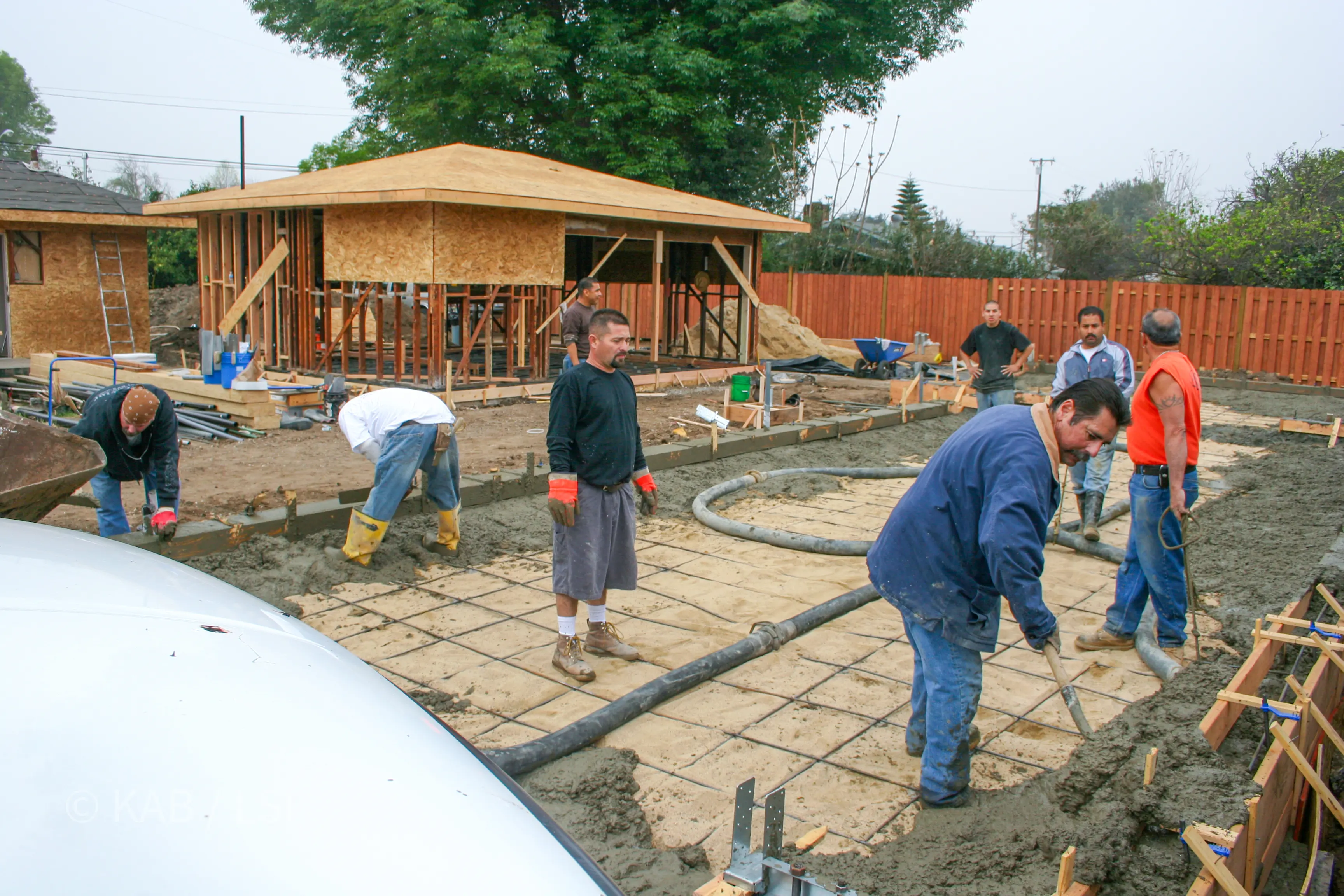
The eight-man crew on the monolithic pour. Perimeter footing, stem wall, and slab in one continuous operation — the only way to get a truly level, crack-resistant surface for a coach that weighs as much as a house. © KAB/LSI
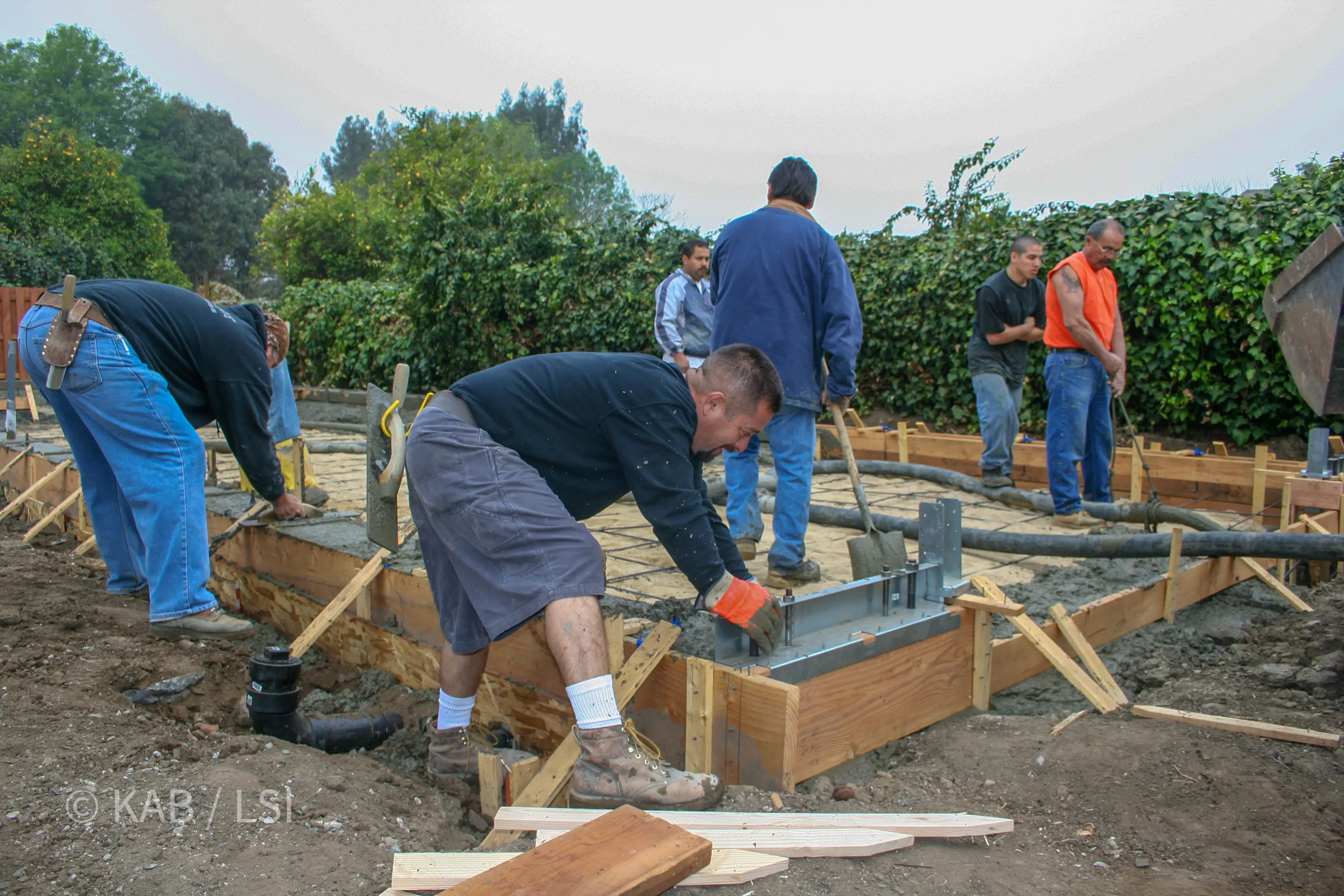
Finishing the stem wall at the Strong-Wall corner. The anchor bolts you see embedded here are what the shearwall hardware will thread into. Every connection detailed before the concrete flashes. © KAB/LSI
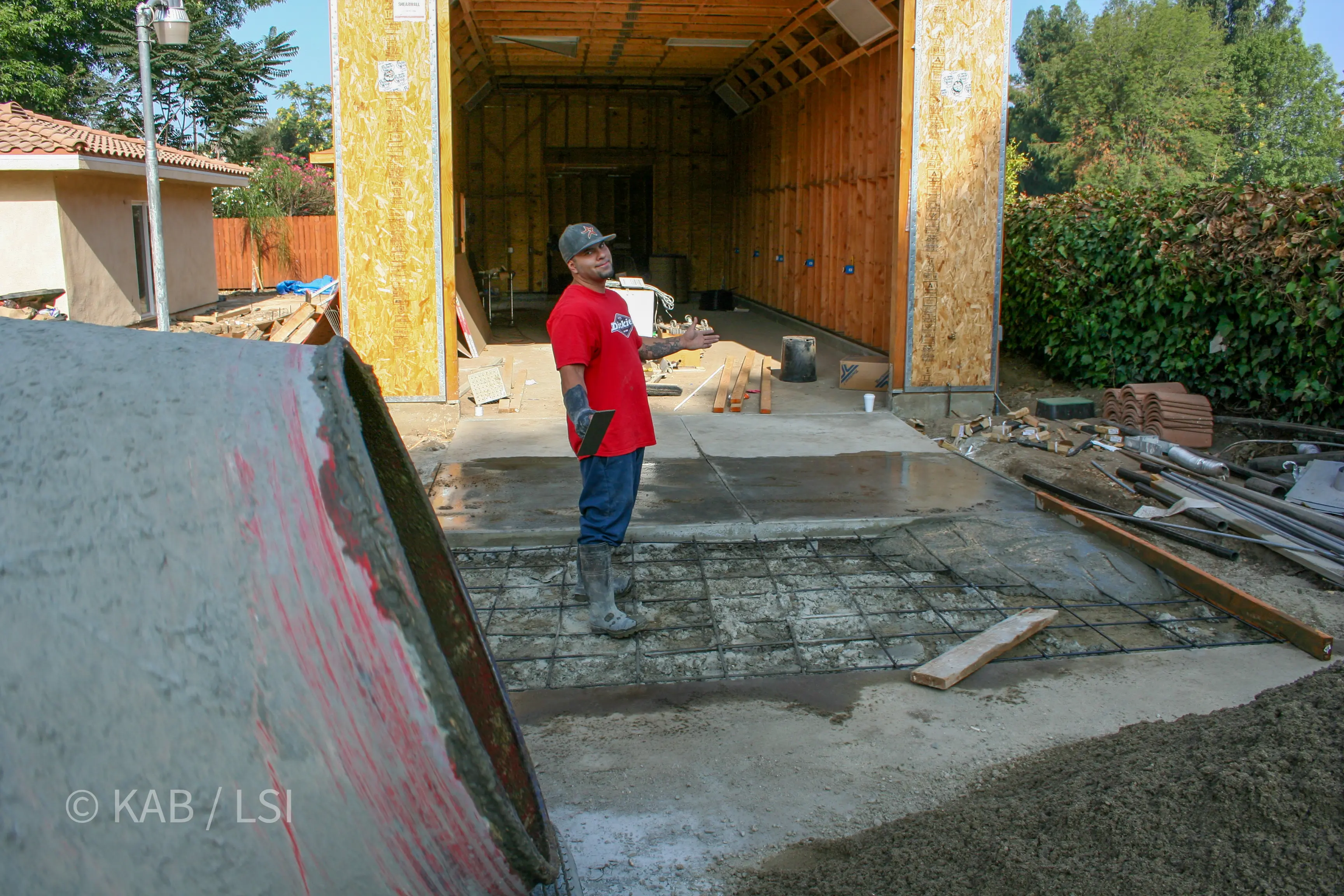
The apron pour outside the garage door. Reinforced wire mesh, proper slope for drainage, a surface engineered to hold a coach’s jack pads without telegraphing. The driveway is part of the garage. © KAB/LSI
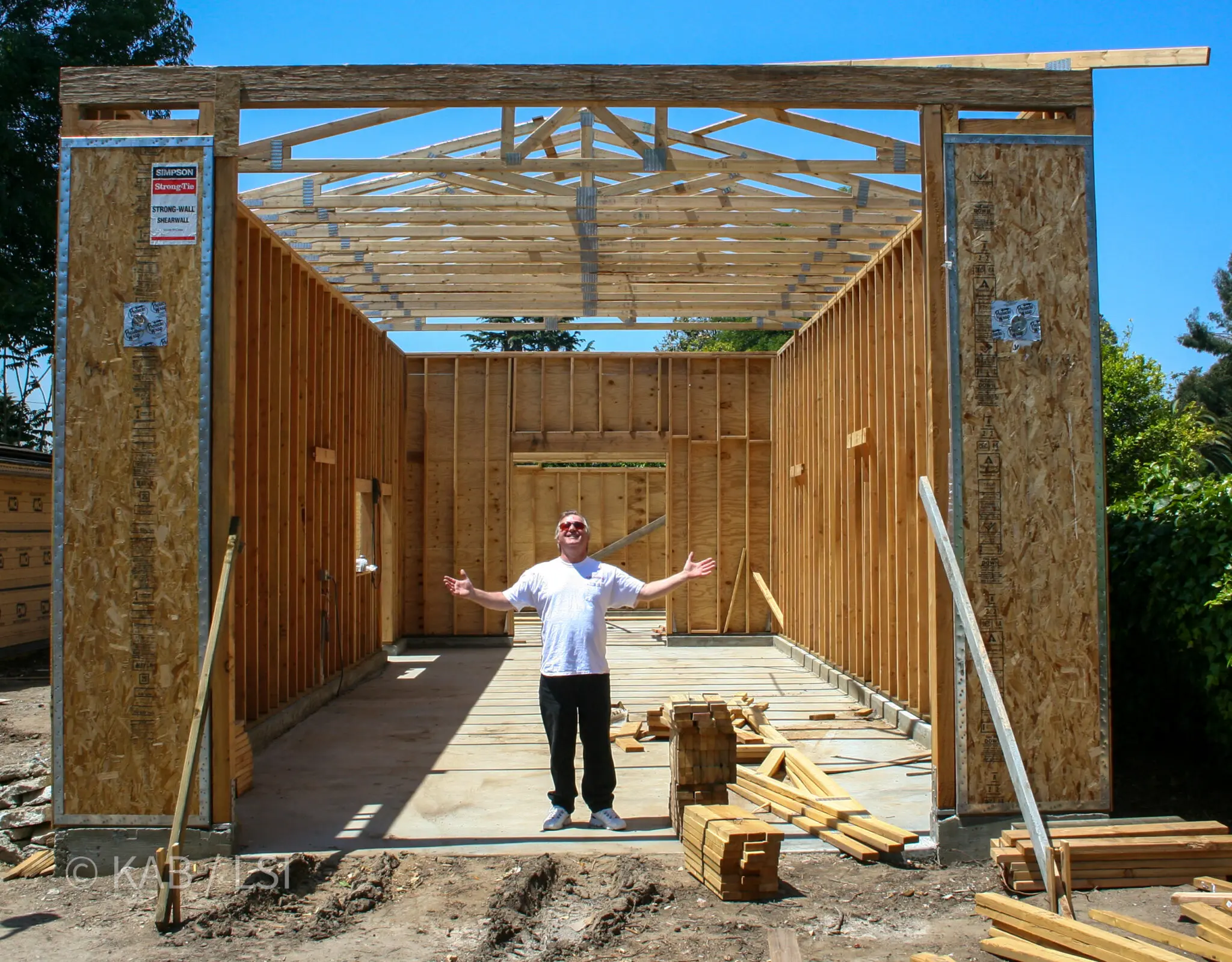
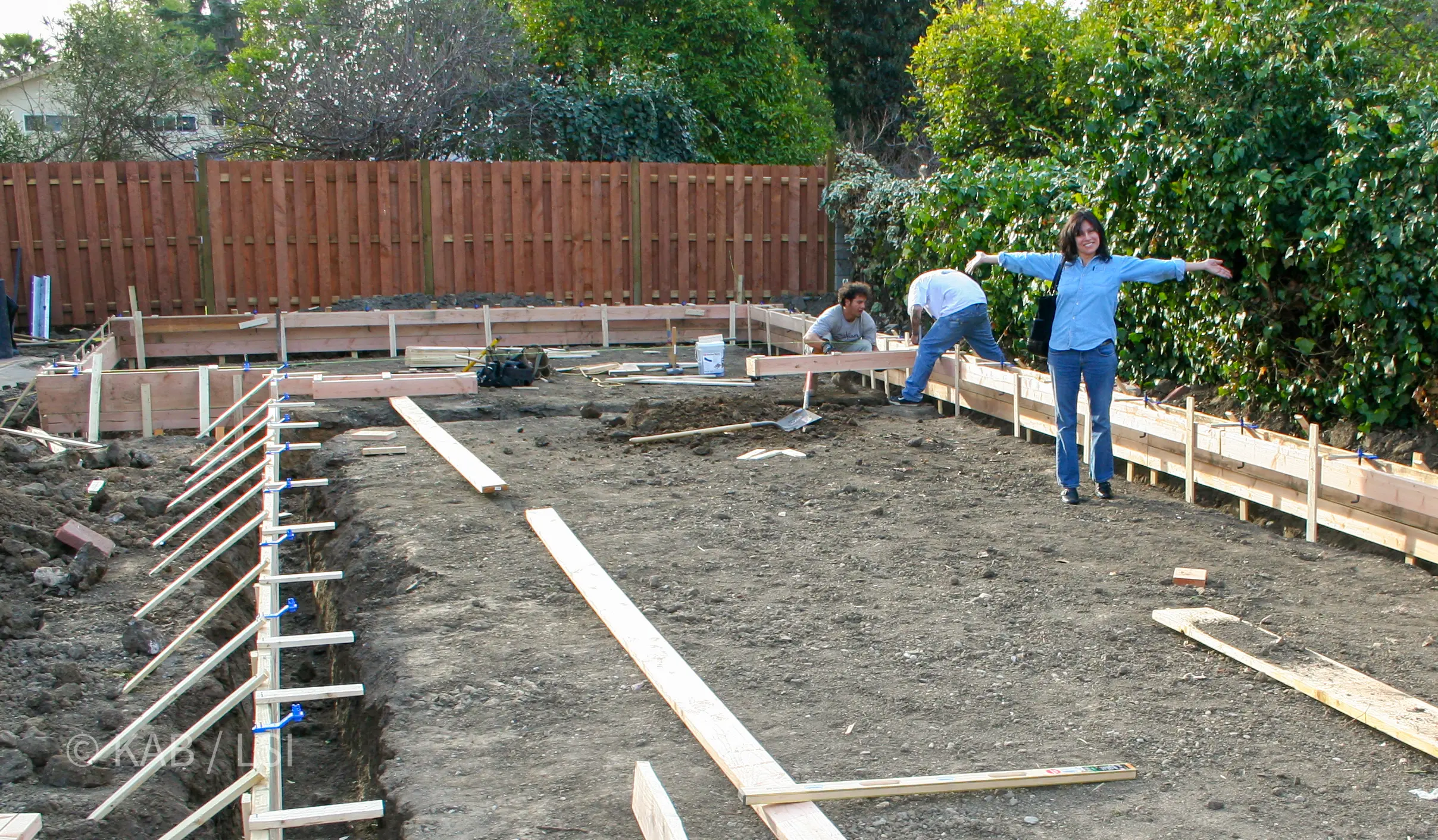
Where it started. Linda, arms wide, standing on the first 25 feet of her future 60-foot-deep RV garage. Dirt, forms, conviction. Every finished building on this page started exactly like this. © KAB/LSI
What we learned from those two builds — La Mirada first, West Covina seven years later — became the foundation of everything that followed. The interior height, the door width, the slab depth, the plumbing layout, the way the building had to sit on a lot to actually function for the lives people wanted to live — we figured it all out by building one and watching it work.
Twenty years and dozens of structures later, the answers don’t fit in this chapter. The longer conversation — how an RV garage actually works, what it costs, what it becomes — lives on its own page. Visit RV Garages →
Forty-five years in, I stopped building. I started watching. The neighbors who’d watched me work for decades started calling.
That’s how I got here. Now — what we do today.