The Hillside Network
Who is on it
Not a vendor list.
Not a directory.
Names and introductions happen in conversation — usually on the property, sometimes over coffee.
After forty-five years on the La Habra Heights hillside, you build a quiet network. A handful of people I have watched do honest work on hard properties — and a handful of professionals who solve the kinds of problems hillside owners do not expect to have until they are sitting in them.
This page is not a phone book. There are no names below, no numbers, no links to anyone’s website.
What this page does do is name the kinds of help that exist up here. Most owners in La Habra Heights do not know half of these doors are open, or what they cost when a neighbor opens them instead of a stranger.
01
Start here — this one has a clock
The one thing
you forgot to look up at.
Two men, one on the ground and one in the tree. Under an hour of actual work.
You knew May 1 was coming. You had the weed eater out and your son-in-law over for the weekend. You went through the City’s brochure picture by picture — dead shrubbery, castor bean, tumbleweeds green and dead, discarded limbs and refuse, chaparral, arundo. You even caught the California tobacco plant before it took the slope.
Then the inspection notice arrives with a photograph of your queen palm on it.
Dead palm fronds are on the same list. You never looked up, and neither did your brush crew — they do not carry climbing gear, and a palm is not something you send a man up without it. Besides, you had it done. Three years ago. Four, maybe.
Now it is May, every tree service on this hill is booked by every other property that got the same notice, and the quote is a thousand dollars. Twelve hundred. For one palm. And you have seven days to send the inspector proof it is done.
That is not a price. That is a hostage negotiation. And it happens every April, May and June, to somebody on every road up here.
If nobody answers the notice — you are on a cruise, you are with a parent in the hospital, you simply missed it — the City can clear the property itself. The brochure is blunt about it: the City has the authority to abate without prior notice and/or approval of the property owner. That is a crew of five or ten men on your land, working to their standard and not yours. And the bill is not the couple of hundred you handed your son-in-law.
What the City charges, from its own 2026 schedule
Unpaid, it goes onto the Los Angeles County property tax bill. There is, in the City’s words, zero tolerance. Read the 2026 brochure →
I do not take that work and I make nothing from it. But I know a licensed tree company that will do a queen palm properly for three to four hundred dollars, most any day of the year — a little more if two have grown together or it stands against a power line. They gave me their word on that price. The fair thing, if they hold to it, is to send them the rest of your tree work the other nine months of the year.
And if you already have someone who does palms in that range, tell me. I will go look at their work, and if it holds up they can bless a lot of neighbors up here.
02
The part you should read twice
How this works,
and what it is not.
It is not a certification. It is one man who watched them work and would use them again.
I am not connected to any of these people. No contracts, no arrangements, no finder’s fee — I do not make a dollar when you hire one of them, and I would not know if you did.
I offer no warranty and no guarantee on their work, and I take no responsibility for it. The relationship is yours.
What I do is look first. I have interviewed nearly everyone on this list. Most of them I have filmed on an actual job — my property, or a neighbor’s — and photographed while they worked, before I ever considered passing the name along.
03
What people call about
The roof, and what
is under it.
Nobody looks up at their own rafter tails until escrow makes them.
Tile roof repair
Broken tiles from pest-control tenting and solar crews. Repair, not a new roof.
Someone I’d call todayReroofs
When repair genuinely is not enough.
Someone I’d call todayRotted rafter tails and overhangs
The spruce tongue-and-groove under the eave.
Someone I’d call todayRoof cleaning, painting, coating
Extending a roof that is sound underneath.
Interviewing now04
Water — in, out,
and away.
No sewers up here. Everyone finds this out eventually.
Plumbing and re-piping
Whole-house repipes and the ordinary emergencies.
Someone I’d call todayMeter-to-house service line
Long hillside runs, easements, and the pressure you lose along the way.
Interviewing nowReducing incoming pressure
One hundred twenty PSI at the meter is common. Fixtures are not built for it.
Interviewing nowWhole-house filtration and softening
The water is extremely hard. This part is buildable.
Someone I’d call todayTankless and instant hot water
At the kitchen sink, the dishwasher, the laundry.
Interviewing nowWater storage tanks
For fire. Independent of the utility.
Interviewing nowSprinklers
Irrigation and fire suppression both.
Interviewing nowHillside drainage and French drains
Where the water goes when it is not going where you thought.
Interviewing now05
Ground and
hardscape.
Poured on clay that moves, by people who know it moves.
Concrete pads
For sheds and outbuildings. The part nobody budgets for.
Someone I’d call todayConcrete finishing
The difference between a slab and a surface.
Someone I’d call todayConcrete driveways
Poured on clay that moves.
Someone I’d call todayPaver driveways and walkways
Set properly, on a base that holds.
Someone I’d call todayExterior walkway and deck tile
Outdoor tile that survives a hillside winter.
Interviewing nowBlock and brick retaining walls
Holding a slope where a slope wants to move.
Interviewing nowPatio decks
Wood and composite, on grade and elevated.
Interviewing now06
Inside
the house.
Setting tile and finishing drywall are two different trades. Usually two different people.
Bathroom and kitchen tile
Setting, not just supplying.
Someone I’d call todayHousekeeping
The trusted local kind, by referral only.
Someone I’d call todayHandyman
The half-day problems that never justify a contractor.
Someone I’d call todayCustom kitchen and bath cabinets
Built for the room rather than ordered for it.
Interviewing nowGranite and marble
Fabrication and installation.
Interviewing nowDrywall install and finish
Two different skills.
Interviewing nowPainting
Interior and exterior.
Interviewing nowDoors and windows
Including French doors out to a secured space.
Interviewing now07
Comfort, power,
and new structures.
Heat one room instead of five empty ones. Start with the bedroom.
Heat pumps, inverters, mini-splits
One room at a time, instead of running the old system through empty ones.
Interviewing nowHe sheds and she sheds
The room at the end of the path.
Interviewing nowFreestanding home offices
Under one hundred twenty square feet needs no permit in California.
Interviewing nowGuest houses
For the season somebody needs somewhere to land.
Interviewing nowADUs
Whether it is possible, and how long City Hall really takes.
Interviewing now08
The one you keep not buying
The shed is the cheap part.
The ground is not.
You have stood in that aisle twice and walked away, and it was never about the money.
You have seen them at Costco, at Lowe’s, at Home Depot. Nine hundred dollars, sometimes less. And you have walked away from one at least twice.
It is never the price. It is the arithmetic that starts on the way home. The box is enormous. Even borrowing your son-in-law’s truck, how does it come off at the other end? Up the driveway. Around the house. Out to the far corner of the acre where you actually want it. And then what does it sit on?
Most people answer that last question by raking the dirt level and setting it down. That does not work, and I tested it so you would not have to. The doors stop closing within a season. The panels rack. Clay swells through the winter and lifts one corner, and the nine hundred dollars becomes a nine-hundred-dollar mistake leaning in the back yard.
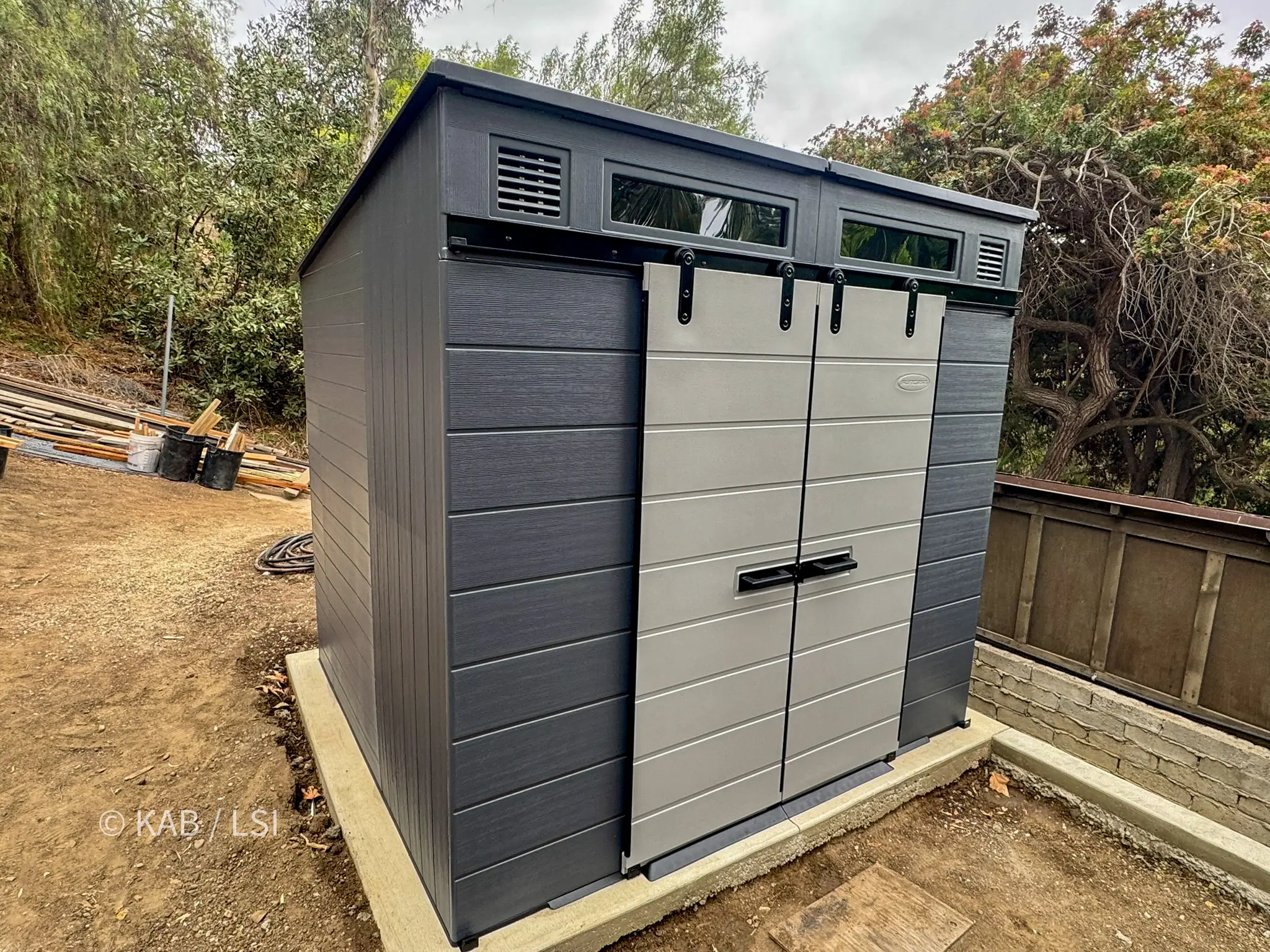
Three days from unused slope to this. The shed was the last day of it.
Here is the order that works. A concrete finisher comes out and decides with you where the shed goes and how large the slab should be — the same footprint as the building, or a foot or two proud so you are not tracking mud through the door, or a small apron so a hand truck can reach it. He digs out the clay, brings in gravel and road base, forms it, and pours. Concrete delivered, or mixed on site with a helper, depending on what your driveway will take. Then it cures.
After that a handyman collects the shed for you, opens the box, carries the parts to where it is going, and assembles it. Seven by eight feet is one day’s work for somebody who has built one before.
Want to see the three days?Open the sequence →
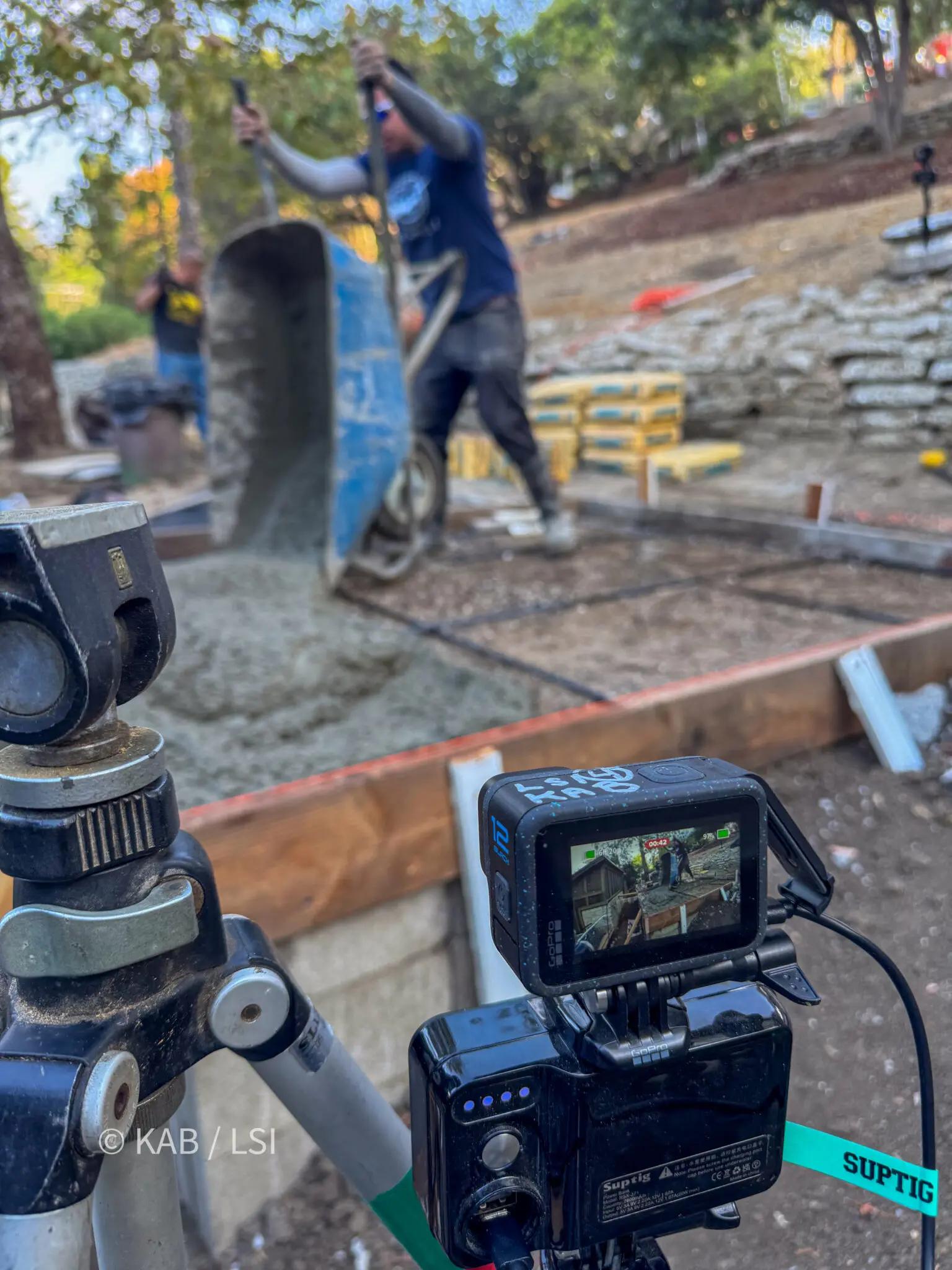
Mixed on site rather than delivered. On a narrow hillside drive that is often the only way concrete arrives at all.
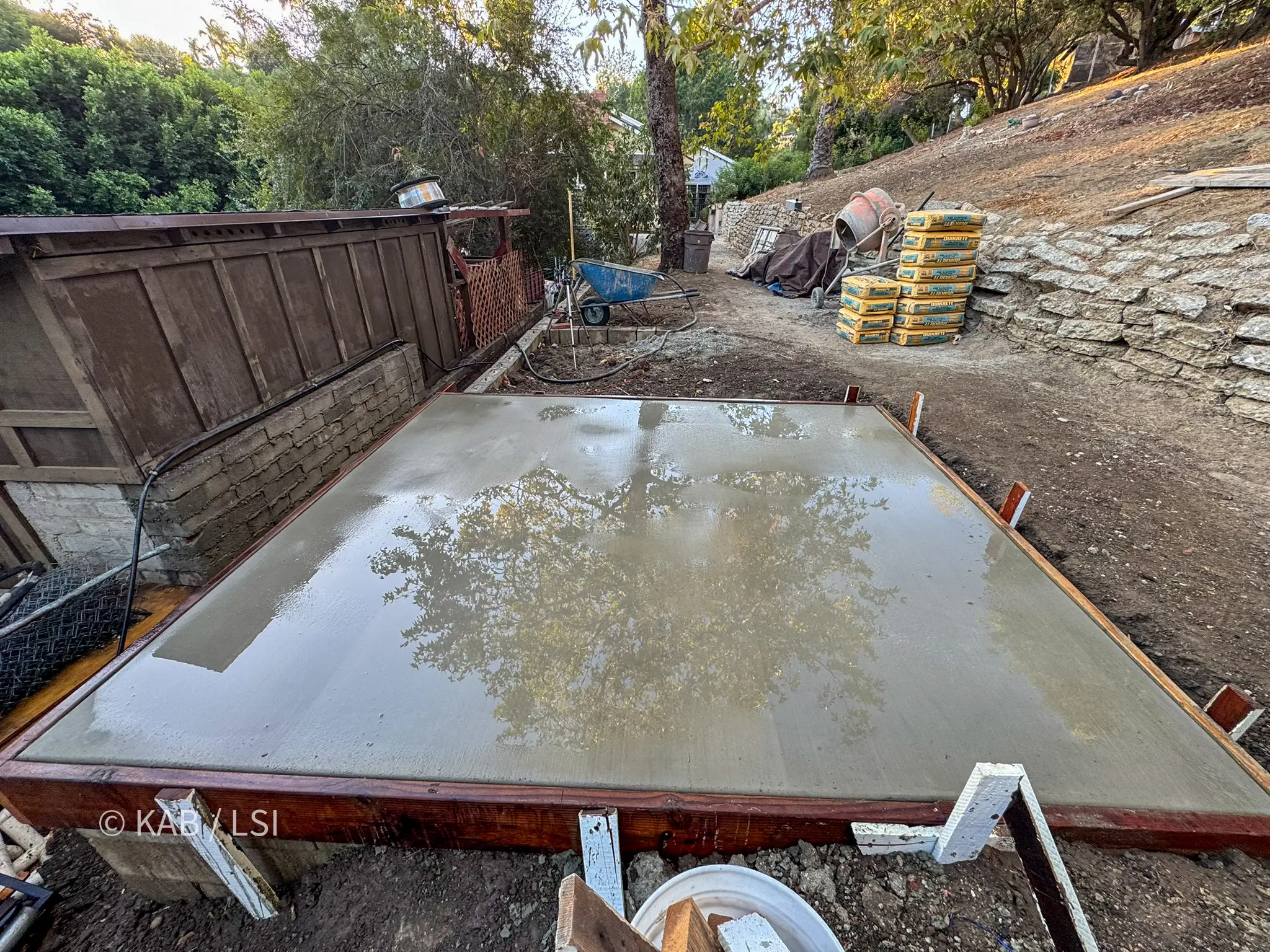
The finished pour. Compacted road base underneath, steel through it, and a surface flat enough that the doors still close in ten years.
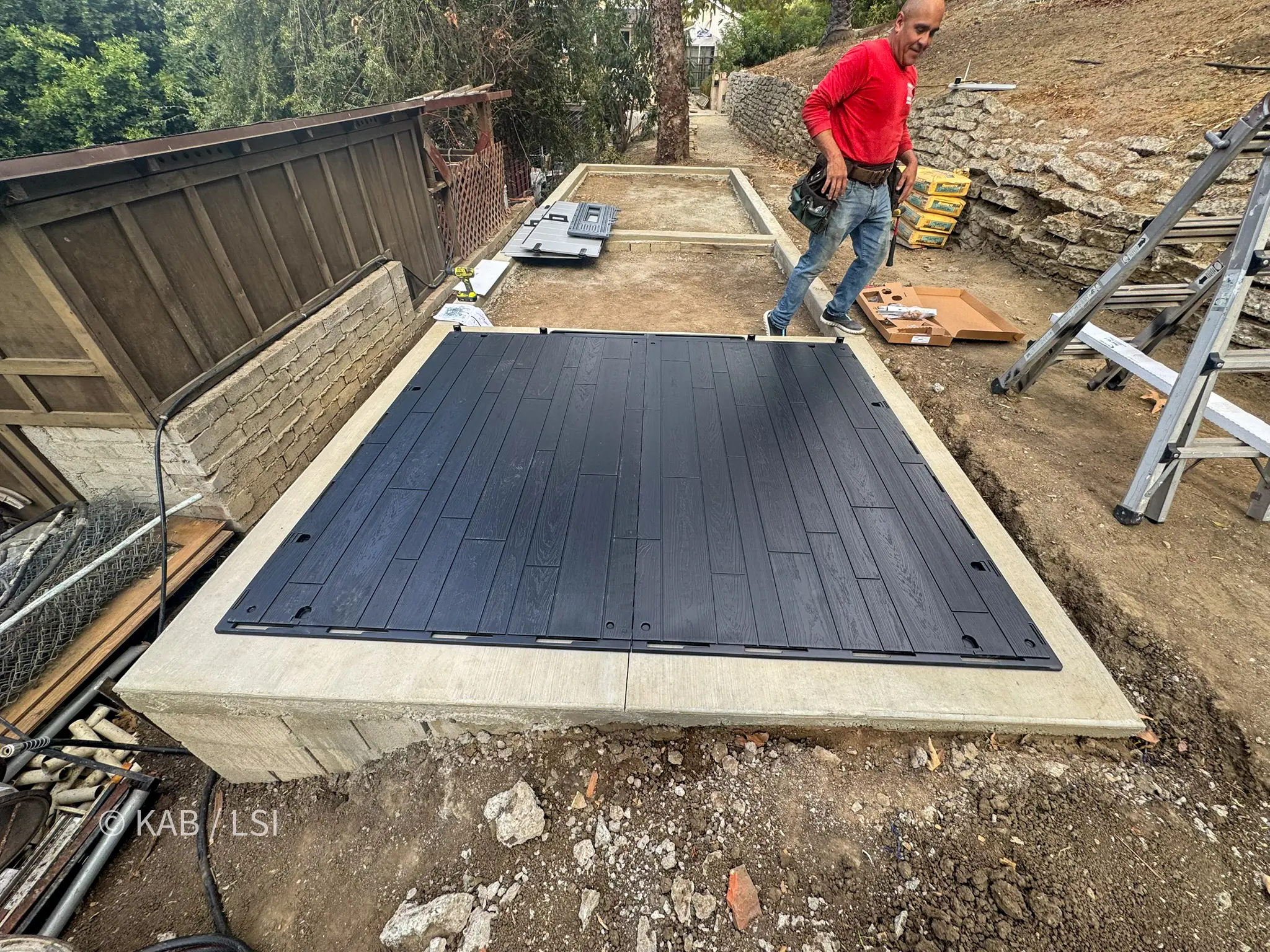
Assembly begins with the floor, laid straight onto the cured slab.
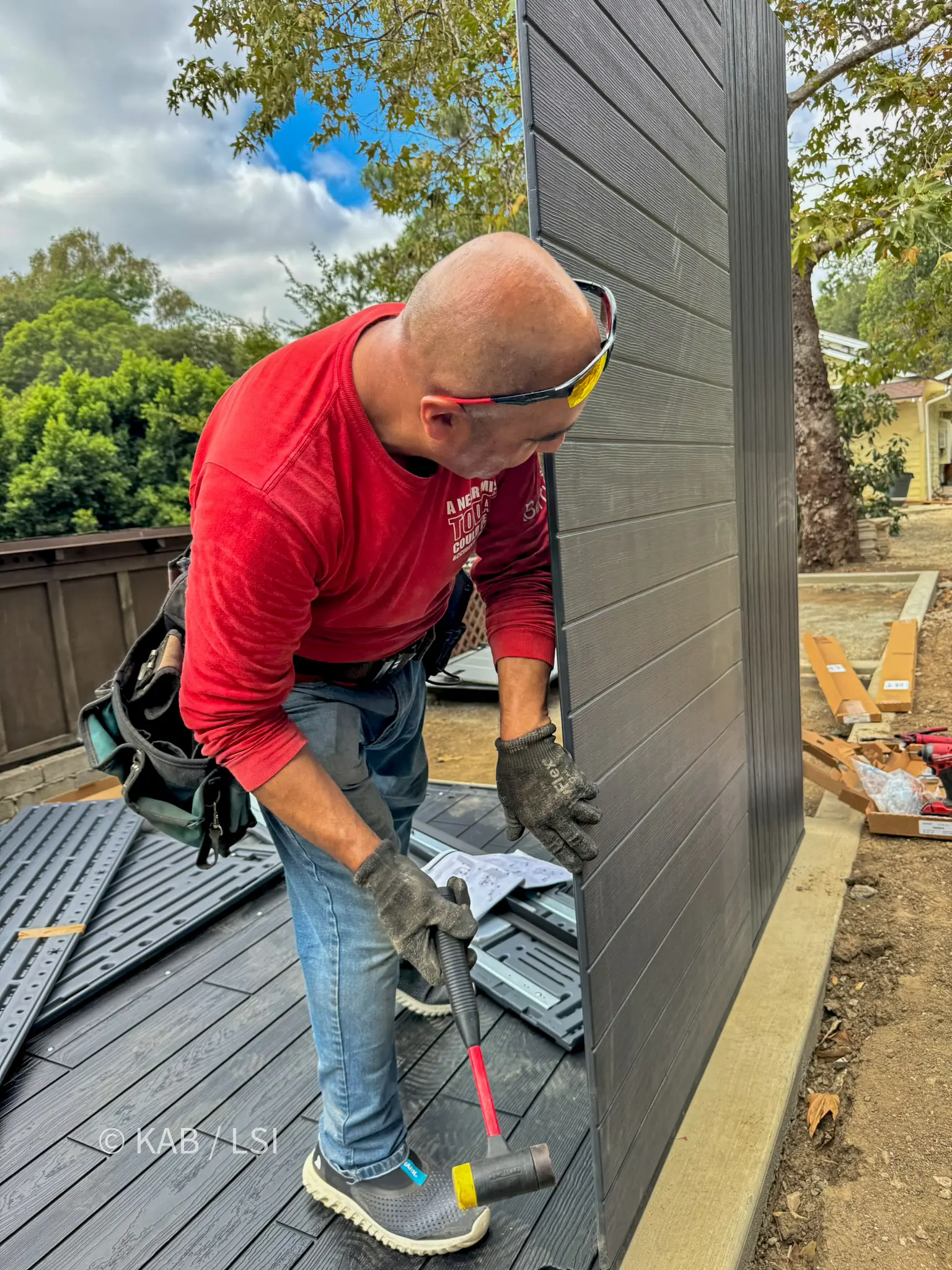
The first wall goes up. Everything after this is faster than it looks.
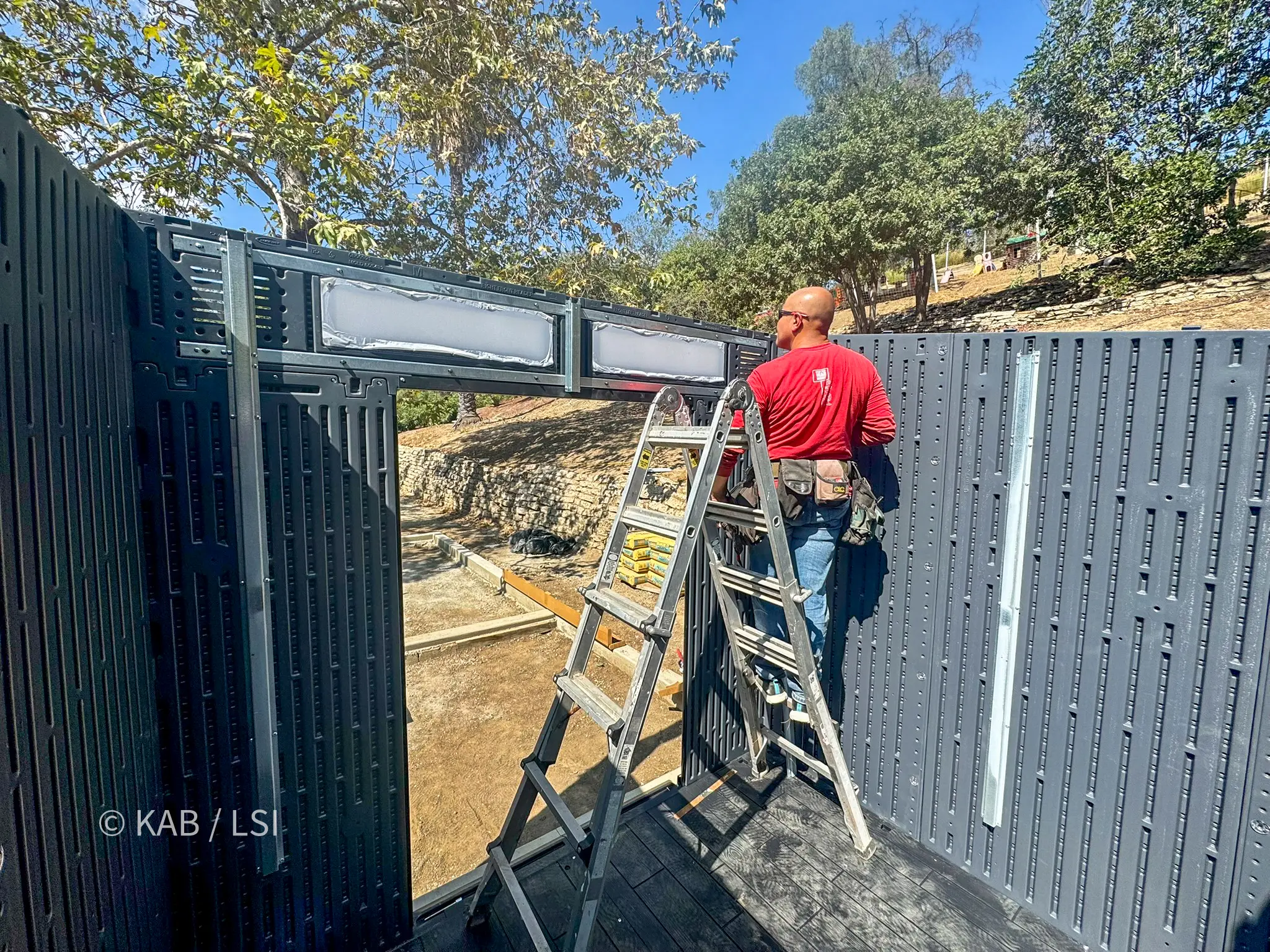
Walls take shape. One man, one day, no special equipment.
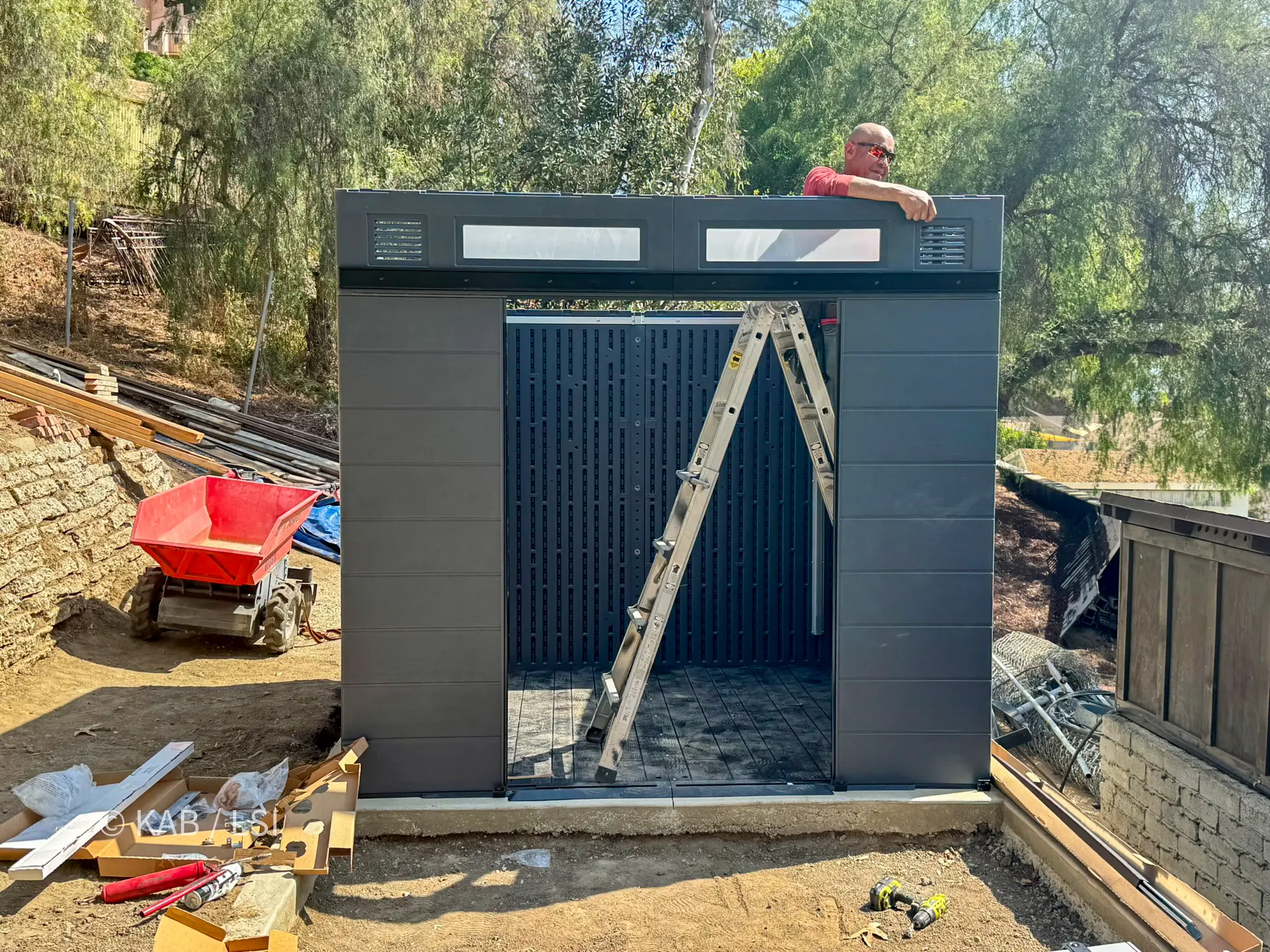
Structure closed, before the roof and doors go on. Then it is anchored to the slab against the wind.
The building can be a Lifetime from Costco, a Tuff Shed, a wood-framed shop, or something considerably larger. It changes almost nothing about the order of operations. The foundation is the investment that decides how well any of them performs over the long term — and it is the part nobody puts in the budget.
09
Perimeter,
and what it protects.
Seven and a half feet, and terrain that does the rest.
Coyote-resistant fencing
Seven and a half feet, and terrain that does the rest.
Interviewing nowWrought iron fences and gates
Welded square tube, fabricated off-site.
Interviewing nowCustom gates and fence sections
Powered entrance gates included.
Interviewing nowSafe rooms
Fire- and burglary-resistant concrete walls and roof, for valuables. Built into the house, or freestanding and built to look like nothing in particular.
Interviewing nowPools, lap pools, and spas
Usually a year out once the city has weighed runoff and permeable ground.
Interviewing now10
A different kind of decision
And the ones with letters
after their name.
Most owners up here have never been told this door exists.
A real-estate attorney can carry a whole transaction in about ten hours — three to four thousand dollars, against a listing commission many times that on a hillside property.
Real-estate attorneys
Lot lines, adjoining property, and transactions handled by the hour.
Someone I’d call todayProbate, trust, and estate counsel
Including partition, and the old names that surface on title decades later.
Someone I’d call todayArchitects
For additions and anything structural.
Interviewing nowLandscape architects
Licensed, and willing to work up here.
Interviewing nowCivil and structural engineers
Before you push out a slope or set a pergola on one.
Interviewing nowThe next step
Ask, and I will
tell you plainly.
Tell me what you need and roughly when. If I have someone, I will make the introduction. If I am still looking, I will say so rather than send you to a stranger.