Water · La Habra Heights
Meter-to-House Water Service Line
The least glamorous thing you own, and the one most likely to decide how the rest of the property behaves. Four hundred and sixty feet of trench, and every decision you did not make while it was open.
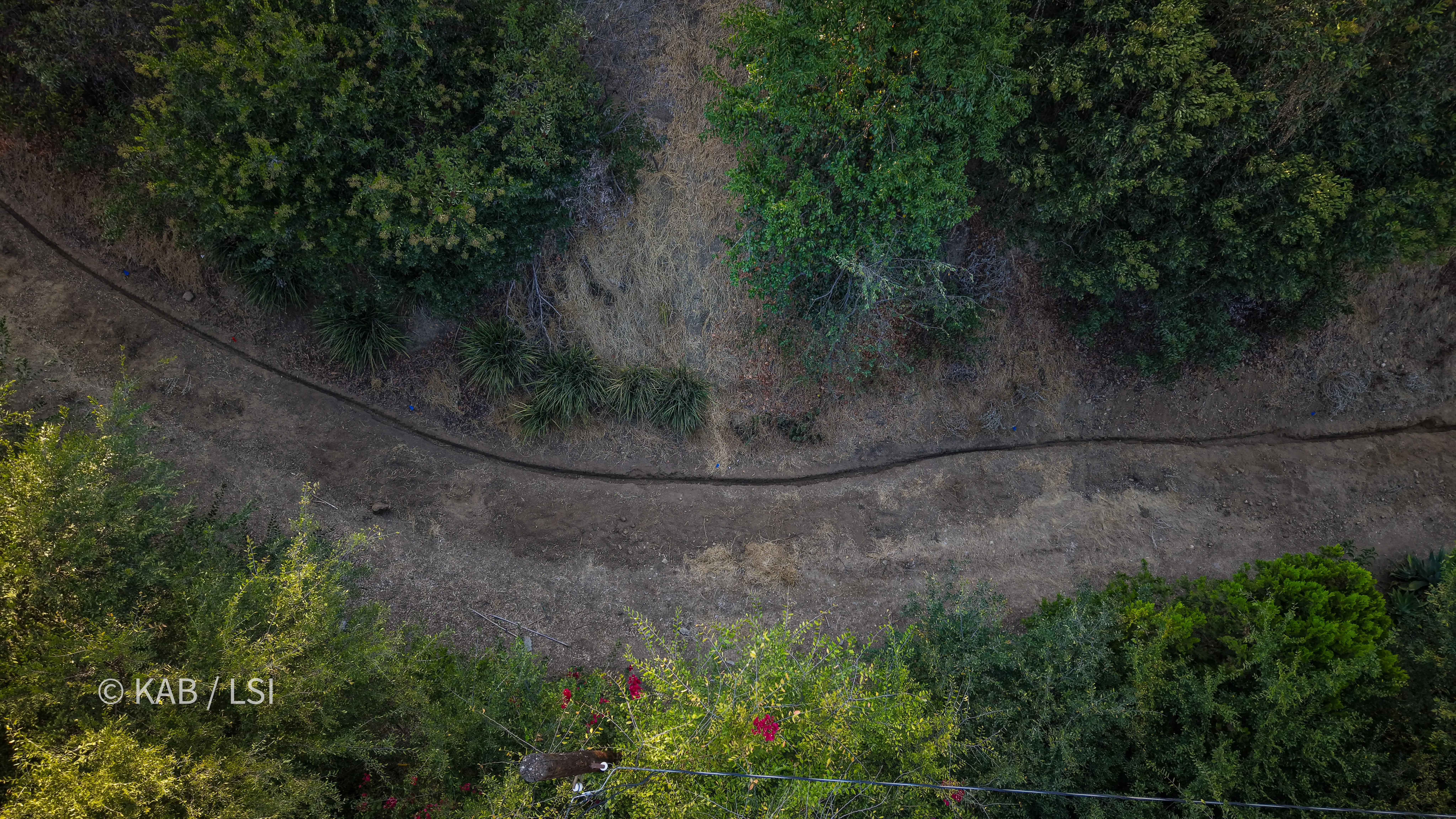
From the road to the house
Four hundred and sixty feet
of trench, and every
decision you did not make
while it was open.
The least glamorous thing you own, and the one most likely to decide how the rest of the property behaves.
The line from your meter to your house is invisible, unloved, and on a hillside it is long. It climbs, it crosses ground you may not own, and it loses pressure the entire way. When it fails it does not fail politely, and nobody knows where it runs.
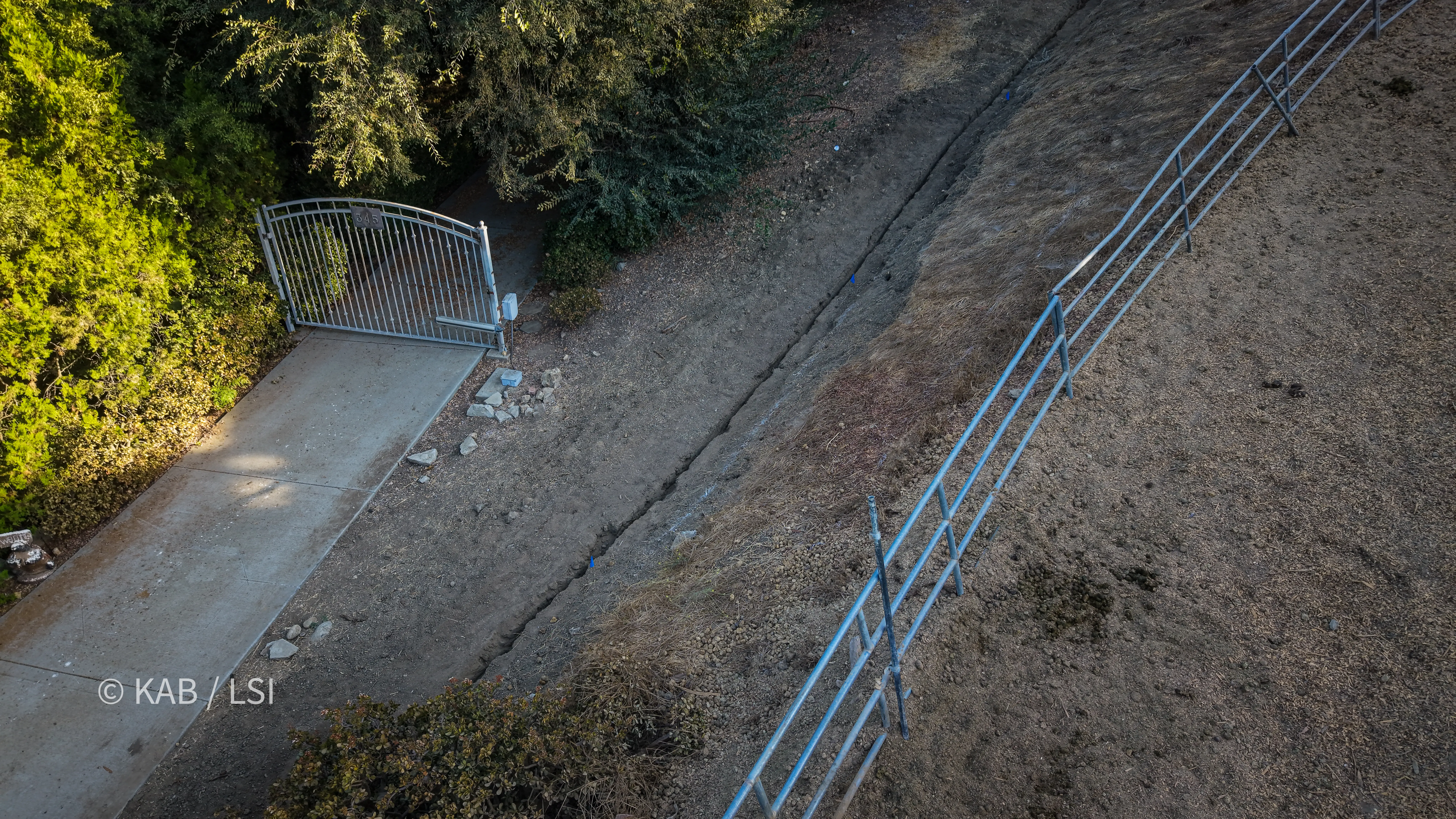
Where it begins. A meter down at the road, and a fence line to follow.
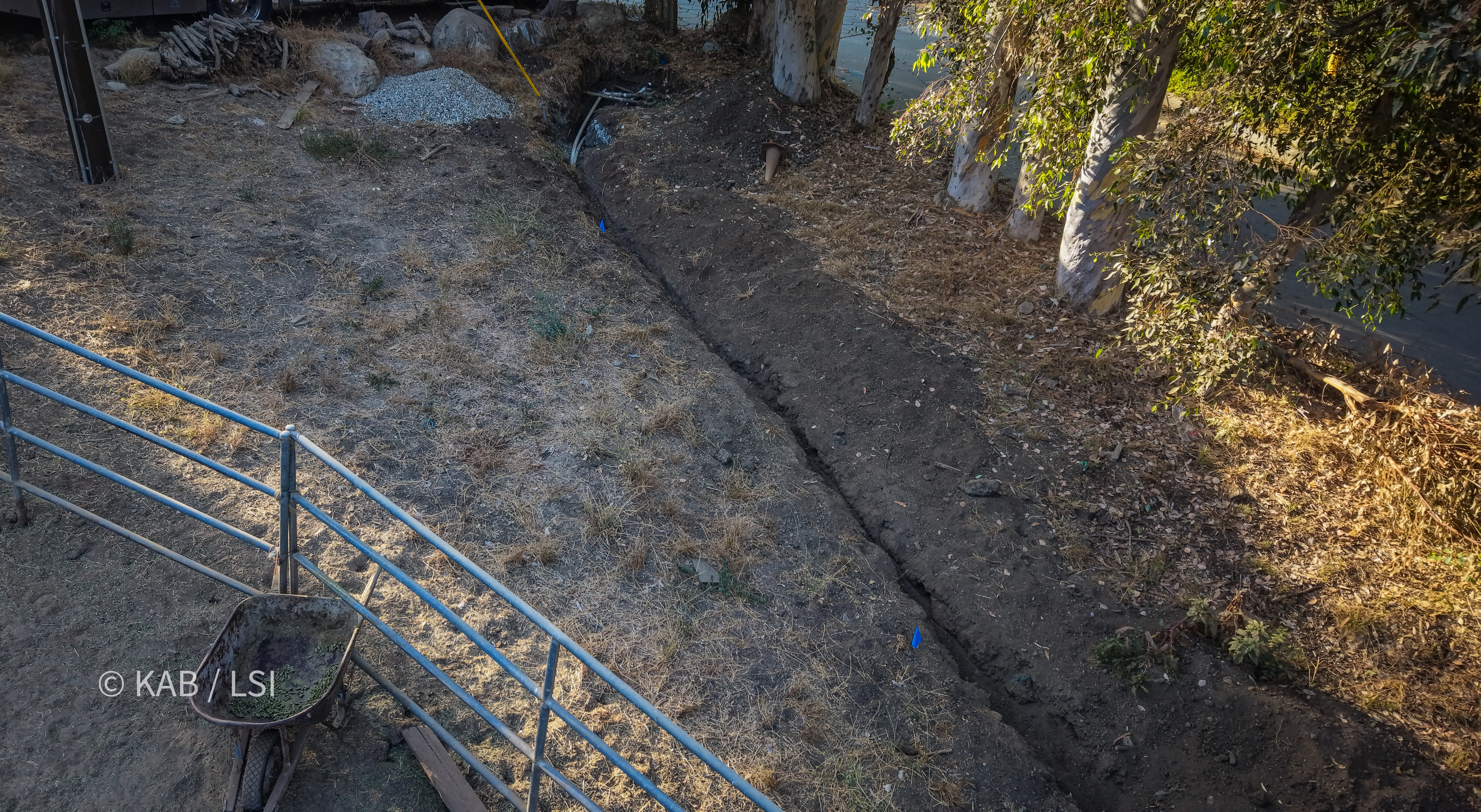
Where it is going. Everything between those two frames is elevation, and elevation is what costs you.
About 100 psi at the meter. By the time it reaches the floor of the house it is 15 psi. Elevation took most of it and friction over that distance took the rest. The arithmetic is on the pressure page →
Because the clay here
pulls pipe apart.
The line she replaced was PVC, and PVC is what failed. The clay soil in La Habra Heights moves — it swells wet and shrinks dry, season after season — and over enough years that movement will separate a glued joint. That is not a defect in the pipe. It is the ground doing what this ground does.
So the decision was two parallel lines, each an inch and a half — one PVC, one PEX-A — in the same trench. The PVC gives volume and stiffness. The PEX-A is a single continuous run between joints and does not care much what the clay does. Two bites at the apple, so that whoever owns this property in twenty years has an emergency on one line and a working house on the other.
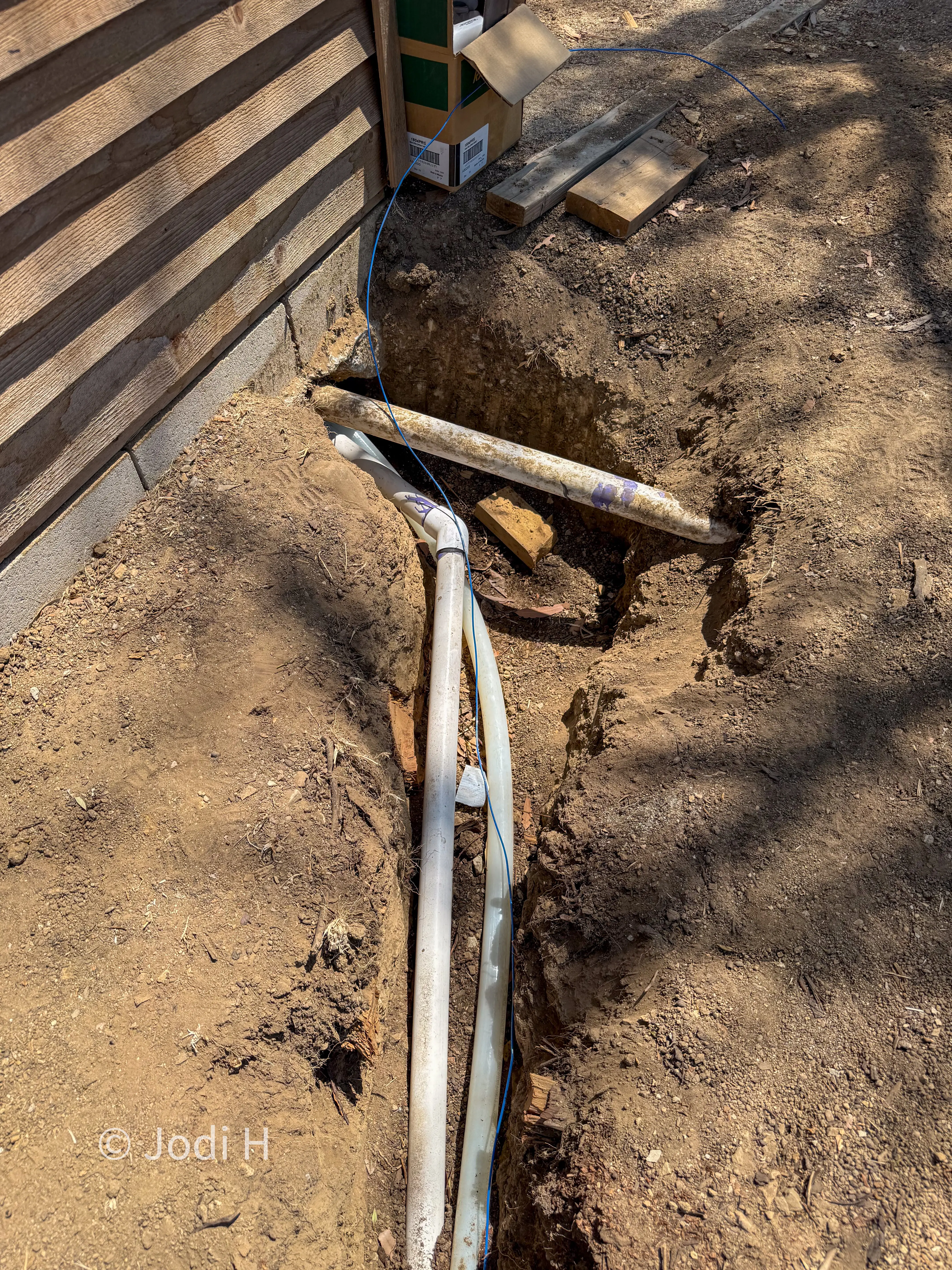
Both lines into the same trench. Run together, buried together, so one ditch buys two chances.
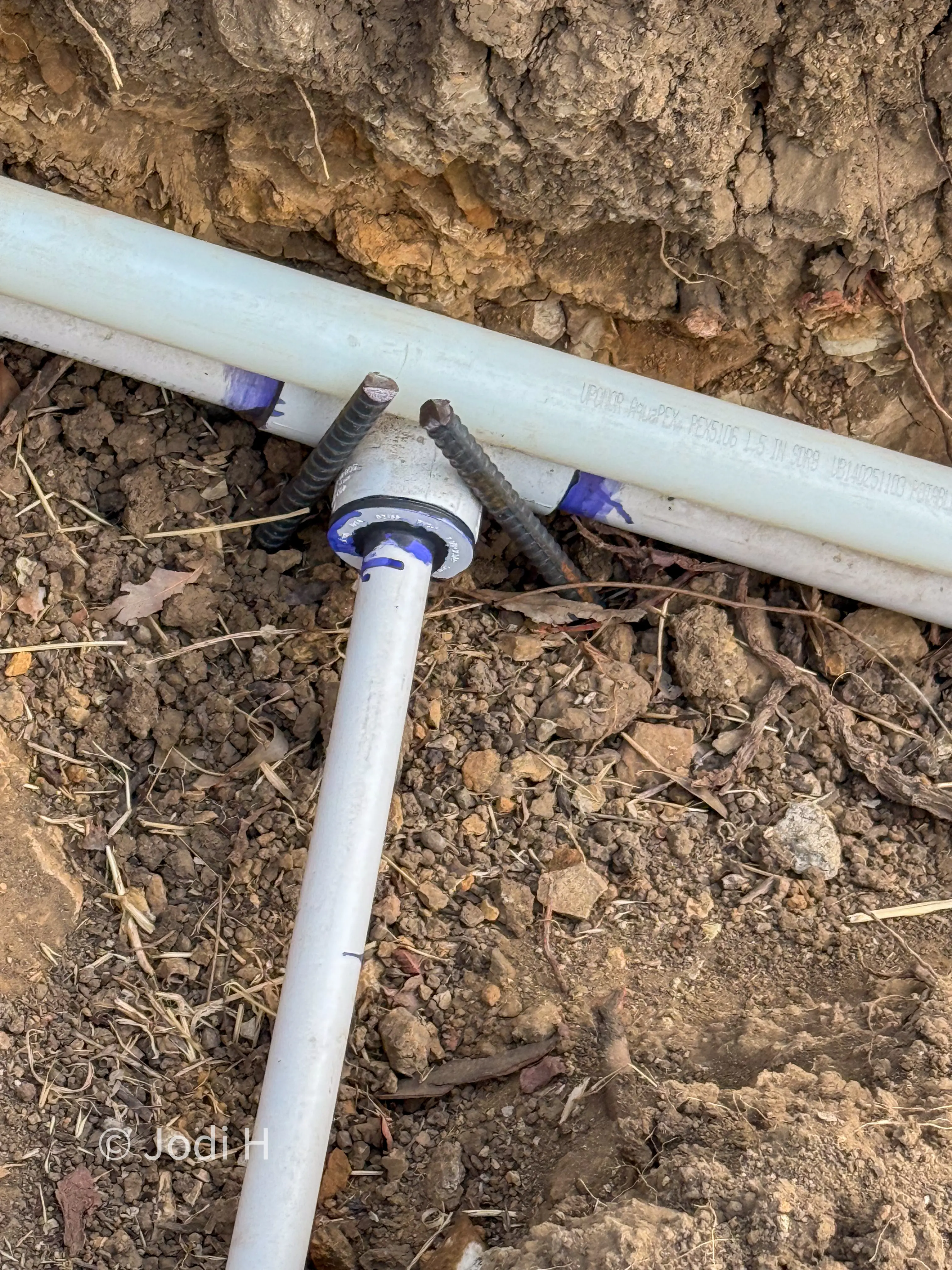
PVC with the bell built into the pipe. One less separate coupling every twenty feet, and a better joint than a coupling would have been.
The PEX-A arrived in hundred-foot coils, because an inch-and-a-half roll of five hundred would be unmanageable on a hillside. It is stiff, and it remembers being a coil. It takes two people to walk a roll down into a trench — one will get knocked over, and it was strapped to the PVC as it went in, so its memory would not lift it back out of the ditch.
Then both lines were tested, separately, before anybody buried anything. Each one was pressurized with an air compressor to about a hundred psi, capped, and left to sit with somebody watching the needle. Every joint on four hundred and sixty feet of pipe is reachable exactly once — a bad connection found on that afternoon costs a fitting, and the same connection found next spring costs a machine, a crew, and a hole in somebody’s hillside.
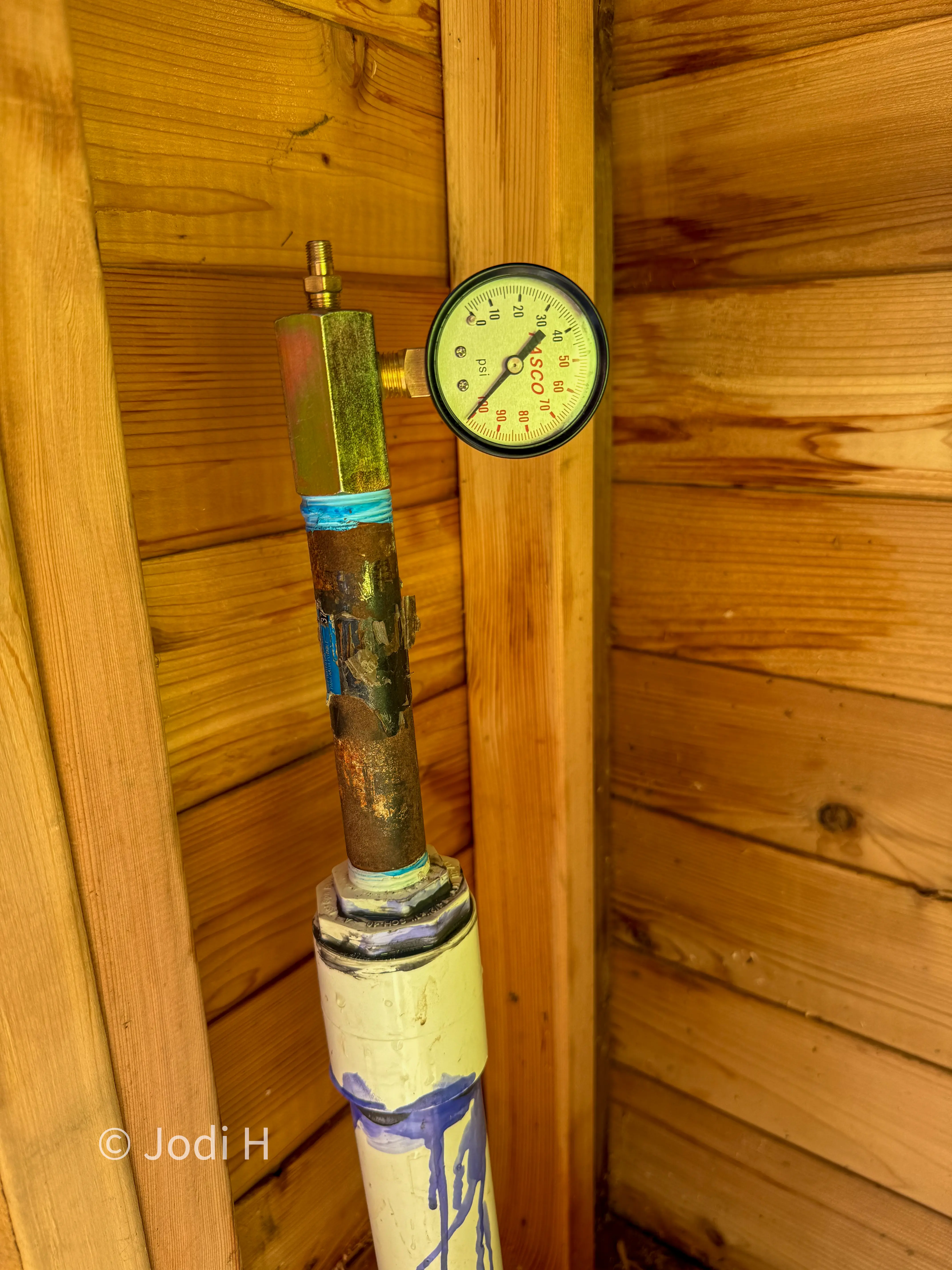
A test rig, not a fixture. The gauge, the cap and the fill valve all came back off before the trench was closed.
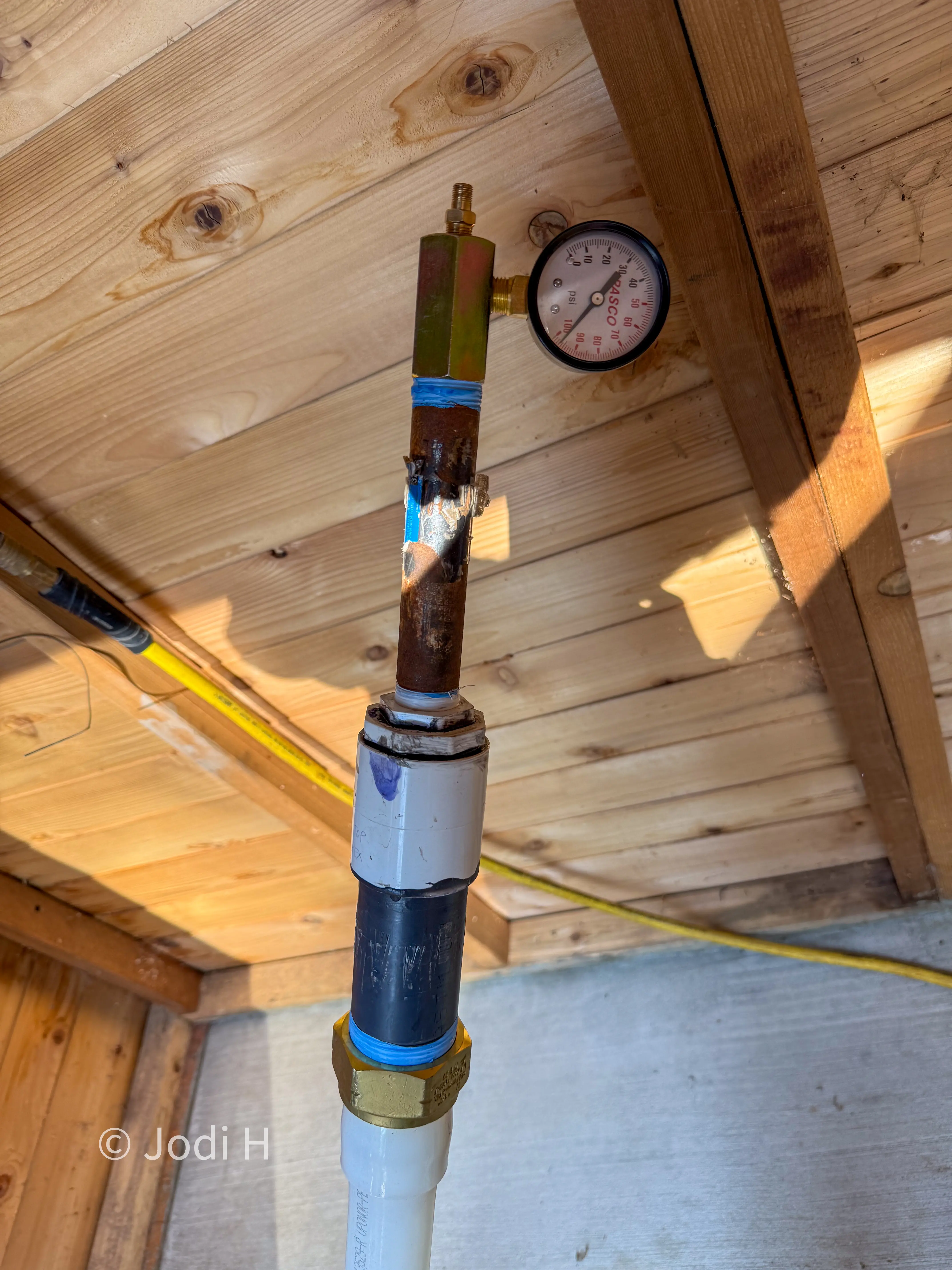
The other line, tested on its own. Two pipes means two tests — there is no way to prove both at once, and no reason to try.
See the trench, start to finishOpen the sequence →

Open ground. Four hundred and sixty feet of it, by hand and machine, across property that is not all yours.
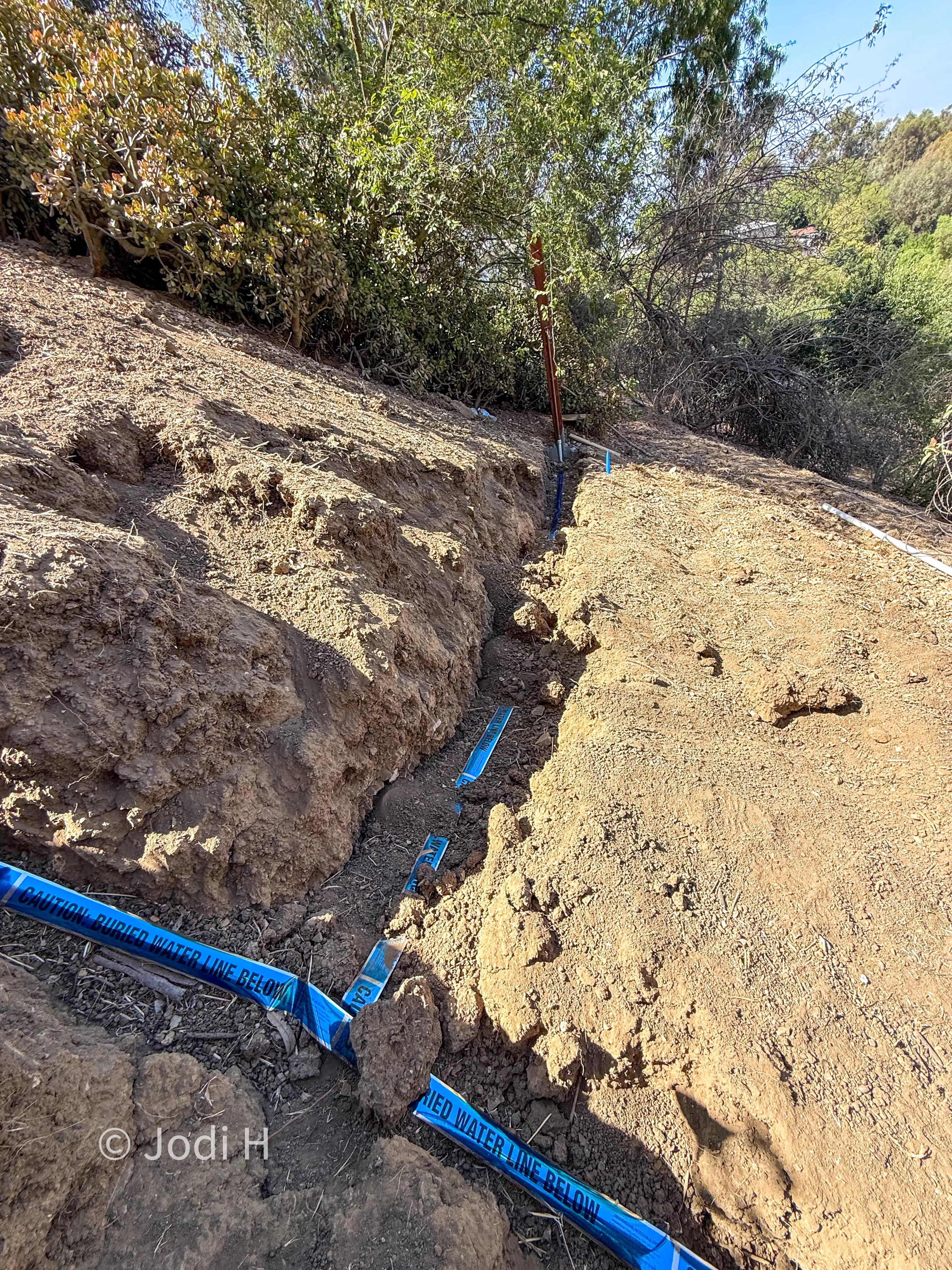
Where the hill is rock, the trench costs what the trench costs. This is the part nobody quotes optimistically twice.
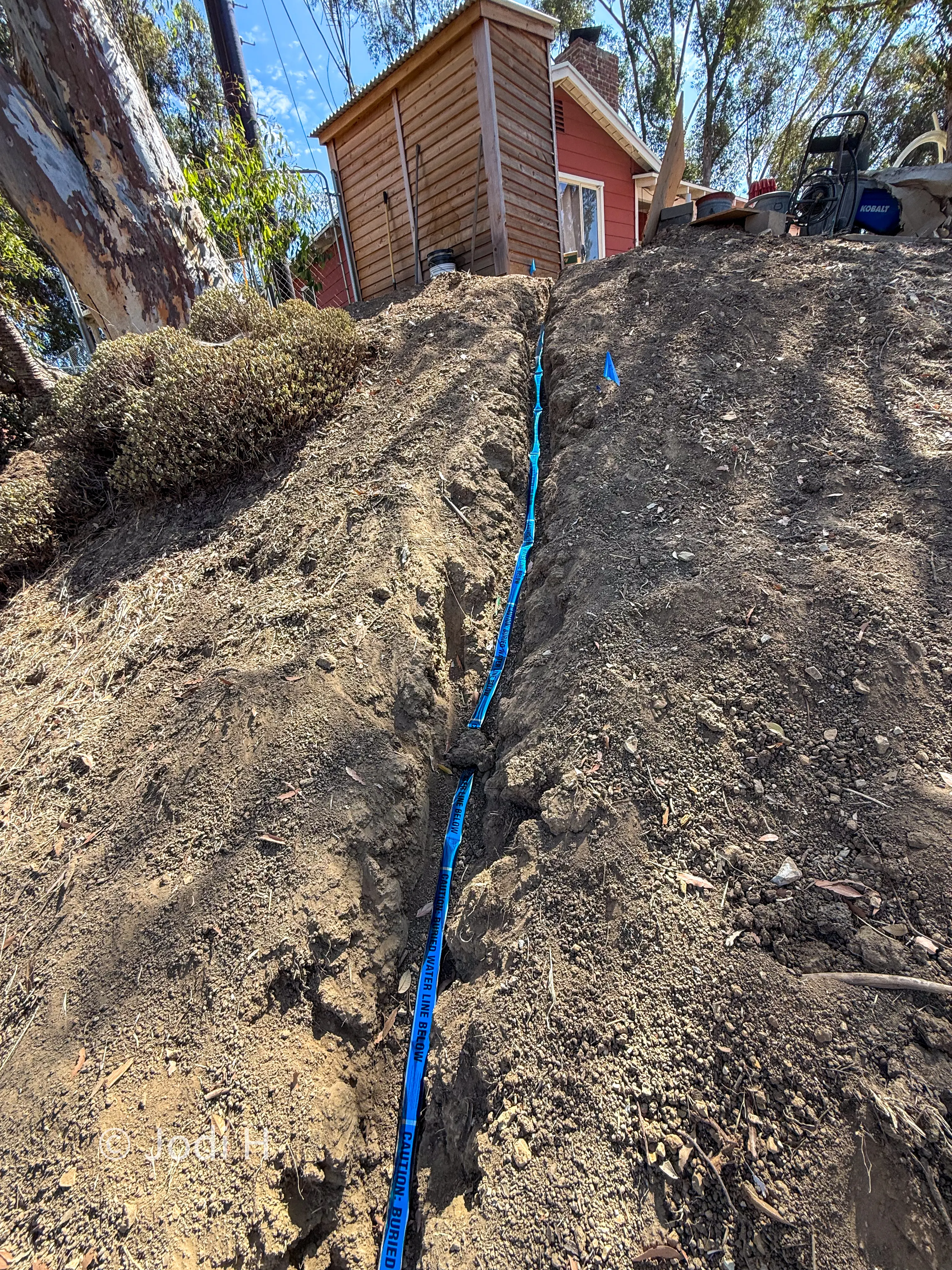
Up. Almost all of this run is uphill, and every foot of rise is pressure you will not have when you get to the top.
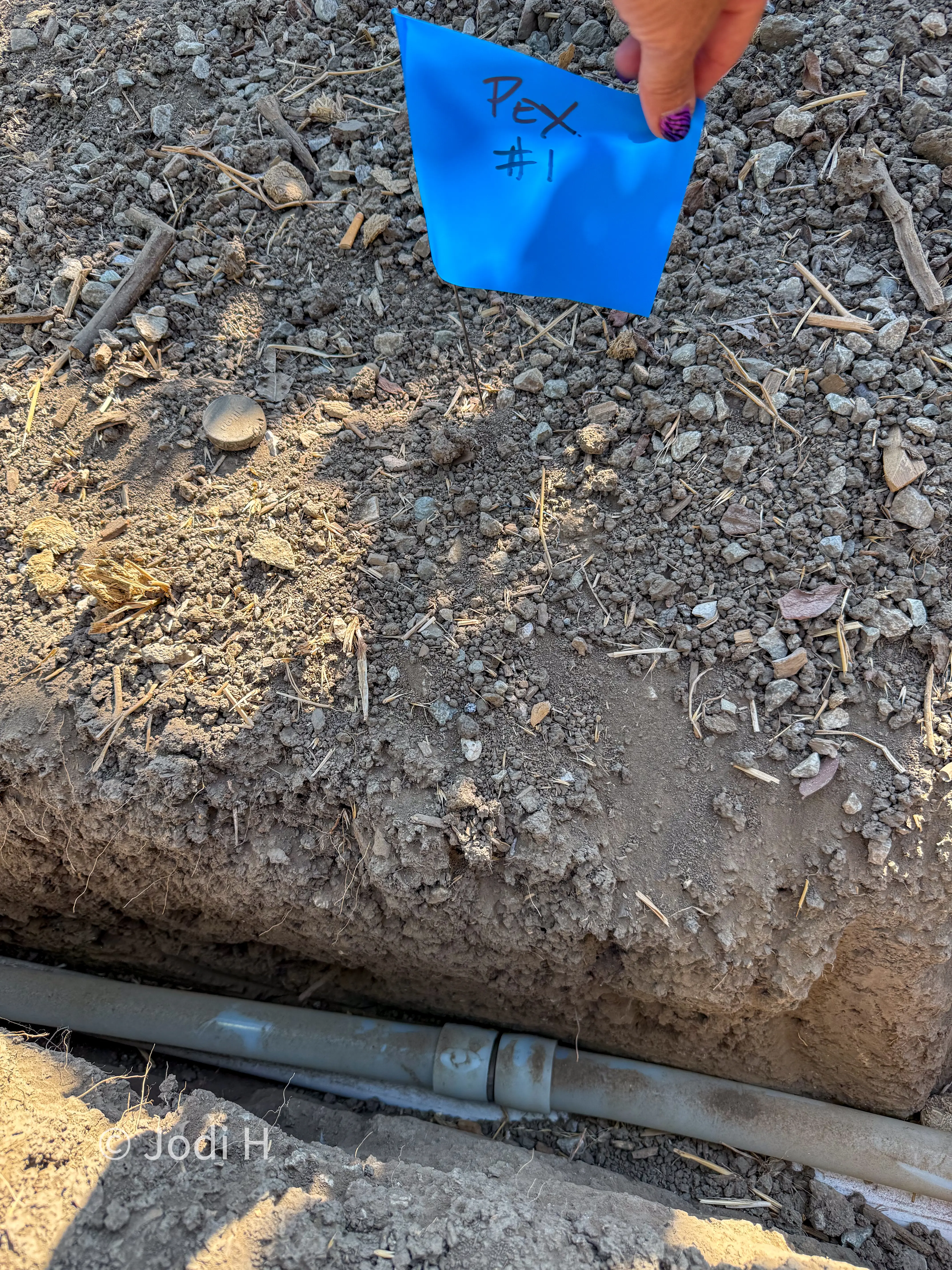
Half backfilled, then blue warning tape the full length. It is there for the excavator operator in 2050 who has never heard of any of us.
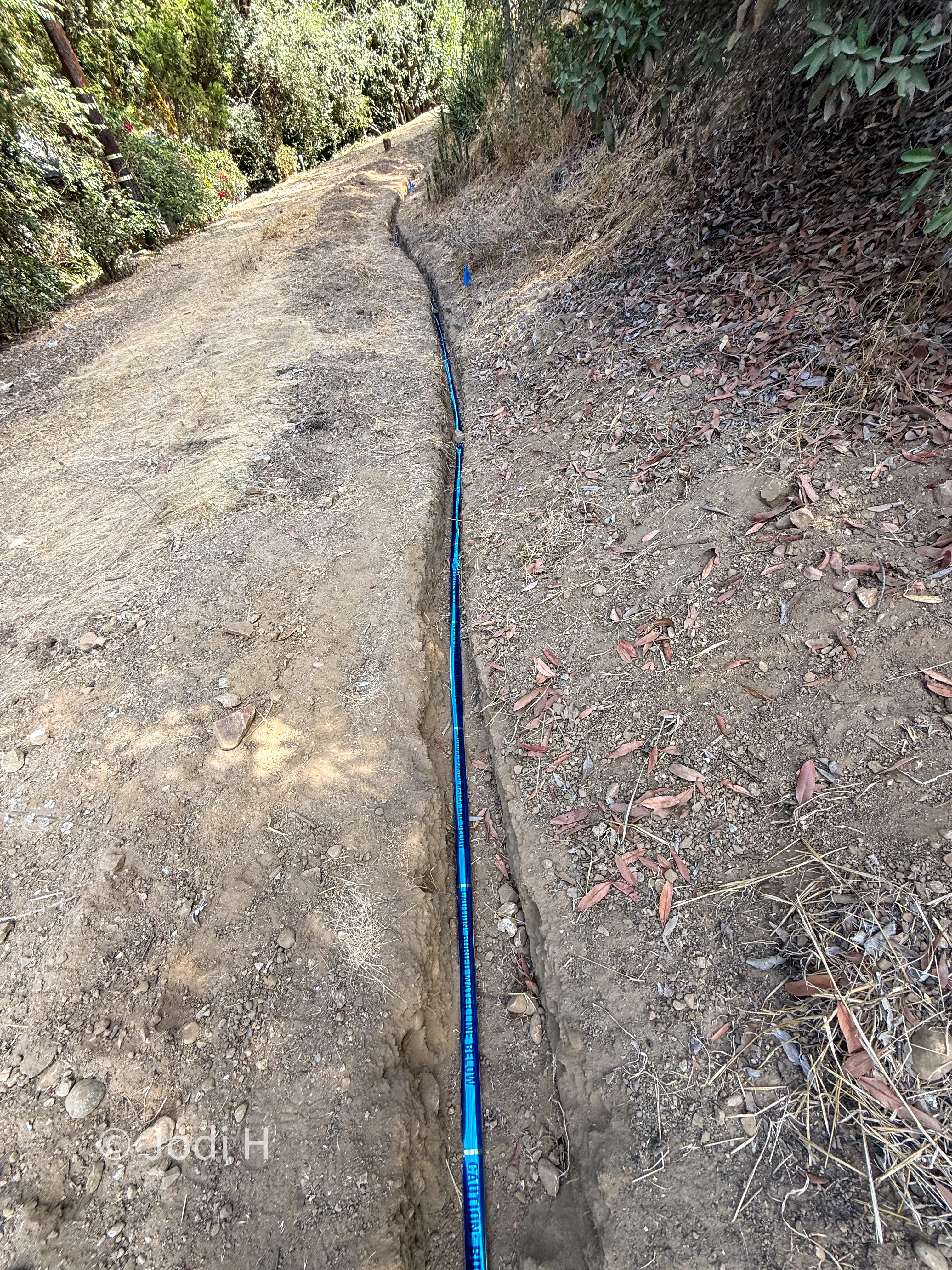
Backfilled. Tracer wire running the whole way underneath, so the line can be found again without guessing.
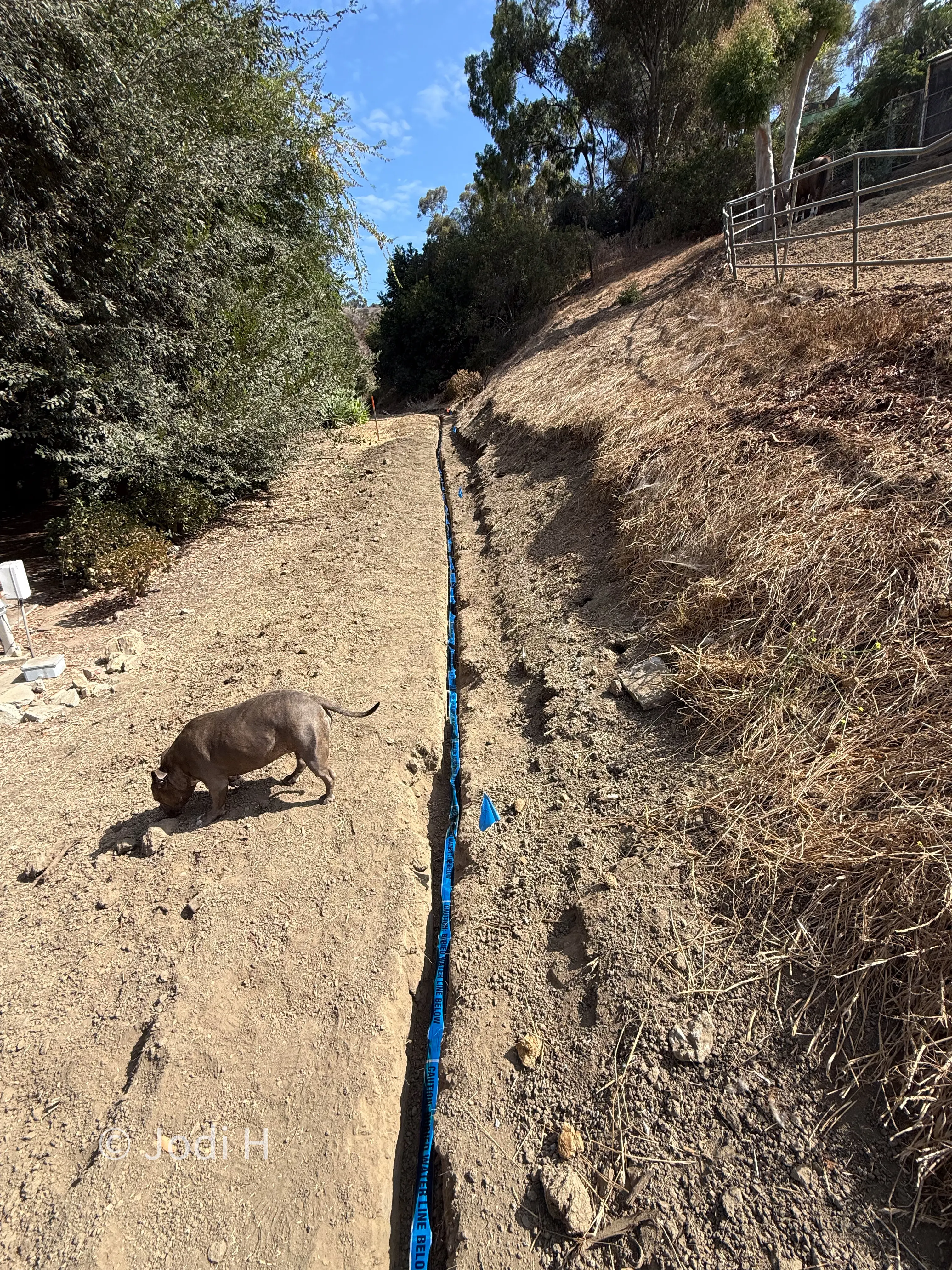
And then it is just a hill again. Which is the entire objective.
It is worth being plain about this, because it is the whole point. The owner did this. Not a contractor, not a crew, not me.
She hired her own help, rented the trencher herself, bought the pipe herself, and worked the weekends. What I did was sit down with her and think it through — a second line rather than one, tracer wire in the ditch, warning tape over it, hose bibs pulled up where she would want them later, a water shed instead of giving up the garage, and eventually a fire tank up the hill. She took every one of those decisions, and then she went and made them happen.
The one day her weekend man needed a second pair of hands to walk a roll of PEX-A into the trench, I sent somebody I trust. She paid him. That is the extent of it, and that is generally the extent of it.
Every joint has an address.
This is the part worth copying even if you take nothing else from this page. A buried line fails at its fittings. Not in the middle of a run — at the joint, where the movement concentrates. So before the trench was closed, every single fitting was flagged and recorded.
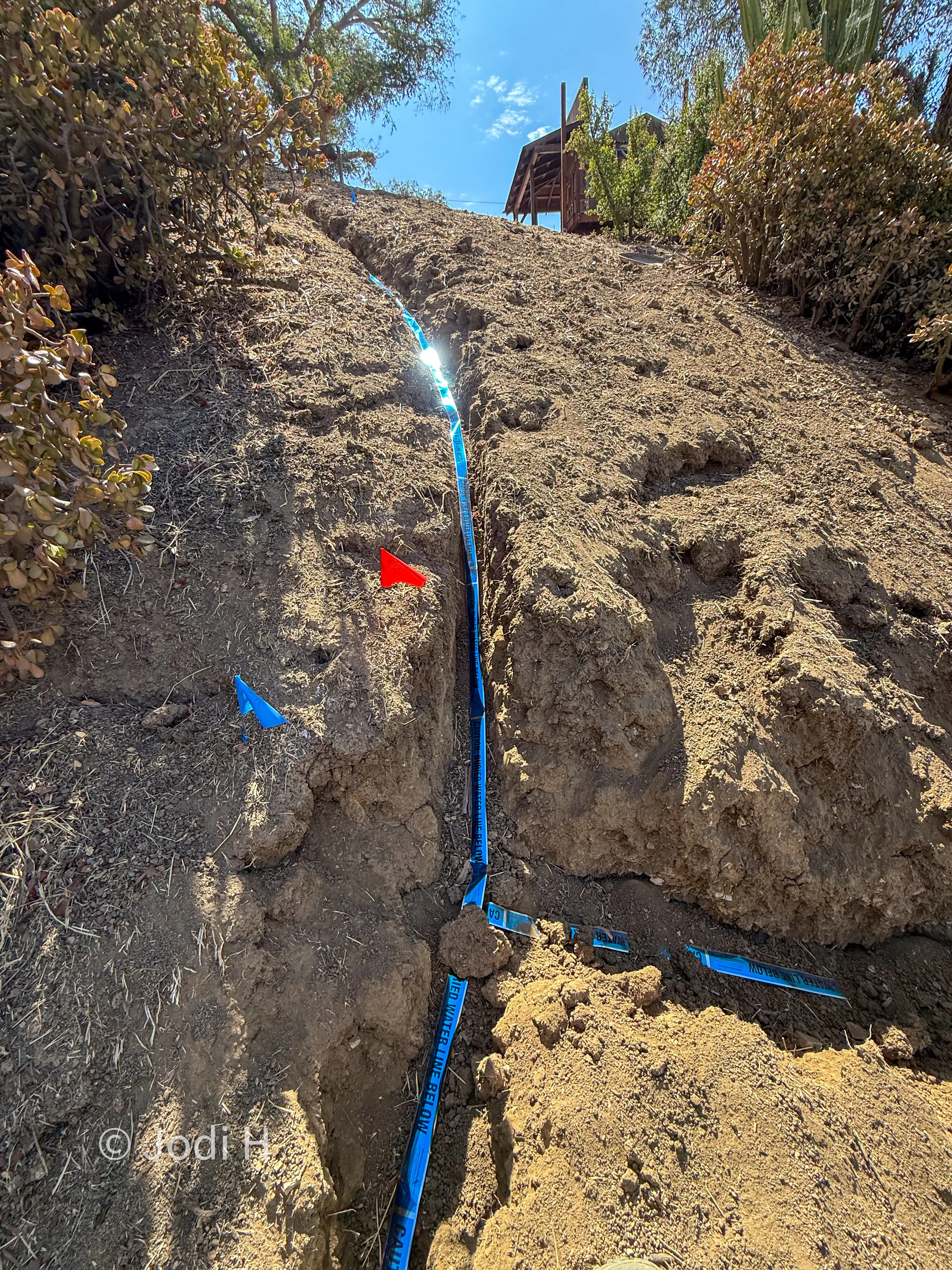
A flag at every fitting, planted before anything was buried. Each one numbered, each one located, each one written down.
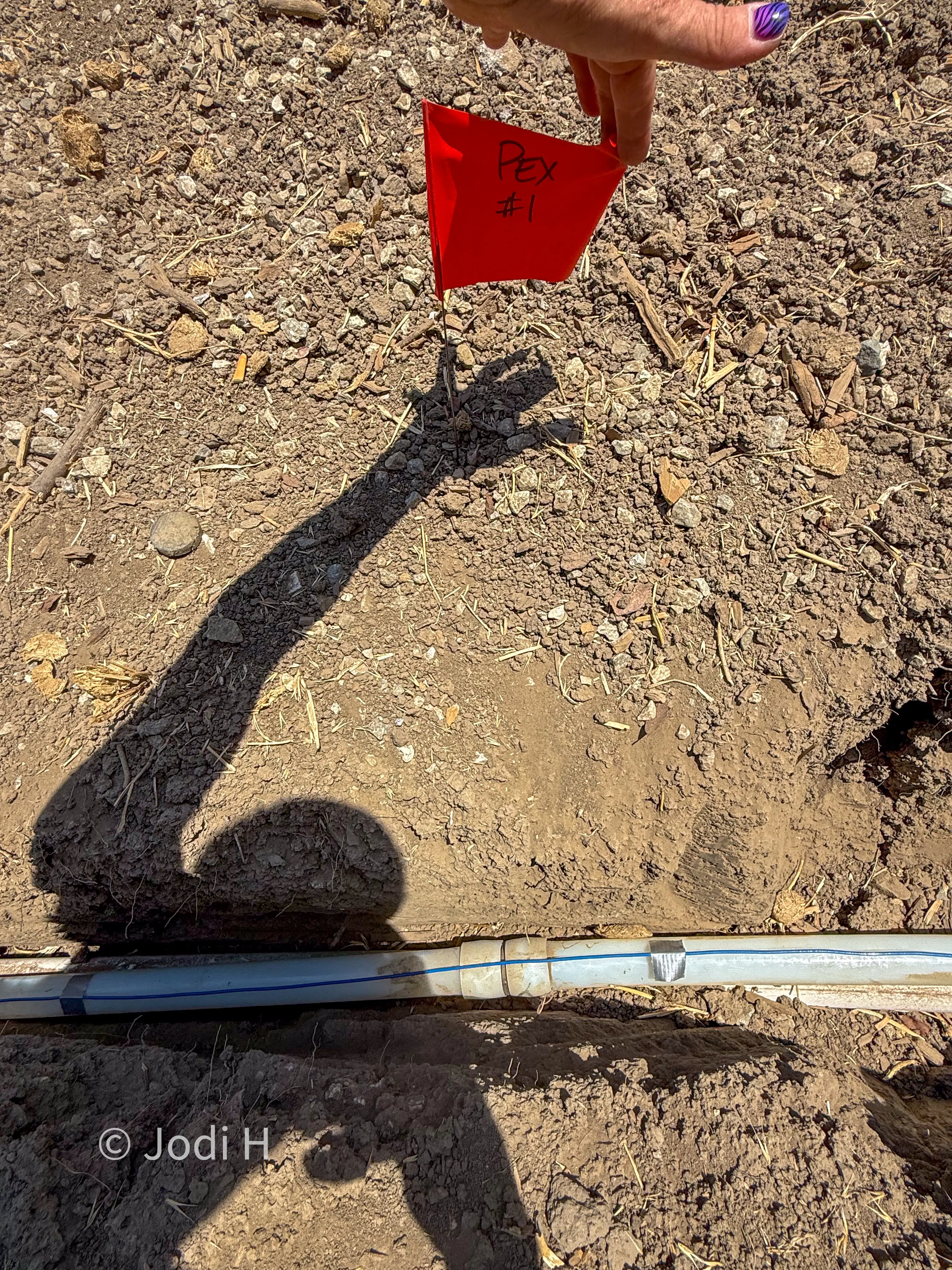
Color-coded and numbered — red for the PEX-A joints, blue for the PVC. There are fewer red ones, because the coils run a hundred feet between connections.
The owner then built her own schematic from those flags — every fitting, its distance along the run, its angle, and a GPS coordinate. It is not a pretty document. It is a document that means somebody standing on that hillside a decade from now can put a phone in one hand and mark the ground with the other, within about a foot.
Add the tracer wire running the length of the trench and a transmitter-and-receiver set that now costs less than forty dollars, and the buried line becomes a beacon. A wet patch in the dirt stops being a mystery and becomes an address. Nobody has to dig exploratory holes across four hundred and sixty feet of hillside hoping to get lucky.
Water where you
would actually want it.
A previous owner had built a long staircase down the slope so she could drag a hose toward a fire if one ever came up the canyon. There was no water at the bottom of it. The staircase went down to nothing.
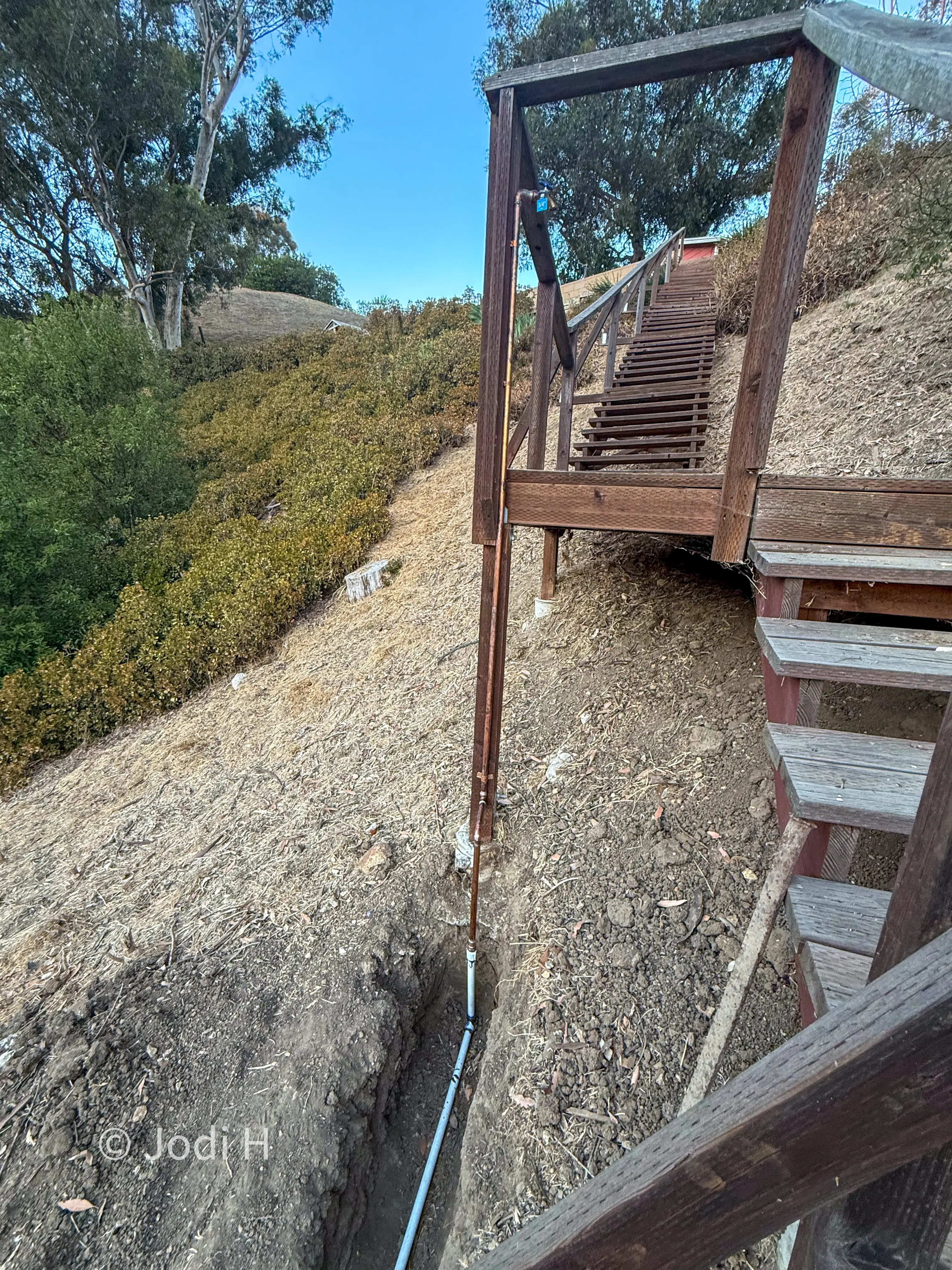
The staircase. Built for a fire that had not happened yet, ending at no water at all.
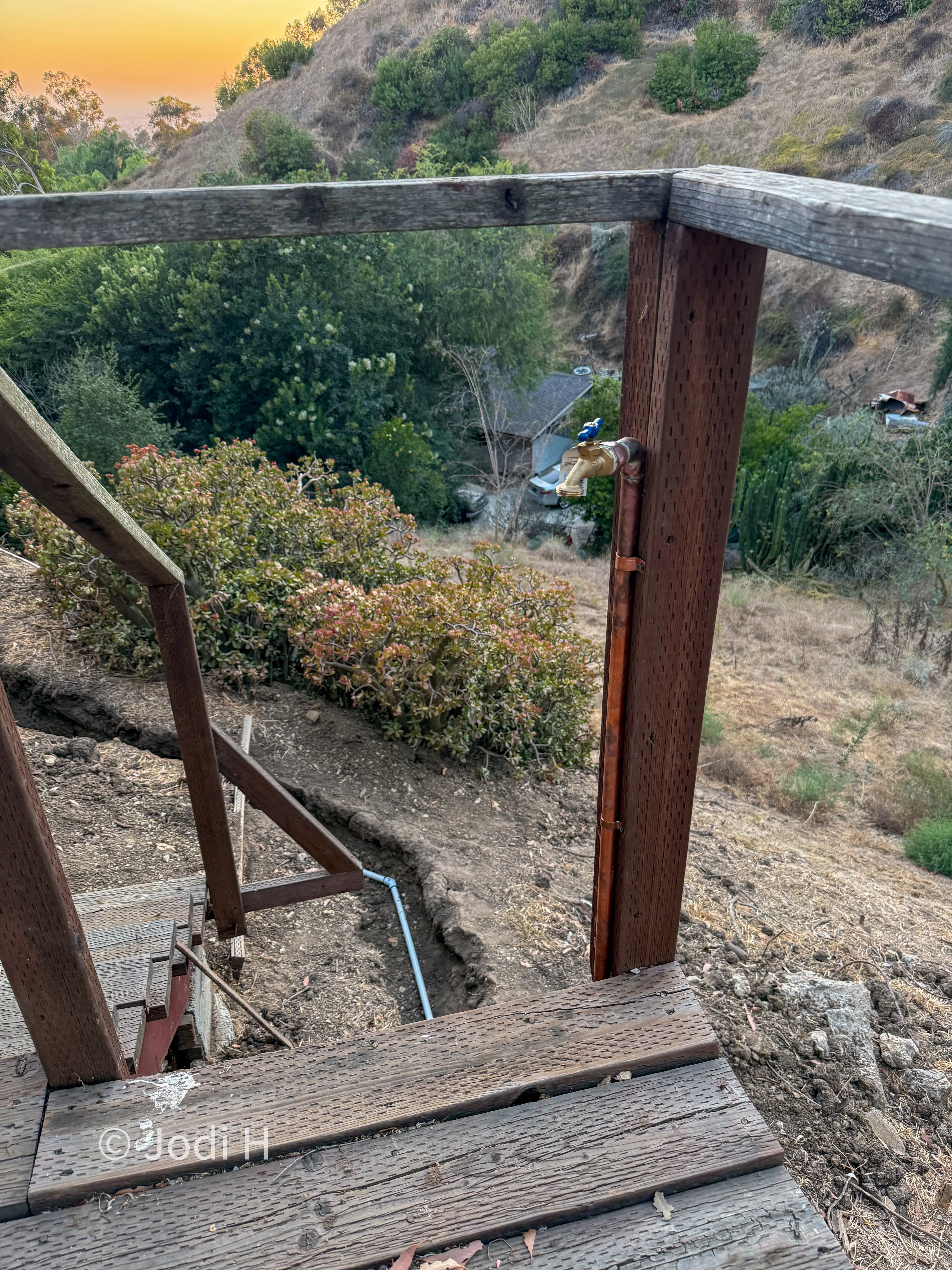
Now there is a bib at the bottom of it. The trench was already open and running past, so this cost the fittings and part of an afternoon — against a separate excavation later, which would have cost many times that.
Two more bibs went in at the property line on the way up. None of them were in the original scope, and each one cost parts and a little labor rather than a mobilization — because the machine, the men and the open ground had already been paid for once.
The digging is
the expensive part.
Be honest about the money first, because nothing here is cheap. Inch-and-a-half PEX-A runs into the thousands for a job this long. Add the PVC, the fittings, the copper for the bibs, five hundred feet of tracer wire, a rented trencher for weekend after weekend, and paid help for every one of those weekends, and a service line replacement on a hillside is a serious number.
What is cheap is only ever the next thing you add while the ditch is already open. Not because the parts are cheap — they are not — but because the machine, the labor and the open ground have already been bought, and they will not be that price again. Every foot you close up is a foot you would have to pay to reopen.
What else belongs in that trench
Think about what that corner of the property becomes later, because you are deciding it now. A concrete pad for wicker chairs and a conversation set. A pergola or a gazebo on top of that pad. A place to park a vehicle you are storing.
Now picture the day the stored car will not start. Do you want to run a hundred feet of extension cord out there and leave a charger on it for two hours — or do you want an outlet that was put in on the same afternoon as the hose bib?
And run one more conduit than you think you need, empty, for low voltage. Later you pull an Ethernet cable through it and hang a hardwired camera looking back toward the house and the entrance. A pergola or gazebo post is an excellent camera mount, and a hardwired camera on a third of an acre does not care about your Wi-Fi range or a dead battery.
Water, power, and an empty conduit. One trench, one mobilization, one bill — instead of three.
Fifteen psi arrives.
Sixty leaves.
The line arrives at the top of the hill at about 15 psi, which is a garden trickle, not plumbing. So one of the property’s existing sheds was reconfigured into a water shed beside the house.
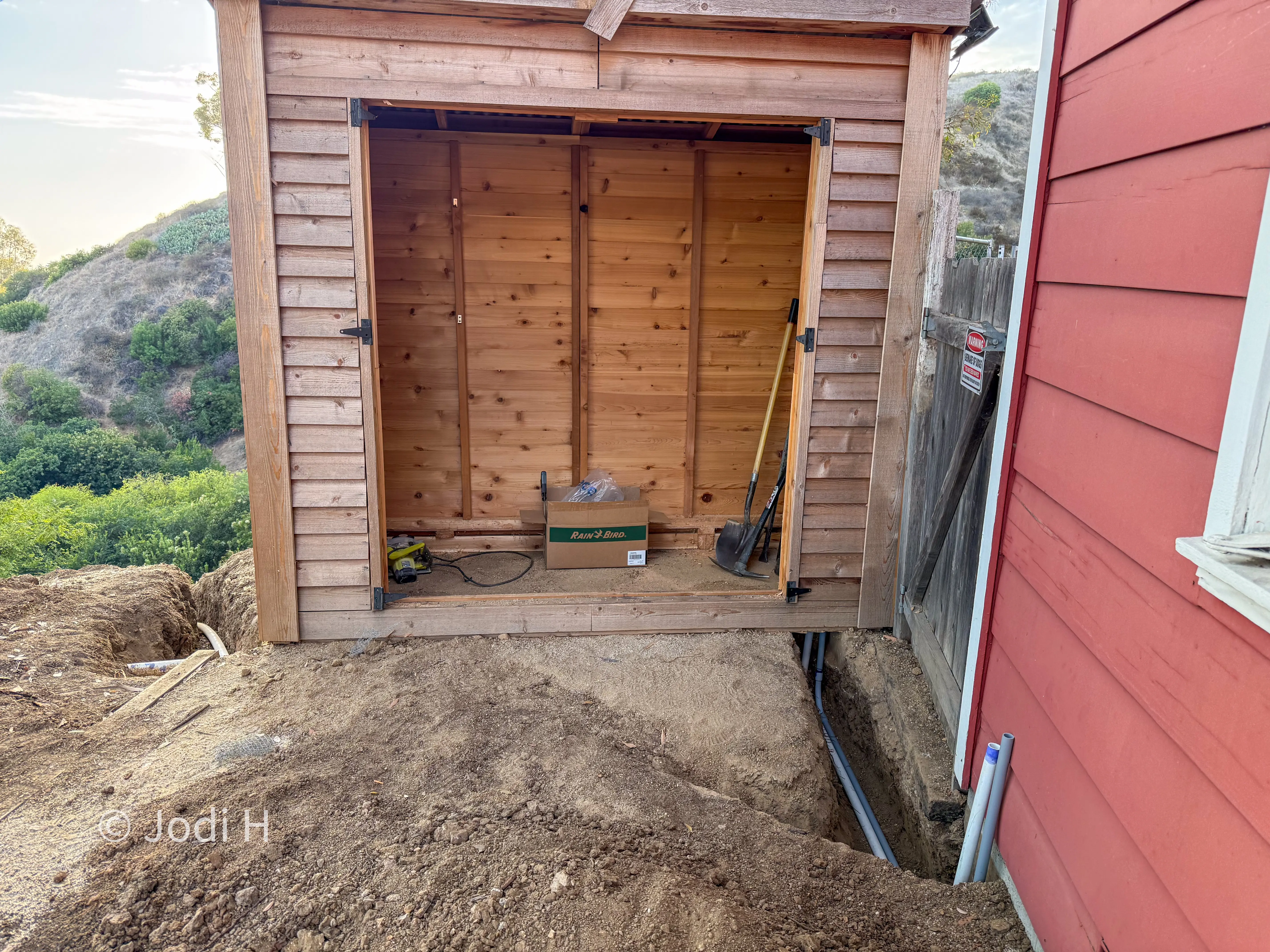
A shed that was already there, given a job. Cheaper and quieter than building anything new.
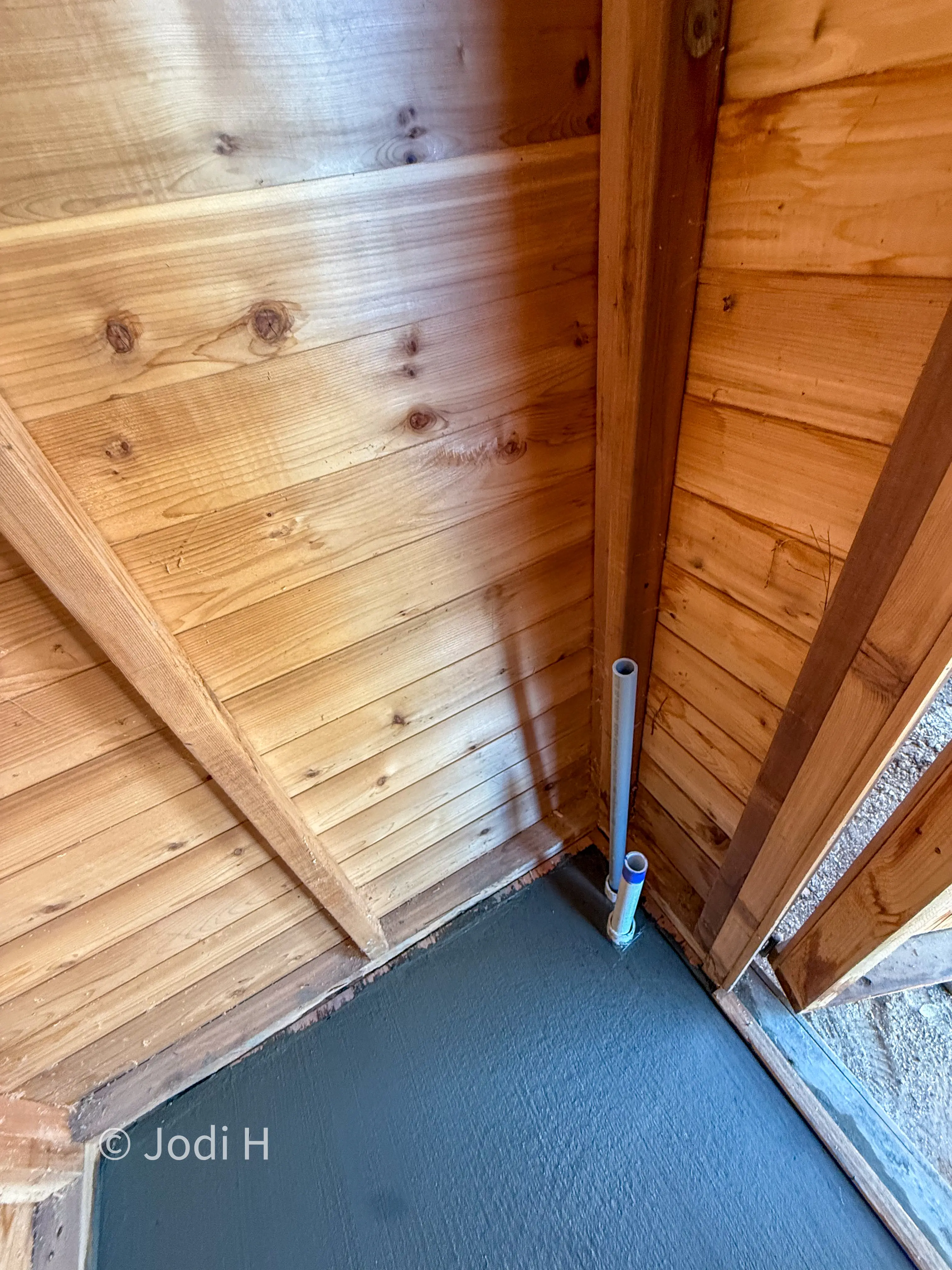
The line comes up inside, where it can be worked on standing up and in the shade.
Inside goes the same equipment a farm in Idaho or a pole barn in the Idaho panhandle would use, and for the same reason: a one or two horsepower pump and a twenty to forty gallon tank, held at about 60 psi. The tank stays pressurized, the pump refills it, and the house gets pressure that behaves like plumbing — showers, dishwasher, laundry, all of it.
People on wells all over the country understand this equipment perfectly. It is only exotic in Southern California, and only to people who learned about water in a city, where it simply arrives.
She is not a builder. Not a plumber, not a grader, not a roofer. She bought a hillside property to build a compound she could leave to her children, and she started knowing none of this. She now knows more about buried water line than almost anybody I have worked alongside — because she walked every foot of that trench, flagged the fittings herself, and wrote the schematic. That is what a steward looks like. The equity follows the stewardship, not the other way around.
What the trench makes possible
A long line will only
ever give you
what the hill allows.
If your meter is hundreds of feet away and a long way below you, there is a ceiling on what any pipe can deliver. Storage is how you get past it.
Everything above is about getting water to a house. This is the part that comes after, and on the highest properties up here it is the more important half.
Run the arithmetic on your own place. Water loses about 0.433 psi for every foot it climbs. If your meter sits down at the road and your house sits two hundred feet above it, roughly 85 psi of whatever the water company sends disappears into the climb before it ever reaches you. A second pipe helps with friction. Nothing helps with gravity.
Which means a hillside owner eventually arrives at the same question: if the line cannot deliver more pressure, can I store water higher than the house instead?
A tank above the house makes pressure by gravity. No pump, no electricity, no switch to throw. On the day a fire runs a canyon, the power is very often out — either cut deliberately or burned through — and an electric pressure pump becomes furniture. A few thousand gallons sitting uphill does not care. A house in Sierra Madre came through a fire this year that took its neighbors, and the difference was water already on the property.
The tanks themselves are the least surprising part of the budget. A 2,100-gallon polymer tank is about seven feet across and seven and a half feet tall, weighs 270 pounds empty, and costs roughly a dollar a gallon — which is the one genuinely modest number in any of this. Two of them is four thousand gallons — six hours of sprinklers on a roof and a perimeter, or most of a day of one hose.
The one trade-off worth understanding
A tank filled by your own meter can never sit higher than the pressure your meter delivers. Fill it by gravity and you are capped — on a property with 15 psi at the house, that ceiling is around twenty-seven feet of pad, and the tank gives back a little less than the line does standing still.
Go higher than that and a small pump has to help fill it. But the pump only ever fills. Delivery is always gravity. A power cut does not disable the tank; it only pauses the refill, and you are sitting on thousands of gallons while you wait.
Which is why, on most hillside properties, higher and pumped beats lower and unassisted. You are buying pressure on the one day you cannot buy it any other way.
Is this you? Long service line, house near the top, weak pressure that gets weaker when anything else opens, and a fire map you would rather not think about. If that is the shape of your property, the arithmetic above is worth an hour of somebody’s attention before it is worth a dollar of anybody’s money.
Start with one measurement you can take yourself: the pressure at your house with everything shut off, then again with a hose running wide open. Those two numbers tell you almost everything about what your property can and cannot do. How to read them →
The Hillside Network
That was one card out of forty-two.
Roofs, water, ground, structures, and the trades I would call for each one. No names are published here — introductions happen in conversation.
See the full index →