Water · La Habra Heights
Water Pressure on the Hill
One measurement decides whether your plumbing lasts thirty years or starts leaking in five, and almost nobody up here has ever looked at it.
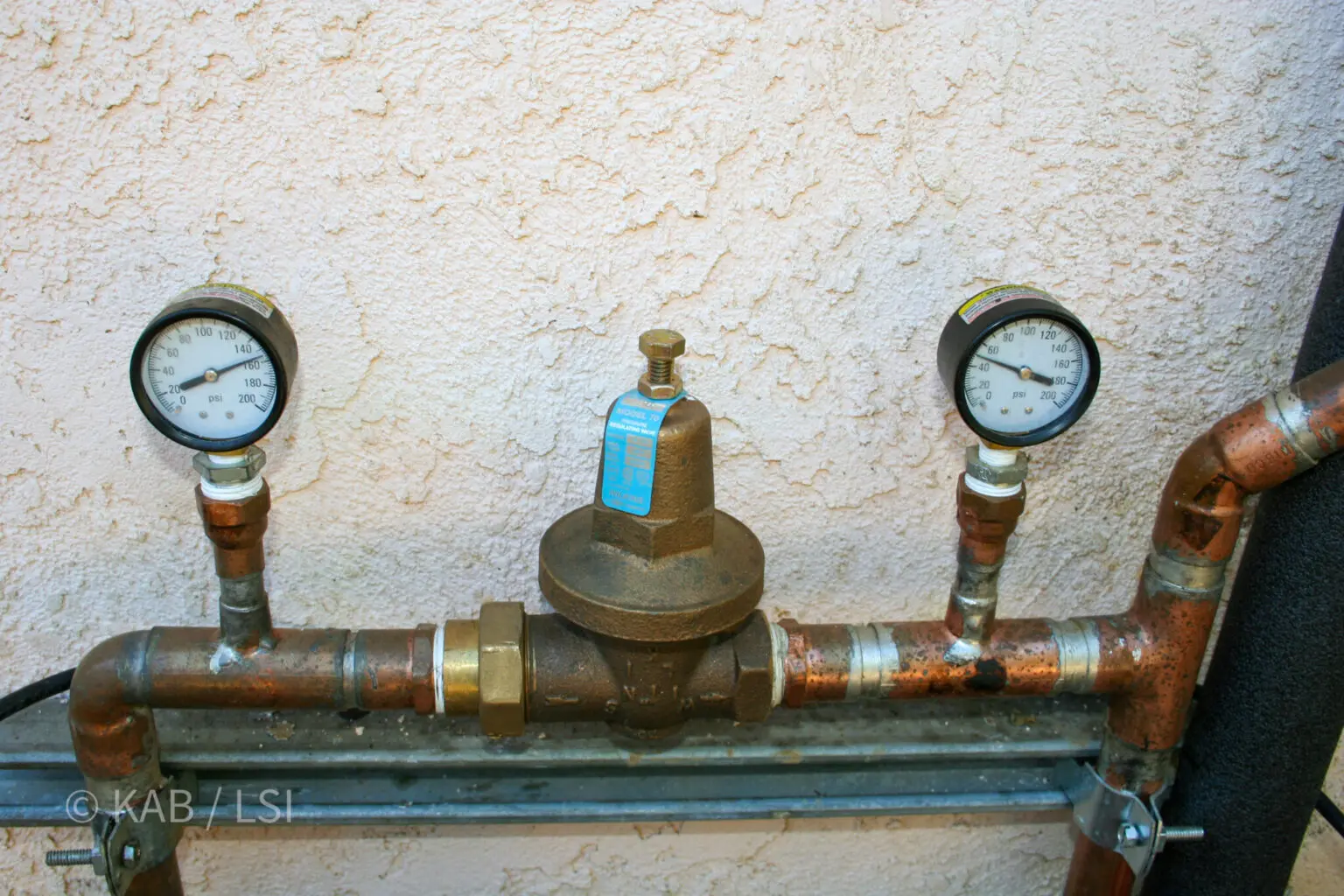
Before you touch a single fixture
The number nobody checks
is the one breaking everything.
Most houses on this hill run at a pressure their own plumbing was never rated to survive.
There is one measurement that decides whether your plumbing lasts thirty years or starts leaking in five, and almost nobody up here has ever looked at it. Incoming water pressure in La Habra Heights commonly runs around 125 psi. In plenty of places it is 160.
Plumbing code discourages static pressure above 80 psi without a pressure-reducing valve. Most plumbers want a house sitting between 50 and 80. If your house has never had a regulator fitted, it has spent its entire life at roughly double that — on every fixture, every supply line, every washing machine hose, every angle stop, continuously, for decades.
Most residential PEX, including PEX-A, is rated 160 psi at 73°F, 100 psi at 180°F, and 80 psi at 200°F. Read that again with your hot water in mind. A hillside house at 160 psi of cold city pressure is already at the ceiling of the cold rating and well past the hot one. Copper is rated in the 250–300 psi range, and PVC to around 350 — which is why PVC, not copper, is usually the sane material for a long run from the meter up to the house. Copper over that distance is enormously expensive and buys you nothing you need.
And then there is the opposite problem. Clients at the very top of the tallest hills have no water tank above them, so by the time the line climbs from the meter to the house there is almost nothing left — 15 psi at the fixture. The answer is the same equipment people use on wells all over the country: a pump and a twenty, thirty or forty gallon tank held at about 60 psi, so the showers, the dishwasher and the laundry behave like plumbing instead of a garden trickle.
Same town, same water company. One neighbor needs the pressure cut in half and the other needs it manufactured.
Why the best view has the worst pressure
Water weighs 62.4 pounds per cubic foot. Spread across a square inch, that is a loss of about 0.433 psi for every foot you climb — one psi for every 2.31 feet of rise. That is not a defect in anybody’s plumbing. It is arithmetic, and it applies to every house on this hill.
Run it on a real property. The meter reads about 100 psi down at the road. The service line climbs roughly four hundred and sixty feet of trench to reach the house — inch-and-a-half, PVC on one leg and PEX-A on the other. By the time it arrives at the floor of a single-story house it is 15 psi. Elevation took most of it and friction over that distance took the rest.
Which gives you the local paradox, and it is worth knowing before you buy: the higher the lot, the better the view, the more the house costs — and the less water pressure it has. The most expensive houses up here are the ones most likely to need a pump.
None of this is exotic knowledge. On a well-fed farm in Idaho every adult in the house understands it. It is only unfamiliar here because most people who buy a hillside home in Southern California did their learning in a city, where water simply arrives.
What the number does
to the rest of the house.
Once you know your pressure, three separate decisions follow from it, and each one has its own page.
Distribution. A home-run PEX manifold gives every fixture its own valved line back to one labeled board. It is a better way to plumb a house — and a manifold fed at 160 psi is a manifold living at the outer edge of its rating for the rest of its life. Plumbing and re-piping →
Treatment. The water up here is extremely hard, and filtration and softening both sit downstream of the regulator. Two to three thousand dollars of parts against ten or twelve for the version on the radio. Whole-house water →
The line itself. Most of the pressure you are missing was lost between the meter and the house, in a trench you may never have thought about. Meter-to-house service line →
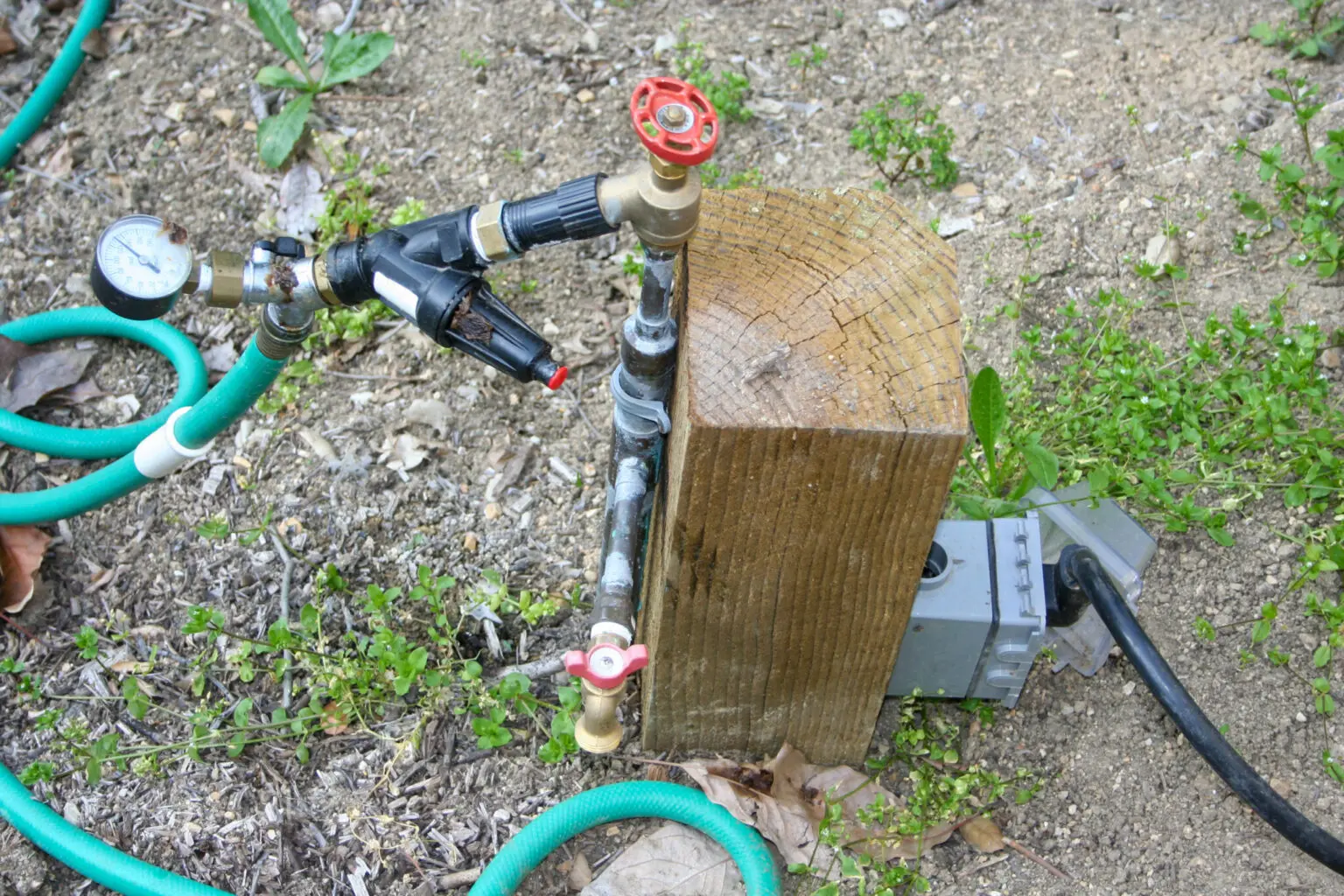
A yard station running at full city pressure — no regulator between it and the meter, which is deliberate. The gauge tells you what is really out here. When an RV connected to this one, it went on through a small plastic inline regulator, because an RV’s plumbing will not survive what a hose bib on this hill can deliver.
That little plastic fitting is the whole page in miniature. Nobody thinks about pressure until something they own is rated for less than what is arriving — and by then the fitting costs twelve dollars and the lesson costs considerably more.
The Hillside Network
That was one card out of forty-two.
Roofs, water, ground, structures, and the trades I would call for each one. No names are published here — introductions happen in conversation.
See the full index →